
What if the biggest budgeting mistake in a California care-facility acquisition is starting with a homebuyer’s closing-cost estimate? Residential figures may miss expenses tied to the facility’s real estate, operating business, due diligence, and transaction structure. That’s why closing costs for buying a care facility can’t be reduced to one generic percentage.
It’s reasonable to want a clear number before moving forward. But which costs apply, when they’re due, and how they’re allocated between buyer and seller depend on what the deal includes and what the purchase agreement specifies. A property purchase, a business acquisition, and a combined transaction each call for different planning.
This guide explains cost categories that may arise in a California care-facility purchase, how business and real-estate components can shape closing, and how licensing-related planning fits alongside it. You’ll also learn how to build a transaction-specific worksheet instead of relying on residential estimates. Assisted Living Real Estate Group brings over 25 years of combined care-facility experience to California buyers, helping them understand transaction components and the closing workflow.
Key Takeaways
- Build your estimate around the assets being acquired: real estate, business assets, or both.
- Review the purchase agreement and California property location to understand how expenses may be allocated.
- Use a transaction-specific worksheet to separate the purchase price, financing, real-estate costs, business costs, and post-close items.
- Closing costs for buying a care facility depend on deal structure, so treat cost categories as possibilities rather than a universal checklist.
- Specialized guidance can help connect valuation, due diligence, financing considerations, and closing into a clearer acquisition plan.
What Do California Care Facility Closing Costs Include?
Closing costs are transaction expenses beyond the agreed purchase price. They aren’t one universal fee, and a buyer shouldn’t assume a residential estimate captures the full cost of acquiring a care facility. The deal structure is the key: applicable costs depend on whether the buyer acquires real estate, business assets, or both, along with the financing and transaction terms.
That distinction matters when setting a budget. A home-purchase calculator may cover familiar property expenses, but it isn’t designed for the business and operational dimensions that can accompany a California RCFE or ARF acquisition. Even two facilities in the same California community can involve different cost reviews if their assets, financing, or agreements differ.
What makes a care-facility closing different from a home purchase?
Buying a property and buying an operating care-facility business are distinct parts of a transaction. A buyer might acquire the real estate, business assets, or both. If the deal includes separate business and property components, each may require its own documentation and expense review. The purchase price alone won’t show how those parts are treated.
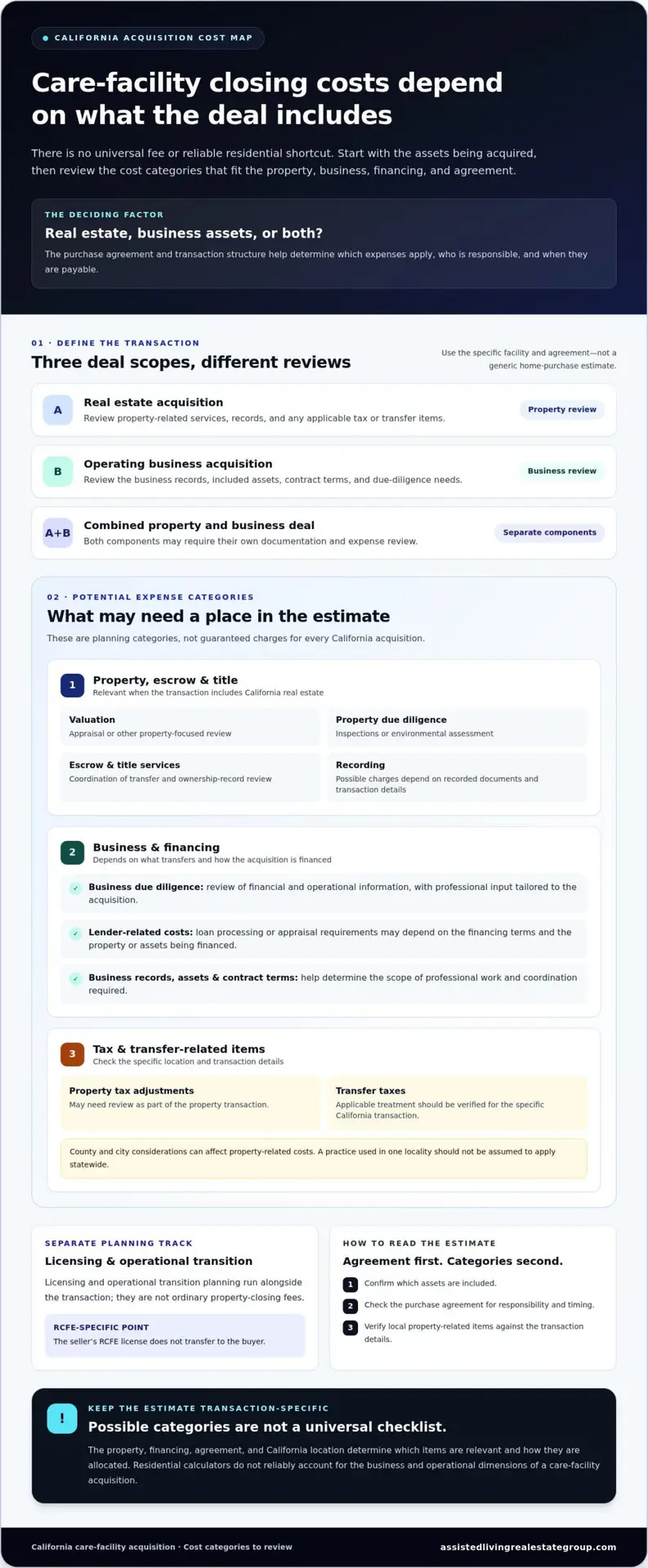
Residential calculators typically focus on a home and its financing. They can’t reliably estimate costs associated with a business transfer or account for the terms of a care-facility purchase agreement. Licensing and operational transition planning also run alongside the transaction. For an RCFE, the seller’s license doesn’t transfer to the buyer, so licensing needs separate attention rather than treatment as an ordinary property-closing fee.
Which California buyers should use this cost framework?
This framework is for individuals, investors, and businesses evaluating a California RCFE or ARF acquisition. It’s especially useful for Southern California buyers, though the same deal-structure questions apply statewide. Local property-related expenses and transaction terms can differ, so build the estimate around the specific facility and agreement instead of copying a generic residential example.
Start by identifying what the transaction includes. Is the buyer acquiring property, business assets, or both? How will the purchase be financed? Which responsibilities and expenses does the agreement assign to each party? These questions help narrow the review, but the transaction documents determine which categories apply. Treat a preliminary list as a planning tool, not a guaranteed set of charges for every acquisition.
A disciplined estimate starts with the deal itself. Once the structure is clear, sort potential expenses into relevant categories and distinguish transaction costs from separate licensing or post-close planning. That clarity supports more informed acquisition decisions while keeping both the investment and continuity of care in view.
Which Expenses May Appear When Buying a California Care Facility?
A useful estimate groups expenses by what they relate to instead of treating every potential charge as part of one standard closing package. Some items connect to the real estate, others to the operating business or acquisition financing, and some may arise only after closing. The purchase agreement and transaction structure determine which expenses apply, who is responsible for them, and when they’re payable.
Property, escrow, title, and recording-related categories
If the acquisition includes California real estate, the transaction review may cover property valuation, inspections or environmental assessment, escrow coordination, title-related services, and document recording. These categories aren’t automatic. The property, financing, deal terms, and location determine which are relevant and how they’re allocated.
- Valuation and property review: An appraisal or other property-focused due diligence may be part of a financed or negotiated purchase.
- Escrow and title: These services can support the transfer process and review ownership records. Customary allocation may vary by location and agreement.
- Recording and transfer-related items: Possible charges depend on the documents being recorded and the transaction’s location and details.
- Tax-related treatment: Property tax adjustments or transfer taxes may need review. Verify the applicable treatment for the specific California transaction.
County and city considerations can affect property-related costs in California. Don’t assume that a practice used in one locality applies statewide. Check transfer, tax, title, escrow, and recording items against current transaction details before including them in the estimate.
Business, financing, and transition-related categories
When the deal includes an operating care-facility business, the expense review may extend beyond property services. Business records, included assets, contract terms, and the scope of due diligence help determine the professional work and coordination the acquisition requires. The items to review depend on what is being transferred and how the agreement defines the transaction.
- Business due diligence: Reviewing financial and operational information may require professional input tailored to the acquisition.
- Financing: Lender-related costs, such as loan processing or appraisal requirements, depend on the financing terms and the property or assets being financed.
- Closing coordination: Managing separate business and real-estate components may call for additional coordination reflected in the deal’s expense plan.
- Transition planning: Costs tied to post-close operations or management should be tracked separately from expenses needed to complete the acquisition.
Licensing is another parallel planning consideration for California care facilities, not simply a property-closing line item. The California Adult Care Facility Regulations resource from the California Department of Social Services provides information about adult care facility licensing and oversight. Track licensing-related planning separately from escrow and business-transfer expenses.
Keep these categories provisional until they’re matched to the agreement, financing documents, and property location. Explore care-facility buying guidance from Assisted Living Real Estate Group for help organizing a California facility acquisition.
Why Care-Facility Closing Costs Vary by Deal Structure
The same California facility can produce different cost estimates depending on what the buyer acquires. A business-only transaction, a real-estate purchase, and a combined acquisition each call for a different review of documents, professional services, financing, and potential property-related expenses. A standard residential closing-cost percentage can’t reliably predict a facility buyer’s total because it’s built around a home purchase, not the mix of business and property components that may shape a California care-facility deal.
Use the comparison below to identify questions for your transaction, not as a universal checklist. The purchase agreement, included assets, financing documents, and facility location in California determine which categories merit review.
| Transaction structure | Possible categories | Items to verify |
|---|---|---|
| Business acquisition without real estate | Business due diligence, financing-related expenses, transaction coordination | Assets included, financing terms, contract allocation, transition responsibilities |
| Real-estate acquisition without the operating business | Property valuation, inspections, escrow, title, recording, possible tax or transfer items | Property documents, local California requirements, agreement terms, current transaction treatment |
| Combined business and property acquisition | Potential categories from both components, plus coordination between them | How the agreement treats each component, assets included, financing structure, local requirements |
Business acquisition versus real-estate acquisition
An operating care-facility business and the property it occupies are distinct transaction components, even when a buyer considers acquiring both. Business-related review may focus on operating records and the assets included in the agreement. A property component may bring valuation, title, escrow, or inspection considerations. In a combined deal, understand how the documents address each part. Don’t assume costs tied to one component automatically apply to the other.
How financing and California location can change the review
Financing costs depend on the selected loan and its final terms. A lender’s requirements may affect the documents, valuation work, or other transaction steps, so build the estimate from the actual financing terms rather than a residential calculator. For more on this part of acquisition planning, see Financing Your RCFE Purchase: A Buyer’s Guide.
Location matters, too. Property-related tax, transfer, escrow, title, and recording treatment may require current, transaction-level verification for the California facility. Confirm how its location and agreement affect those items before treating them as fixed costs. Assess local transaction details for the specific property instead of inferring them from a general industry resource.
For closing costs for buying a care facility, the practical test is whether each potential expense connects to an asset, financing term, contract obligation, or location-specific property requirement in the California acquisition. A structure-first review gives buyers a more useful estimate than applying a single percentage to the purchase price.
How to Prepare a California Care-Facility Closing-Cost Estimate
A useful estimate starts with the transaction record, not a residential calculator or a percentage applied to the purchase price. Build the estimate from the actual deal documents. Gather the purchase agreement, financing documents, property information, and business records first. Then separate the agreed purchase price from costs that may arise before closing, at closing, or after the acquisition.
Build a transaction-specific cost worksheet
Use a worksheet to connect each potential expense to its source and status. This makes it easier to identify what’s documented, what needs follow-up, and what doesn’t belong in the closing estimate. Leave figures blank until a transaction-specific document supports them.
- Define the transaction: Review the purchase agreement to identify whether the deal includes real estate, business assets, or both. Note any allocations or responsibilities stated in the agreement.
- Collect financing records: Add available lender or loan documents, including stated requirements and charges. Don’t estimate financing expenses from generic market averages.
- Separate cost groups: Create distinct sections for the agreed purchase price, financing, real estate, business acquisition, and post-close items. This keeps operating and management expenses from being mistaken for closing costs.
- Record supporting documents: For each potential expense, note the document or transaction source that supports it, such as the purchase agreement, financing paperwork, or a property-related record.
- Mark open items: Leave amounts empty when they aren’t documented. Add a verification status so unresolved items remain visible instead of becoming assumed costs.
Set up columns for expense category, responsible party, source document, expected timing, and verification status. Include a notes field for questions, clarifications, or links between an expense and a particular asset or agreement term.
Review timing, allocation, and open questions
Use the transaction documents to identify who is responsible for each listed expense and when it is expected to be paid. Don’t assume a universal payment schedule or allocation. Record the timing stated in the relevant documents, and flag anything unclear for review as the transaction progresses.
Keep acquisition costs separate from post-close operating, licensing, and management-transition planning. Those items may affect the buyer’s broader cash plan, but they shouldn’t be merged into a closing estimate without a documented reason. A due diligence checklist for buying a care home can help organize the review of business and property information; use it alongside the worksheet rather than repeating every diligence task here.
Before relying on the estimate, check that each entry has a source, responsible party, and timing. Remove unsupported averages, illustrative prices, percentages, and unverified California tax or transfer assumptions. For help organizing transaction components and the closing workflow, get guidance on a California care-facility acquisition.
How Assisted Living Real Estate Group Supports a California Facility Closing
After mapping potential costs and organizing the transaction documents, buyers can work with a specialist in California care-facility acquisitions. Assisted Living Real Estate Group supports buyers through BUY RCFE opportunities, valuation, contract negotiations, due diligence, financing connections, and closing. This coordinated perspective keeps the business and property components in view as the transaction moves forward.
Coordinate the transaction without relying on generic estimates
Closing costs for buying a care facility should be reviewed in the context of the actual acquisition, not estimated from a residential template. The team helps buyers connect valuation, purchase terms, due diligence findings, financing considerations, and the closing workflow so the cost review reflects what the deal documents describe.
That means examining how the agreement treats the assets being acquired, which expenses it assigns to each party, and what the financing documents require. If a potential expense lacks a supporting source or clear allocation, keep it as an open item rather than treating it as a confirmed cost. The aim is a focused transaction plan, not a one-size-fits-all estimate.
Financing connections are one part of this process. Assisted Living Real Estate Group has specialized financing partnerships for RCFE and senior-living acquisitions, helping buyers consider financing as part of their broader plan. Any financing structure, approval, or terms remain subject to the applicable lender and transaction.
Take the next step with a California care-facility specialist
A care-facility acquisition carries both financial and human significance. Questions about transaction structure, valuation, contract terms, or closing expenses deserve a clear, confidential conversation grounded in the specifics of the California opportunity. Assisted Living Real Estate Group brings over 25 years of combined experience in opening, owning, selling, and buying care facilities and agencies. The firm’s California real-estate license number is 01476029.
Bring the purchase documents and the questions still open in your worksheet. A focused discussion can help clarify which parts of the transaction need attention and how closing fits into your acquisition plan, without assuming every deal has the same cost categories or outcome.
Discuss your California care-facility acquisition confidentially with Assisted Living Real Estate Group.
Move Forward With a Clear Acquisition Plan
A well-planned California care-facility acquisition begins before the final figures are settled. Use your cost worksheet to identify what’s documented, what still needs clarification, and which decisions could affect your available capital. This gives you a stronger basis for evaluating an opportunity and planning the next phase of ownership, without mistaking preliminary assumptions for confirmed obligations.
The right estimate isn’t simply the lowest estimate. It’s grounded in the actual transaction, with open questions visible and key commitments understood. That clarity can help you approach a consequential investment with discipline while keeping sight of the facility’s potential care and community impact.
If you’re weighing an RCFE, ARF, or another California care-facility opportunity, take the next step with a focused conversation about your acquisition goals and transaction documents. Discuss your California care-facility acquisition with Assisted Living Real Estate Group.
Frequently Asked Questions
What are closing costs when buying a care facility in California?
They’re expenses associated with completing the acquisition, separate from the agreed purchase price. Depending on the deal, closing costs for buying a care facility may relate to property, business assets, financing, or transaction coordination. For example, an acquisition that includes a building may require property-related review that a business-only deal wouldn’t. Use the purchase documents to identify each expense and its assigned responsibility before including it in your budget.
Are closing costs for buying a care facility the same as residential closing costs?
No. A home purchase generally centers on residential property and its mortgage, while a California care-facility transaction may also involve an operating business or business assets. Some expense types can overlap, but a residential calculator won’t account for every facility-specific component. For a Southern California buyer, compare the actual assets and terms in the proposed deal, not a care-facility acquisition with a standard home purchase.
Who pays closing costs when buying a California care facility?
The responsible party depends on the written transaction documents and the acquisition details. An expense may be assigned to the buyer or seller, or handled according to a negotiated term. For each item, note the document that establishes responsibility and the expected payment timing. If the purchase includes both a business and property, review how the agreement treats each component instead of assuming one allocation applies to the entire deal.
How much should I budget for closing costs when buying a care facility?
There’s no dependable universal figure for a California facility purchase. The estimate depends on the assets included, financing terms, property location, and negotiated responsibilities. Instead of applying a residential percentage, build a working budget from documented expenses. For example, separate amounts supported by lender or escrow documents from items still awaiting verification. Keep unsupported figures blank, then update the estimate as transaction-specific information becomes available.
Can financing change the closing costs for a care-facility purchase?
Yes. Financing terms can affect the expenses involved, when they’re due, and what documentation the transaction requires. The effect depends on the selected financing and final terms, so don’t rely on assumptions from another buyer’s loan. Track lender-related items in their own worksheet section and compare them with the purchase agreement. Specialized financing connections may help buyers consider funding as part of acquisition planning, but they don’t guarantee approval or terms.
What happens if the deal includes both the care-facility business and the property?
Review the business and real-estate components separately, then consider how the purchase documents connect them. Identify the business assets included, the property being acquired, and any terms that address both parts. This can surface questions to resolve before finalizing the estimate, such as whether a potential expense relates to the property, the business, or both. Don’t treat a combined acquisition as a routine residential property closing.
Are licensing and operating expenses part of care-facility closing costs?
Not automatically. Licensing-related transition items and ongoing operating expenses may affect the buyer’s broader acquisition budget, but they aren’t necessarily expenses required to complete the closing. Separate them by purpose and timing: costs tied to completing the transaction, licensing-related planning, and expenses incurred after operations begin. For an RCFE acquisition in Southern California, keep licensing questions visible in the planning worksheet and review them separately from property and business transaction items.