
What if your first broker meeting could do more than introduce your facility? With the right preparation, it can clarify what you want from a sale or acquisition, which information matters, and how sensitive details will be handled. Knowing how to prepare for a meeting with a business broker is especially important when the conversation involves a California residential care facility for the elderly (RCFE) or adult residential facility (ARF).
It’s reasonable to feel unsure about which records to bring, how much to share, or how to explain priorities such as timing, valuation, confidentiality, and transition. You don’t need every answer before the meeting. You do need a clear starting point and focused questions.
This guide explains how to organize facility and business information, outline your goals, and ask how the broker handles confidential marketing and transaction stages, from valuation and negotiations to due diligence and closing. You’ll be better prepared to describe your California opportunity accurately and leave with practical next steps.
Key Takeaways
- Define whether you’re exploring a California care-facility sale or acquisition, then identify the priorities that should guide the meeting.
- Use a buyer- or seller-focused checklist to organize the facility, business, property, and transaction information you’re ready to discuss.
- Learn how to prepare for a meeting with a business broker by setting clear boundaries around sensitive information and asking how it will be handled.
- Ask focused questions about RCFE or ARF experience, transaction support, and responsibilities after the meeting.
- Assisted Living Real Estate Group’s California care-facility focus can help shape a practical discussion about valuation, due diligence, financing, and transition planning.
Why preparation matters before meeting a California business broker
A first broker meeting is a working conversation, not a test of whether you have every detail figured out. Its purpose is to clarify your goals, establish which facts are available, assess whether the opportunity or transaction is a fit, and identify useful next steps. A broker can guide parts of a business sale or acquisition. The overview What is a Business Broker? provides general background on that role.
Start by identifying your position. A California facility owner considering a sale may want to discuss timing, the business and property, valuation, and management transition. A prospective buyer may be focused on location, facility characteristics, acquisition priorities, and the information needed to assess fit. If you’re still weighing whether to buy, sell, lease, or wait, say so. The conversation can address decisions that are still open without forcing them into a single transaction path.
A productive broker meeting turns your goals and available facts into a clear discussion about fit, process, and next steps. That’s the practical standard to aim for when considering how to prepare for a meeting with a business broker. You don’t need every answer in advance, but you should distinguish what you know from what you’re still evaluating.
What should you want from the first broker meeting?
Choose a concrete outcome, such as understanding the representation process, discussing a possible sale, or deciding whether a facility fits your acquisition criteria. Write down questions that could shape your next decision. Mark which facts are established, which details need review, and which priorities may change. Address immediate questions first, then note subjects that require document review or a later discussion. This keeps the meeting useful without rushing important decisions.
How a California care-facility meeting differs
An RCFE or ARF transaction brings together a care-facility business and its real-estate context. The discussion may include the facility’s location and property, operating model, business priorities, and the transition the buyer or seller envisions. These details can affect how each side evaluates fit, so a property-only conversation may leave important business questions unanswered.
Keep the discussion specific to the California opportunity. Describe the facility and property, explain your role and objectives, and identify questions about the operating context that need further review. For example, an owner may be considering how management transition fits into a sale, while a buyer may want to understand which business and facility details matter when evaluating an acquisition. Treat licensing and regulatory requirements as separate questions for California-specific review, rather than assumptions to resolve in a broker meeting. Clear boundaries keep the conversation focused on transaction goals while recognizing the care-facility context.
What to prepare before meeting with a business broker
A concise, accurate briefing is more useful than a stack of unorganized documents. Before the meeting, decide what you’re comfortable discussing and what should wait until you’ve agreed on a process for sharing sensitive information. This practical approach to how to prepare for a meeting with a business broker keeps the conversation specific without putting private business details into casual circulation.
Seller preparation checklist
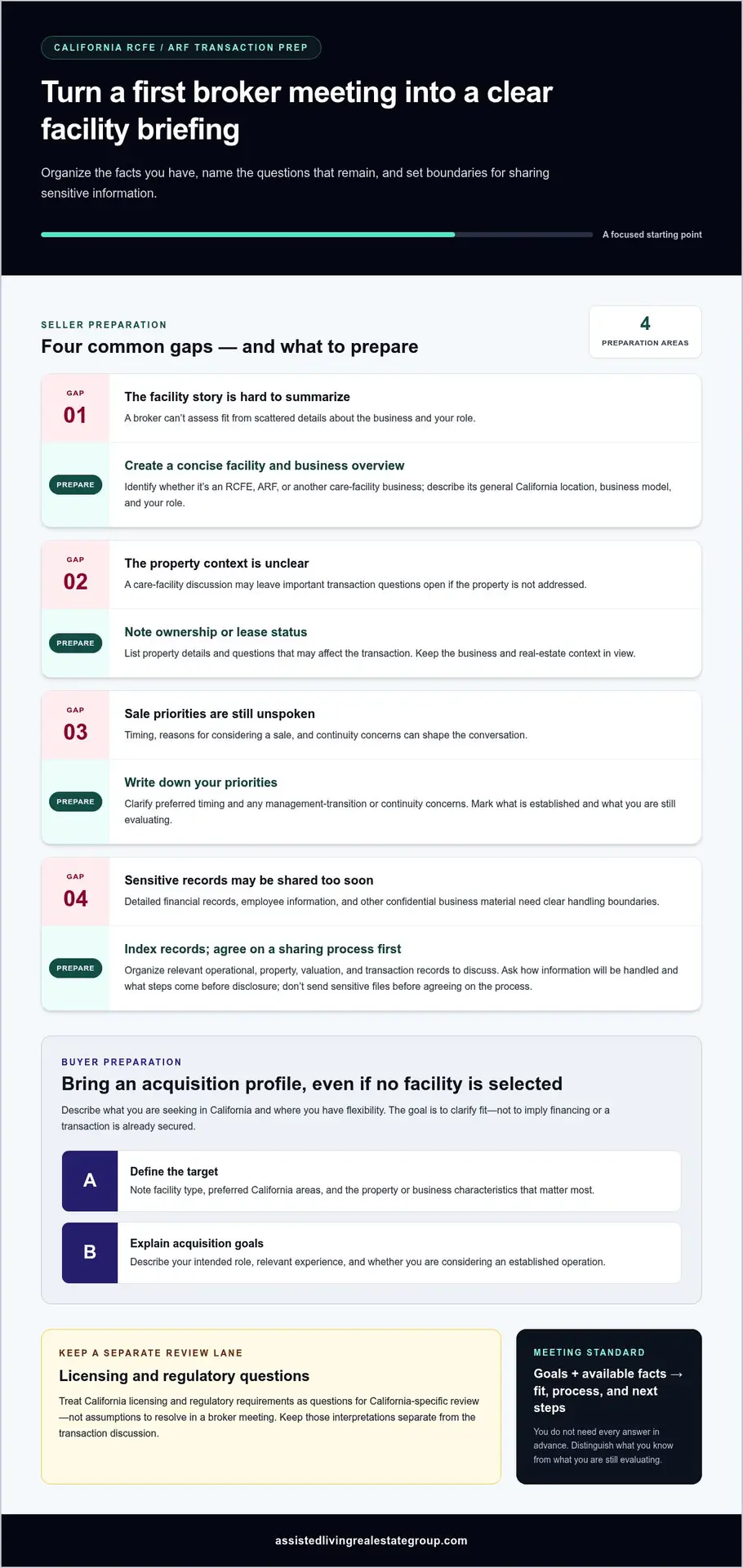
Prepare a working overview of the California facility and the transaction you’re considering. Keep facts current, distinguish confirmed information from estimates, and note questions instead of guessing. Organize your preparation in this order:
- Summarize the facility and business. Identify whether it’s an RCFE, ARF, or another care-facility business, describe its general location, and outline the business model and your role.
- Describe the property. Note whether the real estate is owned or leased, and list property details or questions that may affect the transaction.
- State your priorities. Clarify your preferred timing, reasons for considering a sale, and any concerns about management transition or continuity.
- Organize questions and records. List operational, property, valuation, and transaction questions. Make an index of relevant records to discuss instead of sending sensitive files before agreeing on an information-sharing process.
Flag information that shouldn’t be shared casually, such as detailed financial records, employee information, or other confidential business material. Ask how information will be handled and what steps come before disclosure. For California facility licensing and regulatory topics, refer to the California RCFE and ARF Regulations. Keep regulatory interpretations separate from the broker’s transaction discussion.
Buyer preparation checklist
Buyers can bring a clear acquisition profile even if they haven’t selected a specific facility. Describe what you’re seeking in California and where you have flexibility. The goal is to help the broker understand fit, not to suggest that financing or a transaction is already secured.
- Define the target. Note the facility type, preferred California areas, and the property or business characteristics that matter most.
- Explain your acquisition goals. Describe your intended role, relevant experience, and whether you’re considering an established operation or a turnkey acquisition.
- Identify decision-makers. Clarify who will evaluate opportunities and who needs to participate in major decisions.
- Prepare financing questions. List what you need to understand about potential financing pathways, documentation, and timing without assuming approval, rates, or terms.
For a California senior-care acquisition or sale, specialist facility brokerage support keeps the discussion focused on the business and property context.
How to discuss an RCFE or ARF and protect sensitive information
RCFE and ARF discussions call for more than a property description. A buyer and seller may view the same California facility differently: one is assessing fit and evaluation needs, while the other is considering how to present the business and manage a potential transition. Keep the conversation grounded in facts about the property and business, and separate known details from questions that need further review.
| Buyer discussion priorities | Seller discussion priorities |
|---|---|
| Facility category, California location, property characteristics, operating context, and information needed to evaluate fit. | Facility and business overview, property context, transaction priorities, transition considerations, and how information may be shared. |
Use the table to focus the conversation, not to assume a transaction outcome. Identify licensing context as a topic for California-specific verification, but don’t treat a broker meeting as a substitute for regulatory guidance. For broader background on long-term care, the Federal Long-Term Care Overview provides general context. Keep facility-specific questions tied to the California opportunity and verify applicable requirements through appropriate sources.
Confidentiality practices guide how information is shared, but they aren’t a promise of absolute secrecy. Discuss what will be shared, with whom, and at what stage before providing sensitive material. This matters when an unexpected disclosure could affect a facility’s reputation, business relationships, or day-to-day operations.
Questions sellers should raise about confidentiality
Ask how information will be handled, used, and shared with prospective buyers, and what process applies before detailed materials are distributed. Discuss how confidential marketing can limit unnecessary exposure and operational disruption. Identify what belongs in an initial overview and what should wait for a later review. Avoid including resident-identifying or other highly sensitive information in casual emails or introductory materials.
Questions buyers should raise about facility fit
Clarify whether the opportunity involves an RCFE, ARF, or another care-facility category, then ask which property and business details will inform the next evaluation stage. Keep licensing questions factual: note what you need to understand and identify it for separate California-specific verification. This helps distinguish transaction information from regulatory interpretation.
For sellers, a useful boundary is to begin with a high-level description, then discuss a deliberate process for any deeper exchange. Buyers can explain what they need to assess fit without requesting confidential records prematurely. This step-by-step approach is central to how to prepare for a meeting with a business broker when a California care facility is involved. It respects the sensitivity of the business while keeping the discussion practical and focused.
Meeting questions and agreeing on next steps
A useful meeting should end with more than a general sense of direction. Use a simple sequence to keep the discussion anchored to your California facility and transaction priorities, then turn conclusions into assigned follow-up actions. This approach to how to prepare for a meeting with a business broker helps everyone understand what’s been discussed and what still needs attention.
- Goals: Confirm whether the focus is a sale, acquisition, lease, or an initial assessment of fit.
- Facility facts: Review relevant business and property details, distinguishing established information from open questions.
- Questions: Address the issues most likely to shape your next decision.
- Process: Discuss the transaction stages that apply, such as valuation, negotiations, due diligence, financing, closing, or management transition.
- Responsibilities: Clarify who will provide information, review it, and make decisions.
- Follow-up: Agree on specific next steps and how updates will be shared.
Questions that clarify broker experience and process
Ask about the broker’s experience with California senior-care and adult residential-care transactions, including work involving RCFEs or ARFs. Then focus on how the process fits your situation. Which stages are relevant? How will valuation, negotiations, due diligence, financing, closing, or transition support be coordinated? Who will handle communication, and how will decisions and updates be shared?
Also clarify your preferred communication method and identify everyone who should participate in key decisions. A seller may want to understand how the broker coordinates a sale; a buyer may need clarity on how an opportunity is evaluated and what information is needed at each stage. Keep questions tied to your circumstances rather than expecting every transaction to follow the same sequence.
How to close the meeting with a clear action plan
Before wrapping up, summarize the priorities you agreed on, unresolved questions, and information-sharing boundaries. Make sure each person understands their responsibilities. Don’t leave follow-up as “we’ll be in touch.” Record the action, owner, and agreed method of follow-up so the next conversation builds on the first.
- Action: What specific task or information is needed?
- Owner: Who will handle it?
- Follow-up: How will progress or questions be communicated?
A meeting creates momentum when every next step has a clear owner and an agreed way to follow up. That plan doesn’t guarantee an offer, closing date, or transaction result. It gives you a practical framework for moving forward while keeping decisions deliberate and expectations grounded.
For a focused discussion about a California care-facility sale or acquisition, discuss your transaction goals with Assisted Living Real Estate Group.
How Assisted Living Real Estate Group supports a prepared California meeting
Preparation gives a broker a clearer view of your priorities. Assisted Living Real Estate Group specializes in senior-care and adult residential-care real estate, focusing on the details that matter to a Southern California transaction instead of treating an RCFE or ARF as a generic property or business. The group works with buyers, sellers, and clients exploring lease opportunities involving care facilities in California.
A facility’s business and real-estate context are closely connected. An owner may be weighing a sale and management transition, while a buyer may be assessing a particular facility and deciding what information to review next. A prepared conversation brings those distinct goals into focus and identifies relevant areas for discussion without assuming a particular outcome.
Why specialist experience matters in care-facility transactions
Assisted Living Real Estate Group brings over 25 years of combined experience opening, owning, selling, and buying care facilities and agencies. That background helps keep meetings grounded in the realities of senior-care and adult residential-care transactions. The discussion can center on your facility type, property, business priorities, and questions specific to your situation rather than broad assumptions.
The firm uses a confidential marketing strategy to guide how a Southern California opportunity is presented and how transaction discussions are organized. Confidentiality is central to that approach, but it isn’t a promise that information can never be disclosed. Owners can use the meeting to identify sensitive information and discuss a deliberate process for sharing materials as the transaction progresses.
What to expect when you take the next step
Buyers and sellers can bring their goals to an initial focused conversation, even if some priorities are still taking shape. Assisted Living Real Estate Group supports buying, selling, and leasing care facilities in California. Transaction support includes valuation, negotiations, due diligence, financing, closing, and management transition. These areas can be discussed in relation to your transaction, without implying a particular timeline or result.
To make the meeting useful, explain what you’re considering and what decision you hope to make next. A seller might want to understand how valuation and marketing fit into a potential sale; a buyer may want to discuss facility fit, financing considerations, and information needed for further evaluation. The conversation can identify practical next steps while respecting your priorities and information-sharing boundaries.
If you’re considering a Southern California care-facility sale, acquisition, or lease, discuss your California care-facility goals with our team. Sharing your objectives gives the meeting a clear starting point and keeps the discussion focused on the transaction path you’re exploring.
Make your next conversation count
The first meeting doesn’t need to settle every question. Its value is in helping you move from broad intentions to a more deliberate decision about a California care-facility sale, acquisition, or lease. Use what you’ve clarified to identify the next conversation, the information it requires, and the people who should be involved.
That’s the practical purpose of learning how to prepare for a meeting with a business broker: approach an important business decision with clear priorities, thoughtful questions, and a realistic view of what remains to be explored. You can begin before every detail is settled. A focused discussion can shape the path ahead while leaving room for careful review.
Assisted Living Real Estate Group works with California senior-care and adult residential-care transactions. If you’re ready to discuss your goals and the path you’re considering, start a conversation about your California care-facility goals.
Bring your priorities, ask directly, and take the next step with confidence.
Frequently Asked Questions
What should I bring to my first meeting with a business broker?
Bring a concise summary of your goals and the information needed to explain your situation. A buyer exploring a Southern California RCFE might outline the facility type, preferred area, acquisition priorities, and financing questions. A seller could prepare a high-level facility, business, and property overview, along with current sale priorities. You don’t need every supporting record. Start with what you’re comfortable discussing, then agree on a process before sharing sensitive material.
Is a meeting with a business broker confidential?
A meeting can include a discussion about careful information handling, but it shouldn’t be treated as a promise of absolute secrecy. Before sharing sensitive details about a California care facility, clarify how information may be used, who may receive it, and what should wait until a later stage. For example, begin with a general business overview instead of sending detailed financial or employee records before agreeing on an information-sharing process.
What questions should I ask a business broker before selling my California care facility?
Ask how the broker will approach valuation using the facility’s business and property context, and how a confidential marketing strategy will support your goals. You can also ask which transaction stages the broker supports and how updates will be communicated. Ask about relevant California RCFE or ARF experience without requesting private client details. Clarify which issues require separate legal, tax, or licensing review.
Can I meet with a business broker before deciding whether to buy or sell?
Yes. An exploratory conversation can help you sort through options before committing to a sale or acquisition path. If you’re considering an RCFE in Southern California but haven’t settled on buying, leasing, or waiting, explain what’s motivating the discussion and what remains uncertain. Learning how to prepare for a meeting with a business broker can turn those uncertainties into useful questions without presenting an undecided goal as a firm plan.
How do I prepare to discuss an RCFE or ARF with a broker?
Prepare clear, factual information about the facility category, California location, property, business model, and your role. Separate details you know from items you still need to verify. For example, describe an operational question as something you want to investigate rather than assuming the answer based on a brief discussion. A broker can address transaction context, while licensing interpretations and legal advice require separate review.
What happens after the first meeting with a business broker?
After the meeting, next steps may include clarifying your objectives, identifying information relevant to the transaction, or agreeing on an appropriate review process. A California seller might refine the business overview before discussing valuation or marketing; a buyer might define facility criteria for further evaluation. The broker and client can assign responsibilities and agree on follow-up communication. An initial conversation doesn’t assure an offer, closing date, or transaction result.
How can a business broker help with financing for a California care-facility acquisition?
A broker can include financing in the acquisition discussion and connect the process with specialized financing partnerships. For a California care-facility buyer, this can help clarify which financing questions to address as the opportunity is evaluated and what information may be relevant to a lender conversation. It doesn’t guarantee loan approval, funding, rates, or terms. Treat financing as one part of the acquisition plan, alongside facility fit and transaction review.