
An RCFE sale contingency meant to protect a California buyer can also put a closing at risk if its terms are unclear. RCFE sale contingencies need to address more than the property: buyers and sellers must also evaluate the care business, licensing considerations, and continuity of resident care.
It’s reasonable to want time to verify the facility, its operations, and the transaction’s key assumptions before moving forward. The challenge is deciding which conditions belong in the purchase agreement, how they affect the closing timeline, and what happens if a condition isn’t met. Real estate diligence and business review matter, but licensing and care transition planning need their own explicit attention.
This guide covers common contingency categories and what each is designed to address, helping buyers and sellers prepare focused questions for their transaction, legal, and licensing professionals. You’ll also learn how to consider diligence periods, approval processes, and care continuity as related but distinct parts of a California RCFE sale. Clear terms and qualified guidance can reduce avoidable uncertainty while keeping residents and staff in view. In Southern California, as elsewhere in California, the agreement and current state requirements should guide transaction-specific decisions.
Key Takeaways
- RCFE sale contingencies are negotiated conditions. The agreement should state what each one covers and what happens if it isn’t satisfied.
- Separate reviews of the care business, property, records, operations, and licensing can uncover issues a real-estate-only review may miss.
- Assess each proposed contingency from both sides: what evidence the buyer needs, what uncertainty the seller faces, and how deadlines may affect closing.
- Before signing or waiving a condition, confirm who is responsible, what documentation is needed, and how notices and contract dates will be tracked.
- Coordinate transaction, legal, escrow, and licensing professionals around distinct workstreams, using the agreement and current California requirements to guide next steps.
What RCFE Sale Contingencies Mean in a California Facility Transaction
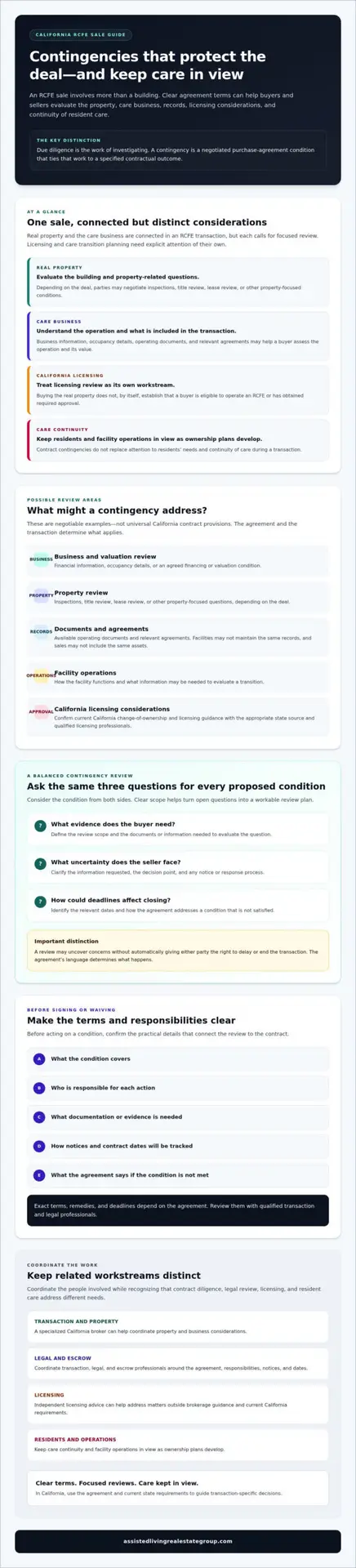
An RCFE sale may involve two connected but distinct assets: the real property and the care business operating within it. Buyers and sellers need to consider the building, business operations, records, and California licensing questions. A contingency is a negotiated condition in the purchase agreement that must be satisfied, waived, or otherwise addressed before the parties proceed under the contract. Due diligence is the work of investigating the transaction, such as reviewing records. A diligence task becomes a contingency only when the agreement ties it to a specified contractual outcome.
This distinction matters. A review can uncover concerns without automatically giving either party the right to delay or end the transaction. The agreement’s language determines what happens. The general concept of a contingent contract is that an obligation depends on a specified condition, but the details of an RCFE transaction need to be set out in its own agreement.
How contingencies fit into an RCFE purchase agreement
Buyers and sellers may negotiate conditions to address questions that need answers before closing. Depending on the transaction, examples could include reviewing business records, evaluating the property, or confirming an agreed financing or valuation condition. These are possibilities, not universal California contract provisions. Each clause should identify its scope, the evidence needed, who is responsible for taking action, and the relevant dates.
Precise terms help both sides plan. A buyer needs to know what review is permitted and what options the agreement provides if a condition isn’t met. A seller needs clarity about the information requested, the decision point, and any notice or response process. Exact terms, remedies, and deadlines depend on the agreement and should be reviewed with qualified transaction and legal professionals.
Why an RCFE sale is not only a property transaction
Property and business diligence can overlap. A buyer evaluating a building may also need to understand how its configuration supports the existing operation. A business-record review may raise questions about the services and processes associated with that location. Licensing is a separate consideration: purchasing the real property does not, by itself, establish that a buyer is eligible to operate an RCFE or has obtained any required approval. Buyers should confirm current California change-of-ownership and licensing guidance with the appropriate state source and qualified licensing professionals.
Contract contingencies also don’t replace the work of maintaining care during a transaction. Residents’ needs and facility operations require attention as ownership plans develop. A specialized California broker can help coordinate property and business considerations, while independent legal and licensing advice addresses matters outside brokerage guidance. For a broader acquisition framework, see the California RCFE buying guide.
Which Due-Diligence and Approval Issues Can Affect an RCFE Sale?
A focused review helps reveal what the buyer is acquiring and which unanswered questions could affect the transaction. The scope depends on the facility and deal structure. Financing, valuation, inspections, title review, lease review, and document access are negotiable examples, not standard conditions required in every California RCFE sale.
Contract diligence and licensing review are related but distinct tracks. A purchase agreement can set terms for investigating the business or property, but it doesn’t establish licensing eligibility or replace review of current California requirements.
- Business: Consider financial information, occupancy details, and other materials that help assess the operation and its value.
- Property: Depending on the deal, parties may negotiate inspections, title review, lease review, or other property-focused conditions.
- Records: Review available operating documents and relevant agreements. Don’t assume every facility maintains the same records or that every sale includes the same assets.
- Operations: Understand how the facility functions and what information may be needed to evaluate a transition while protecting continuity of care.
- Licensing: Verify applicable California licensing and change-of-ownership information with the Community Care Licensing Division (CCLD) within the California Department of Social Services (CDSS), and consult qualified licensing professionals.
Business and facility records buyers may need to review
Potential review materials can include financial records, occupancy information, operating documents, and relevant agreements. Their availability, format, and relevance depend on the facility and transaction structure. Buyers should have appropriate professionals assess the information rather than treating seller-provided records as independently verified. Resident information is sensitive. Plan any access or review with qualified legal and transaction professionals so privacy and disclosure are handled appropriately.
California licensing and property questions to verify
A property inspection or completed transfer of real estate doesn’t answer whether a buyer meets the requirements to operate an RCFE. Confirm which licensing questions apply to the proposed transaction directly with the CCLD and qualified licensing advisers. California Legislative Information provides the text of California Health and Safety Code Section 1569.191. Have counsel assess how the current provision applies to the specific sale and its timing. For additional background, see the California RCFE licensing guide.
Because business and property diligence can intersect, a specialized California RCFE broker may help parties coordinate those transaction considerations. That guidance complements, but doesn’t replace, independent legal or licensing advice. Learn about California RCFE transaction guidance.
How Buyers and Sellers Can Compare RCFE Contingency Terms
Strong contingency language balances two legitimate priorities: the buyer needs enough information to make an informed decision, while the seller needs a workable path toward closing. Compare each proposed condition by its purpose, scope, timing, and possible outcome. Broad wording can leave the parties disagreeing about what evidence is sufficient, or whether an issue allows more time, a change in terms, or another response under the agreement.
| Contingency purpose | Buyer concern | Seller concern | Questions for counsel |
|---|---|---|---|
| Reviewing business records | Are available financial and operating records adequate to assess the business? | Are requests defined, proportionate, and handled with appropriate confidentiality? | What records are included, who may review them, and how are findings addressed? |
| Property evaluation | Can inspections or title review identify issues that affect the acquisition? | Are the review scope, access arrangements, and response process clear? | What evidence is required, and what options does the agreement provide if an issue arises? |
| Financing or valuation condition | Does the proposed condition address the buyer’s stated transaction assumptions? | Could an open-ended condition create uncertainty about whether the buyer will proceed? | What standards, supporting information, and notice steps apply? |
| Licensing-related coordination | What California licensing questions must be verified for the planned transaction? | How can the parties distinguish regulatory work from contractual obligations? | Which matters belong in the agreement, and which require separate licensing guidance? |
Buyer protections and the questions they should answer
For every condition, ask which documents, inspections, or approvals it covers, who evaluates the evidence, and how the agreement handles unresolved findings. A defined condition can make expectations easier to track. Broad language may preserve flexibility, but it can leave more room for disagreement. Before accepting or waiving protections, buyers should review the specific wording with transaction counsel. Waiving a condition may change contractual options, but it doesn’t guarantee closing or prevent later disputes.
Seller certainty, confidentiality, and workable timelines
Sellers may seek clear deadlines, limited access to sensitive information, and specific requests so diligence can proceed without unnecessary disruption. A broader review period may allow time to assess complex materials, while defined deadlines can provide greater schedule clarity. Neither approach is right for every transaction. Set timing to fit the records, review scope, and contract rather than assuming a universal period. Assisted Living Real Estate Group’s confidential marketing approach reflects the value of thoughtful information-sharing, but confidentiality should never be treated as an absolute promise.
Clear terms help both sides plan, though no clause removes every risk. For additional seller-side context, read the California assisted living facility sale guide. Buyers and sellers evaluating RCFE sale contingencies can also consider specialized California RCFE transaction guidance, alongside independent legal advice.
A California RCFE Contingency Review Before Signing or Waiving
Before signing or removing a condition, turn the agreement into a practical review plan. Identify what must happen, who handles each step, and what the contract says if an issue remains unresolved. Because a contingency waiver or removal can affect your contractual options, discuss the specific language with qualified transaction counsel before acting.
- Identify each condition. Confirm whether the agreement covers real estate, business assets, or both. List the diligence items and approvals it expressly addresses rather than relying on assumptions about what a sale agreement usually includes.
- Assign responsibility. Clarify who obtains documents, arranges inspections, reviews findings, and prepares any required notices. Don’t assume the broker, escrow holder, attorney, or licensing contact automatically handles every task.
- Define the evidence. Ask what documents, inspection results, or other information will satisfy each condition, and who will assess whether the evidence meets the written terms.
- Track deadlines and notices. Record contract dates and notice requirements in a shared transaction calendar. Confirm with the transaction professionals who monitors each date and how written notices should be prepared and delivered under the agreement.
- Understand the consequences. Ask counsel what options the agreement provides if a condition isn’t met, and what may change if it’s waived or removed. Don’t give up a written protection based only on informal assurances.
Questions to resolve before signing
Ask whether the agreement clearly identifies the property and business interests involved, which reviews or approvals are included, and who is responsible for notices and deadlines. A specialized broker may help coordinate property and care-business transaction details, but brokerage support isn’t legal advice and doesn’t determine California licensing eligibility. Verify licensing questions with the appropriate California source or qualified licensing professional.
Questions to resolve before a contingency is removed
Confirm that the relevant review is complete, findings have been discussed with appropriate advisers, and any remaining concern has a documented path forward. If an issue is unresolved, ask transaction counsel what contractual options remain before signing a removal or waiver. A licensing contact can address regulatory questions, while counsel interprets the agreement. Keep those roles distinct.
Bring this short checklist to your next transaction discussion:
- Broker: Which property and business components are part of the transaction, and what information is still outstanding?
- Attorney: What does each condition require, how are deadlines and notices handled, and what are the consequences of removal?
- Licensing contact: Which current California licensing or change-of-ownership questions should be verified for this transaction?
A California RCFE broker can help coordinate the transaction workstreams while your independent advisers address legal and licensing questions. Discuss an RCFE transaction with a specialized California brokerage.
Coordinate the RCFE Sale Team and Move Toward a Clear Closing Plan
A clear closing plan depends on the right people handling the right work. The buyer and seller make transaction decisions and provide agreed information. A specialized broker can help coordinate real estate and care-business considerations. Legal counsel advises on contract rights, escrow manages its assigned closing tasks, and qualified licensing contacts help verify current California requirements. Keep these roles distinct, then use the written agreement and verified requirements to guide transaction-specific next steps.
Build a transaction communication plan
Good coordination starts with clear communication, not more meetings. Agree on a primary point of contact for milestone tracking and document coordination, while confirming who is responsible for each contractual notice or deadline. The contact can maintain a list of open questions, the person assigned to answer each one, and any relevant date in the agreement.
- Route contract interpretation questions to legal counsel, not assumptions or informal summaries.
- Direct California licensing questions to the appropriate licensing contact and verify current requirements through the relevant state source.
- Coordinate property and business transaction details through the broker and other professionals assigned to those tasks.
- Share sensitive facility and resident information only through appropriately managed channels, with access handled carefully.
This structure helps surface gaps early without blurring professional responsibilities. A broker can coordinate a transaction, while counsel interprets contract rights.
Get specialized guidance for a California care-facility transaction
RCFE sale contingencies can involve both a facility’s real estate and its underlying business. A broker familiar with California RCFE and ARF transactions may help parties keep those considerations connected as the deal progresses. Brokerage coordination complements independent legal advice and does not determine licensing eligibility or replace guidance from qualified licensing professionals.
For sellers weighing how transaction information is shared, confidential marketing may be a strategy to discuss. It can help guide how information is presented, but no approach should be treated as a guarantee that disclosure will be avoided. The parties should agree with their advisers on appropriate communication and information-handling practices for the transaction.
If you’re considering a California RCFE sale or acquisition, discuss a California RCFE transaction with a specialized brokerage team and clarify which questions belong with your attorney, escrow contact, or licensing professional.
Move Forward With a Clear California RCFE Transaction Plan
Well-defined RCFE sale contingencies help buyers and sellers understand what must be reviewed, who is responsible, and how unresolved issues are handled under the agreement. Keep contract diligence distinct from California licensing review, and coordinate both with qualified professionals. Clear communication can also help parties plan for facility operations and continuity of care during a change in ownership.
A specialized California brokerage can help coordinate real-estate and care-business considerations, while independent legal counsel interprets contract rights and licensing professionals advise on regulatory questions. Assisted Living Real Estate Group specializes in California RCFE and ARF transactions. The team reports more than 25 years of combined care-facility industry experience and offers confidential marketing strategies for sellers, though no approach can guarantee that information remains confidential.
Whether you’re evaluating an acquisition or preparing to sell, thoughtful planning can make the next steps clearer. Discuss your California RCFE transaction with a specialized team and move forward with greater clarity and confidence.
Frequently Asked Questions
What is a contingency in an RCFE sale contract?
A contingency is a negotiated condition that must be satisfied, waived, or otherwise addressed under the purchase agreement. For example, an agreement might make proceeding toward closing conditional on a specified review of business records or property. The clause should explain what it covers, what evidence is relevant, who is responsible, and what happens if the condition isn’t met. RCFE sale contingencies are contract terms, not a substitute for California licensing review.
What contingencies are common in a California business sale contract?
Possible negotiated conditions include review of financial or operating records, property inspections, title or lease review, financing, or valuation. These are examples, not mandatory terms for every California business or RCFE sale. Appropriate conditions depend on what’s being sold, the transaction structure, and the parties’ priorities. In a Southern California facility transaction, buyers and sellers should have counsel review the proposed scope, evidence standards, deadlines, and consequences before agreeing.
Can an RCFE license transfer to a new owner in California?
No. California RCFE licenses are non-transferable, according to the California Department of Social Services information summarized in this guide. A buyer should verify current application and change-of-ownership requirements with the Community Care Licensing Division and qualified licensing professionals. A purchase agreement or transfer of the facility’s real estate does not itself grant licensing eligibility or approval. Plan licensing questions as a distinct workstream alongside contract diligence.
How do due-diligence contingencies affect an RCFE sale?
Due-diligence contingencies can give the buyer a contract-defined period or process to review specified information and decide how to proceed under the agreement. For an RCFE, that review may involve the business, property, available records, or operations. The terms can affect timing and each party’s options if a concern arises. Define the scope and required evidence carefully, and keep contract review separate from California licensing verification and resident-care planning.
What happens if a buyer cannot satisfy a sale contingency?
The outcome depends on the exact agreement, the condition involved, and any required notices or other steps. The contract may describe options if a condition isn’t met, but buyers shouldn’t assume they can automatically cancel, extend the review, recover funds, or change terms. Contact transaction counsel promptly, review the written language and applicable dates, and avoid relying on informal assurances. The seller should also consult counsel before responding or treating the agreement as ended.
Can a seller accept another offer while an RCFE sale is contingent?
Whether a seller can consider or accept another offer depends on the signed agreement and any provisions addressing exclusivity, continued marketing, or backup offers. A contingency alone doesn’t answer that question. Before responding to another proposal, the seller should ask transaction counsel to interpret the existing contract and explain any notice or other obligations. In Southern California, as elsewhere in California, both parties should rely on their written agreement rather than assumptions about customary practice.
When should a buyer or seller ask an attorney to review RCFE sale contingencies?
Involve an attorney before signing, changing, waiving, or removing a contingency, and promptly if a deadline or unresolved finding raises questions about contractual rights. Counsel can interpret the agreement and explain the consequences of proposed steps. A broker may help coordinate real-estate and business transaction considerations, but doesn’t replace legal advice. Ask qualified licensing professionals or the appropriate California state source about licensing requirements, which are distinct from contract interpretation.