
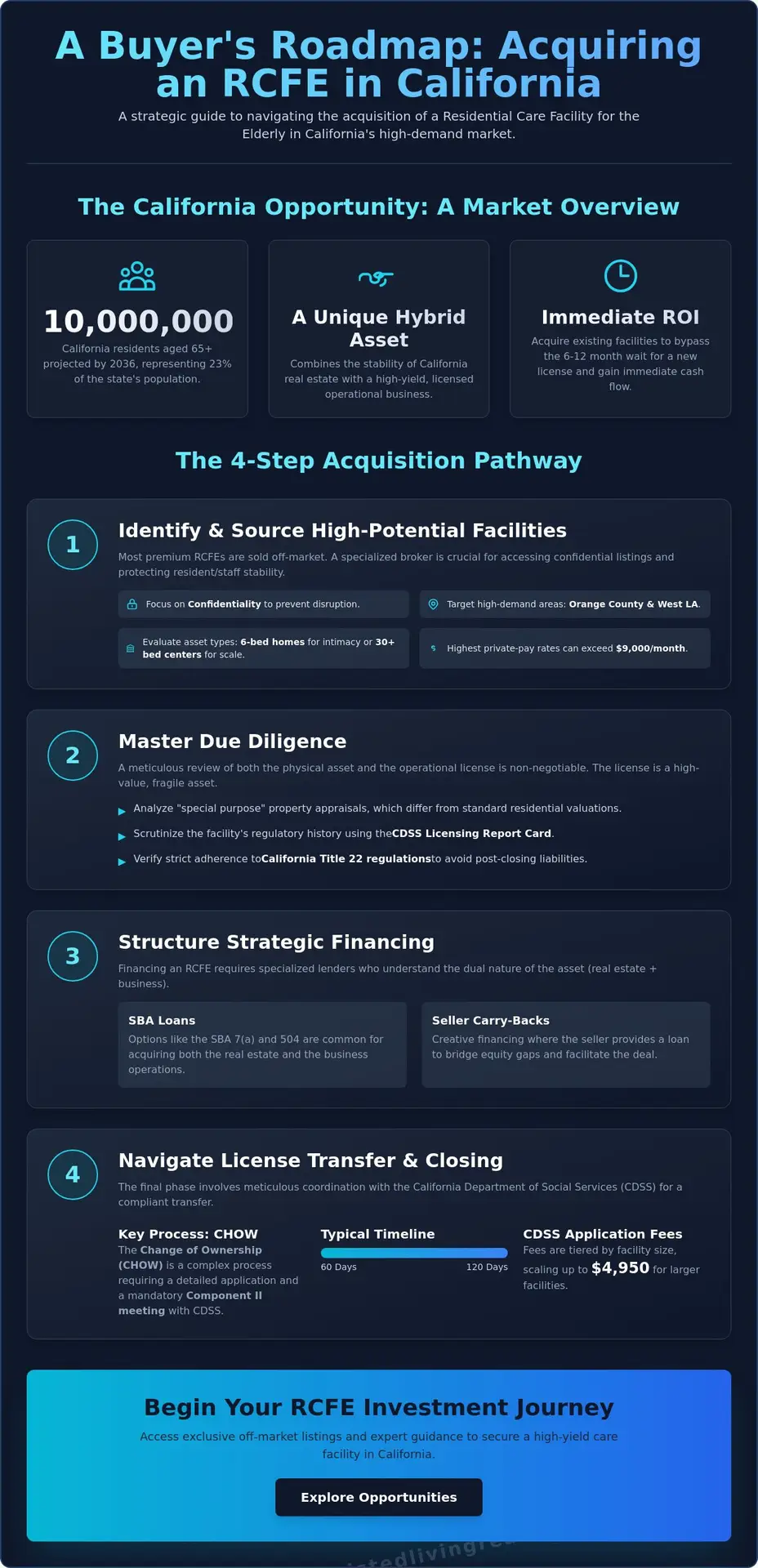
By 2036, California is projected to have more than 10,000,000 residents aged 65 and older, accounting for nearly 23% of the state’s total population. You likely recognize that this demographic shift isn’t just a statistic; it’s a massive opportunity to pair significant financial returns with a legacy of compassionate care. However, the path to a successful acquisition is steep, as you’re purchasing both a specialized real estate asset and a highly regulated business license simultaneously. Mastering the specific steps to buying an RCFE in California is essential to avoid the common pitfalls of licensing transfers and complex financing hurdles.
In this guide, we’ll provide a proven framework to help you navigate the 2026 landscape with the precision of a seasoned professional. You’ll gain a clear timeline for the typical 60 to 120 day change of ownership process and learn how to manage CDSS application fees that now scale up to $4,950 for larger facilities. We’ll also explore the nuances of special purpose property financing and the impact of recent legislative shifts, such as Senate Bill 1406, on your operational bottom line. By the end, you’ll have the roadmap needed to secure a high-yield care facility in one of the nation’s most resilient and exclusive markets.
Key Takeaways
- Understand why RCFEs are unique hybrid assets that combine the stability of California real estate with the high-yield potential of a licensed operational enterprise.
- Master the essential steps to buying an RCFE in California by leveraging confidential sourcing strategies that protect resident stability and staff retention during the transition.
- Learn how to execute rigorous due diligence by analyzing specialized “special purpose” property appraisals and reviewing a facility’s regulatory standing through the CDSS Licensing Report Card.
- Discover strategic financing structures, including SBA loan options and creative seller carry-backs, designed to bridge equity gaps and maximize your investment leverage.
- Navigate the complex Change of Ownership (CHOW) process and the mandatory Component II meeting to ensure a seamless and compliant transition of the facility’s license.
The Strategic Advantage of Buying an Established RCFE in California
An RCFE represents a unique hybrid asset class that demands a sophisticated investment approach. You’re not just buying a residential building; you’re acquiring a cash-flowing operational enterprise with a high barrier to entry. This dual nature is exactly why understanding the specific steps to buying an RCFE in California is so critical for investors who want to balance profitability with a legacy of care. Unlike traditional residential real estate, these facilities are valued based on their cap rates, Net Operating Income (NOI), and the integrity of their operating license.
In the 2026 market, acquisitions offer a distinct strategic edge over ground-up developments. High construction costs and tightened interest rates have made new builds a capital-intensive marathon that many investors prefer to avoid. When you buy an existing Residential Care Facilities for the Elderly (RCFE), you bypass the 6 to 12 month wait for a new license. You step into immediate cash flow and an established staffing structure that is already familiar with the facility’s residents. This turnkey advantage is vital in Southern California, where the “Silver Tsunami” is no longer a prediction. By 2036, California will be home to over 10 million seniors. Securing an existing asset now allows you to capture this massive demand today rather than waiting years for a certificate of occupancy.
RCFE vs. ARF: Choosing Your Investment Path
Choosing between these two models is a pivotal point for your investment strategy. An RCFE focuses on seniors 60 and older, often requiring more intensive medical oversight or memory care as residents age. An Adult Residential Facility (ARF) serves adults 18 to 59 with developmental disabilities or mental health needs. This specialization dictates your staffing ratios, specialized training requirements, and your long-term management burden. To determine which asset aligns with your portfolio goals, see our analysis on RCFE vs. ARF: Which California Facility is Right for You?.
The Regulatory Landscape: Title 22 Compliance
The California Department of Social Services (CDSS) maintains strict oversight through Community Care Licensing. When evaluating the steps to buying an RCFE in California, you must treat the license as a fragile, high-value asset. Any history of non-compliance can stall a transfer or lead to expensive post-closing corrections. Title 22 is the regulatory backbone of California senior care. Successful investors prioritize facilities with clean records, ensuring that the transition from seller to buyer doesn’t trigger unnecessary state intervention or delays in the Change of Ownership (CHOW) process.
Step 1: Identifying and Sourcing High-Potential Care Facilities
Finding the right facility is the first of many steps to buying an RCFE in California. Most premium, high-yield facilities never reach public listing sites. Sellers prioritize confidentiality to prevent resident flight or staff anxiety. You need a specialized broker who understands the nuances of the California Department of Social Services (CDSS) licensing requirements and maintains a network of off-market opportunities. These professionals act as gatekeepers to assets that offer the best balance of physical real estate and operational maturity.
Size matters. In 2026, 6-bed residential care homes are emerging as power assets due to their intimate, home-like feel and lower overhead costs. Conversely, 30+ bed assisted living centers offer scalability and institutional-grade management systems. Southern California remains the primary target for strategic professionals. Coastal Orange County and West Los Angeles command the highest private-pay rates, often exceeding $9,000 monthly for memory care. If you’re ready to see what’s currently available in the market, you can browse our turnkey business acquisitions to find a facility that matches your investment criteria.
Confidentiality and the Letter of Intent (LOI)
Silence is your best ally during the sourcing phase. You’ll start by signing a Non-Disclosure Agreement (NDA) before viewing any sensitive operational data. Drafting a precise LOI is one of the most critical steps to buying an RCFE in California because it sets the tone for the entire transaction. Your LOI should signal your bankability by including proof of funds or a pre-approval letter from an SBA lender. Sellers in this niche market look for buyers who can navigate the regulatory transition without stumbling; your offer must reflect that competence.
Evaluating Financial Performance (EBITDAR)
You aren’t just buying real estate; you’re buying a P&L. Focus on EBITDAR (Earnings Before Interest, Taxes, Depreciation, Amortization, and Rent) to understand the facility’s true operational strength. Look for a high ratio of Private Pay residents over those relying on SSI/SSP rates, which are set at $1,444.07 for 2026. High-performing facilities often have occupancy rates exceeding 90%. Turnkey acquisitions require a deep dive into staffing costs, as labor remains the most significant expense and challenge in the current California care landscape.
Step 2: Mastering Due Diligence for California Care Homes
Once you’ve identified a facility, the verification phase begins. This is where many investors falter, as they treat the acquisition like standard residential real estate. In reality, mastering the steps to buying an RCFE in California requires a deep dive into the facility’s “Special Purpose” status. Lenders will require specialized appraisals that account for the business’s income potential rather than just comparable housing prices. You’ll also need to conduct a Phase I Environmental Site Assessment to ensure the land is free of liabilities that could jeopardize your financing or licensing.
Your operational due diligence must center on the facility’s “Licensing Report Card” from the CDSS. This document reveals the true health of the business beyond the profit and loss statement. You are looking for a history of compliance that suggests a well-run, professional environment. If the facility has a track record of recurring citations, you must factor the cost of remediation into your offer. This phase is about risk mitigation; you’re ensuring the asset you’re buying won’t be crippled by state-mandated closures or heavy fines immediately after you take the keys.
The Licensing Audit: Protecting Your Investment
Reviewing past Title 22 violations is non-negotiable. You need to see the Plan of Corrections (POC) for every citation issued in the last three years to confirm they were resolved and haven’t resurfaced. Ensure the seller’s license is in good standing and free of any “Administrative Actions” that could complicate a transfer. A clean licensing history is the ultimate due diligence win because it minimizes the risk of state-mandated shutdowns or costly operational overhauls during the ownership transition.
Zoning and Land Use Considerations
Don’t assume a currently operating facility is immune to local zoning shifts. You must verify Southern California municipal codes to ensure the property isn’t in violation of “Over-Concentration” laws, which often restrict how close care facilities can be to one another. These local ordinances can impact your ability to expand the bed count or relocate residents in the future. For a detailed breakdown of city-specific regulations, consult our guide on RCFE Zoning Requirements California.
Step 3: Financing Your California RCFE Acquisition
Financing is the bridge between your vision of compassionate care and the reality of a high-yield asset. In 2026, lenders have refined their approach to senior care, requiring more than just a strong balance sheet. You need a financing structure that acknowledges the dual nature of the business. One of the most sophisticated steps to buying an RCFE in California is navigating the “Special Purpose” appraisal. Unlike standard commercial real estate, these appraisals must weigh the business’s Net Operating Income (NOI) alongside the physical property value to determine the true collateral worth.
Creative financing is often the key to closing high-value deals in competitive markets like Orange County or Los Angeles County. Seller carry-backs, where the seller finances 15% to 20% of the purchase price, are viewed favorably by institutional lenders. This arrangement signals the seller’s confidence in the facility’s continued success and reduces your initial capital outlay. You might also consider an “Earn-out” model, where a portion of the final purchase price is contingent on the facility hitting specific occupancy or revenue milestones after you take over operations.
SBA Loan Programs for Care Facilities
The SBA 7(a) program remains the gold standard for turnkey acquisitions because it covers both the real estate and the business goodwill. For those focused on the property itself, the SBA 504 program, often facilitated by California-based Certified Development Companies (CDCs), allows for down payments as low as 10% to 15%. This leverage is a powerful tool for scaling your portfolio without exhausting your liquidity. For a deep dive into current lending terms and eligibility, explore our Financing Your RCFE Purchase: A Buyer’s Guide.
Creative and Lease-to-Own Strategies
If you aren’t ready for a full purchase, master lease agreements or lease-to-own models provide a strategic entry point. These structures allow experienced administrators to build equity while managing operations, eventually transitioning to full ownership. This path minimizes initial risk while allowing you to prove the facility’s performance to future lenders. If you are looking for a flexible way to enter the market, our lease-to-own care home opportunities offer a proven roadmap to eventual acquisition without the immediate burden of a traditional mortgage.
Step 4: Navigating the License Transfer and Closing
The final phase of your acquisition is where legal ownership meets regulatory approval. Unlike purchasing a standard business, the steps to buying an RCFE in California culminate in a rigorous Change of Ownership (CHOW) process overseen by the CDSS. This period typically spans 60 to 120 days; a significantly faster timeline than the 6 to 12 months required for a new facility license. During this window, you’ll coordinate the “Component II” meeting. This is a high-stakes interview with state regulators where you must demonstrate your operational competence and thorough understanding of Title 22 requirements. It’s not merely a formality; it’s the state’s final gatekeeping mechanism to ensure resident safety remains uncompromised under your leadership.
Escrow in a care facility sale requires a specialized approach. You should work with escrow officers who are intimately familiar with California care home transactions to manage the “Holdback” effectively. This financial reserve protects you from undisclosed liabilities, such as unpaid employee wages or pending regulatory fines that the seller may have incurred. While escrow handles the funds, you must focus on the human element of the handover. Finalizing the operational transition involves sensitive resident notifications and a strategic staff retention plan. In the 2026 market, keeping a facility’s original care team intact is your most valuable insurance policy for maintaining occupancy and care quality from day one.
The CDSS Application and Orientation
Success starts with the meticulous filing of the Part A and Part B application for your new owner entity. This is one of the most critical steps to buying an RCFE in California, as any administrative error can reset your licensing clock. The CDSS will scrutinize your management bio and previous Title 22 experience to ensure you’re qualified to hold the license. In the current 2026 regulatory environment, the state prioritizes applicants who show a sophisticated blend of financial stability and a clear commitment to compassionate, high-standard care. Avoid delays by ensuring all Live Scan clearances for your management team are completed before the application hits the reviewer’s desk.
Closing the Transaction and Post-Closing Success
Once you’ve cleared the regulatory hurdles, the focus shifts to your first 100 days of ownership. This is your opportunity to implement a strategic plan that improves occupancy through refined marketing and upgrades to care services. You aren’t just a landlord; you’re the steward of a community. Navigating this transition requires a partner who understands the intersection of real estate and regulation. To ensure your acquisition is handled with the expertise it deserves, partner with Teri Szoke for expert RCFE brokerage and consulting. With a proven roadmap and a commitment to excellence, you can transform a turnkey facility into a high-performing legacy asset.
Mastering the Future of California Senior Care
The 2026 landscape for residential care is defined by a rare convergence of high demand and specialized opportunity. By mastering the steps to buying an RCFE in California, you position yourself at the forefront of a market that rewards both analytical rigor and operational excellence. Success requires more than just capital; it demands a strategic roadmap that navigates the complexities of Title 22 compliance and the nuances of special-purpose financing. You’ve learned how to identify high-potential assets, execute rigorous due diligence, and secure the financing necessary to bridge the gap between investment and impact.
Navigating this high-barrier-to-entry market alone is a risk you don’t have to take. With over 25 years of specialized experience in California senior care real estate, our team provides the seasoned expertise needed to manage confidential marketing and complex CDSS licensing transfers with precision. Secure your California care facility investment with Assisted Living Real Estate Group and leverage a proven track record of high-value RCFE and ARF sales. The opportunity to build a legacy of care while achieving significant financial returns is within your reach. Your journey toward owning a premier care facility starts with the right partner.
Frequently Asked Questions
How long does it take to buy an existing RCFE in California?
It typically takes between 60 and 120 days to complete a change of ownership (CHOW) for an existing facility. This timeline is significantly shorter than the 6 to 12 months required for a brand new license. The speed often depends on how quickly the buyer submits the Part A and Part B application packets to the CDSS and how fast the state schedules the Component II interview.
Do I need to be a certified RCFE administrator to buy a facility?
No, you don’t need to be a certified administrator to own the business, but the facility must have a certified administrator on staff at all times. Many owners choose to complete the mandatory 80-hour Initial Certification Training Program (ICTP) themselves to maintain operational control. This certification requires passing a state exam with a score of at least 70% and submitting an application within 30 days of passing.
Can I buy an RCFE with an SBA loan in 2026?
Yes, SBA 7(a) and 504 loans remain the primary financing vehicles for these acquisitions in 2026. Lenders view these as “special purpose” assets, which requires a specialized appraisal that accounts for business income. A common benchmark for an SBA 7(a) loan is a 25-year term with interest rates around 6.75%, provided the business shows a strong Debt Service Coverage Ratio of at least 1.25x.
What is the average down payment for an assisted living facility in California?
Most buyers should prepare for a down payment between 10% and 15% when using SBA financing programs. If the seller provides a carry-back of 15% to 20% of the purchase price, it can significantly reduce your initial cash requirement. Institutional lenders often favor these structures because they demonstrate the seller’s continued confidence in the facility’s financial health and the buyer’s long-term success.
What happens to the residents when I buy an existing care home?
Residents generally remain in the facility, but you must provide them with proper legal notice regarding the change in ownership. If you plan to adjust rates, California law now requires a 90-day written notice for any increase, a requirement that changed from 60 days on January 1, 2025. Maintaining resident stability is one of the core steps to buying an RCFE in California to ensure immediate cash flow.
Is an RCFE considered a commercial or residential property for financing?
Financing for an RCFE is typically treated as a commercial “special purpose” loan, even if the physical structure is a residential home. Lenders evaluate the property based on its income-generating potential and the value of the business license rather than just residential comps. This distinction is why specialized appraisals are mandatory to verify the facility’s Net Operating Income and overall business value.
What is the difference between buying the business and buying the real estate?
Buying the business involves acquiring the license, resident contracts, and staffing structures, while buying the real estate involves the physical land and building. Most high-yield acquisitions are “turnkey,” meaning you purchase both simultaneously. However, some investors choose a “lease-to-own” model where they operate the business first and purchase the real estate after proving operational success and securing permanent financing.
How do I find off-market RCFE listings in Southern California?
Accessing off-market listings requires partnering with specialized brokers who maintain confidential relationships with facility owners. Because public listings can cause staff turnover and resident anxiety, the best opportunities are often handled through private networks. These exclusive listings are essential steps to buying an RCFE in California for investors seeking high-performing assets in competitive areas like Orange County or West Los Angeles.