
What if the most resilient real estate play in the Golden State isn’t a Silicon Valley office park, but a six-bed boutique RCFE in a quiet Orange County suburb? With California’s population of seniors aged 65 and older projected to grow by 2.1 million by 2030, the “Silver Tsunami” is a blue ocean of opportunity for savvy entrepreneurs. You likely recognize that residential assisted living (RAL) offers a unique chance to achieve both impact and income. However, the path to a successful closing is often blocked by the 120-day licensing backlogs at the California Department of Social Services. Partnering with specialized assisted living business brokers California investors trust ensures you don’t become another statistic in the 30% of RCFE transactions that fail during escrow due to regulatory hurdles.
You’ve worked hard to build your capital; you deserve a transition that protects your investment. We’ll show you how to value the “Blue Sky” of an operation while maintaining the confidentiality required to prevent staff turnover. This guide provides a roadmap for buying, selling, and scaling your RCFE portfolio in California’s high-barrier market. You’ll learn to secure turnkey acquisitions and maximize ROI through strategic exits in the boutique senior care landscape.
Key Takeaways
- Learn why standard commercial agents often fail Title 22 assets and why specialized expertise is required to navigate California’s unique regulatory and licensing landscape.
- Master the three-pillar valuation framework used by specialized assisted living business brokers California to accurately price the real estate, business operations, and license value of an RCFE.
- Discover how to protect your facility’s census and prevent resident flight by utilizing confidential marketing strategies that bypass the inherent risks of a public MLS listing.
- Follow a proven five-step roadmap for Southern California acquisitions, from financial prequalification in markets like Fresno and Thousand Oaks to navigating the Letter of Intent.
- Understand how a boutique, consultancy-driven approach allows you to achieve “Impact and Income” by capitalizing on the California “Silver Tsunami” through high-barrier-to-entry investments.
Why Specialized Assisted Living Business Brokers are Essential in California
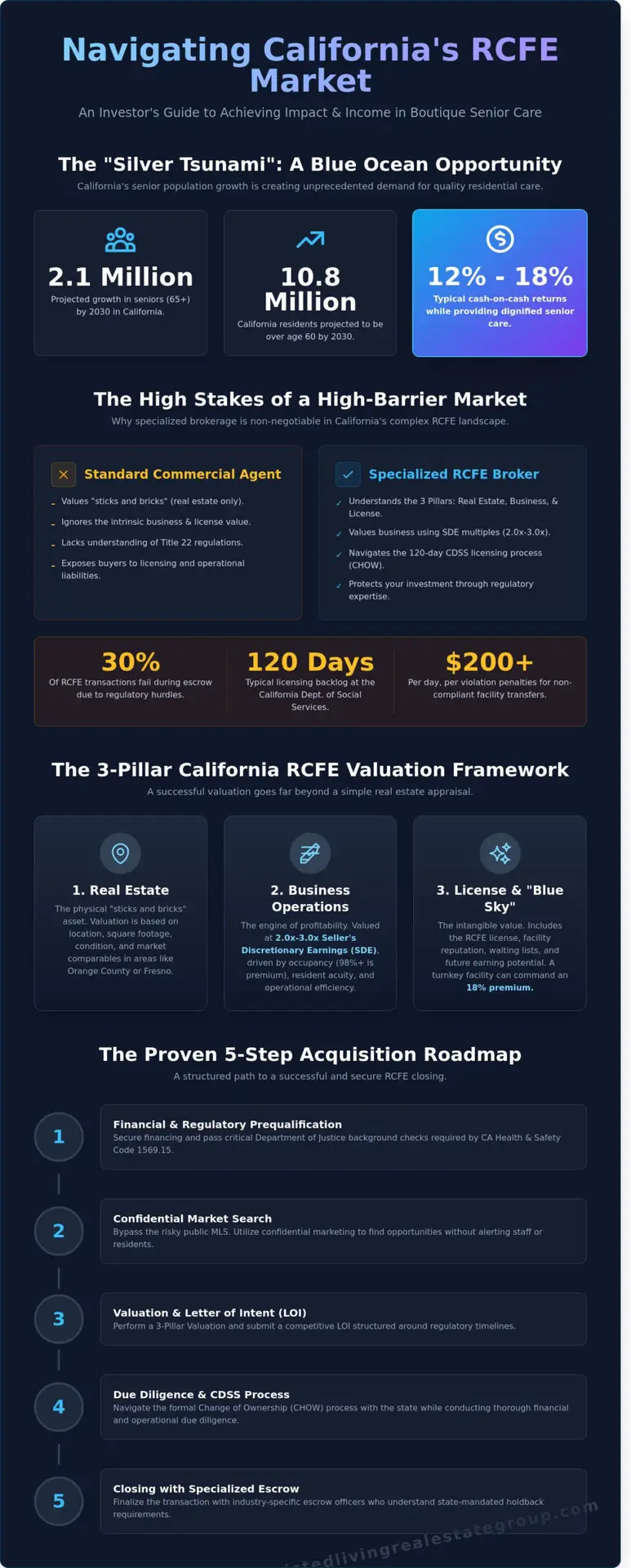
Success in the California senior housing market requires more than a standard real estate license. Specialized assisted living business brokers California act as strategic partners, bridging the gap between sophisticated real estate investment and the rigorous demands of social services. By 2030, the California Department of Aging projects that 10.8 million residents will be over age 60, creating a “blue ocean” for boutique care providers. We view this demographic shift as an opportunity to master the “Impact and Income” philosophy, where investors generate 12% to 18% cash-on-cash returns while providing dignity to seniors in high-end, residential settings.
Standard commercial brokers often fall into the “sticks and bricks” trap. They value a property based on square footage and comparable sales, ignoring the intrinsic value of a Residential Care Facilities for the Elderly (RCFE) license. This oversight is dangerous. In California, the business value often exceeds the real estate value because of the high barrier to entry and the scarcity of licensed beds. A generalist agent doesn’t understand the nuances of Title 22, the state’s governing body of regulations, leaving buyers exposed to operational liabilities that can sink an investment before the first resident moves in.
The High Stakes of California’s Regulatory Environment
The California Department of Social Services (CDSS) oversees every transaction through the Community Care Licensing Division. Every sale requires a formal Change of Ownership (CHOW) process. If a broker fails to structure the purchase agreement around the CHOW timeline, which typically spans 60 to 120 days, the buyer risks operating without a valid license. In Southern California, non-compliant transfers can result in civil penalties of $200 per day per violation, or immediate facility closure, destroying the asset’s reputation and its ROI.
Traditional Real Estate vs. RCFE Business Brokerage
Valuing a boutique RAL facility differs significantly from a standard multi-family asset. While a duplex might trade at a 5% cap rate, a high-performing RCFE business often commands a 2.0x to 3.0x multiple of SDE (Seller’s Discretionary Earnings). Experienced assisted living business brokers California use industry-specific escrow officers who understand the holdback requirements for state-mandated audits. Pre-qualification isn’t just about credit scores; buyers must pass a Department of Justice background check and prove their eligibility to hold a license under California Health and Safety Code 1569.15 before they can even submit a competitive offer.
Valuing a Care Home: The California RCFE Valuation Framework
Valuation in the California RCFE market isn’t a guessing game. It’s a calculated science that blends real estate appraisal with business valuation. When you work with assisted living business brokers California, they focus on three core pillars: the physical real estate, the daily business operations, and the intrinsic value of the RCFE license itself. Each pillar supports the others. A beautiful property in Thousand Oaks is just a house without the license; a license is just a piece of paper without a stabilized census.
In high-density markets like Van Nuys, “Blue Sky” value is a major factor. This represents the intangible worth of a facility’s reputation and its future earning potential. Brokers calculate this by projecting the next 36 months of stabilized cash flow. A facility with a consistent 98% occupancy rate and a documented waiting list will always trade at a premium. Investors recognize that they aren’t just buying a building. They’re buying a proven track record of Impact and Income.
The acuity of your residents also dictates your cap rate. High-acuity care, such as hospice or advanced memory care, allows for higher monthly fees. This increases your net operating income without necessarily increasing your square footage. In regions like Fresno, turnkey status is the gold standard. Savvy investors are willing to pay an 18% premium for a facility that’s already compliant with Title 22 regulations and fully staffed, as it eliminates the 6 to 12 month lead time required to launch a new RAL from scratch.
EBITDA and the Multiplier Method for Senior Care
California buyers look at EBITDA first. For a standard 6-bed boutique facility, add-backs are crucial. Common add-backs include the owner’s salary, personal vehicle expenses, and one-time facility upgrades performed in 2023. Normalizing these expenses reveals the true ROI. If you’re looking to maximize your exit, you should consult with a specialist to ensure your financial statements are investor-ready. A clean P&L can increase a multiplier by 0.5x to 1.0x in the current market.
The Geographic Premium: Southern California Market Drivers
San Jacinto and Carson are emerging as high-yield RCFE hubs due to lower entry costs and a rapidly aging local demographic. Investors are moving inland to find better spreads. According to the Southern California Acquisition Roadmap, demand for senior housing continues to outpace supply in these secondary markets. This makes them a blue ocean for entrepreneurs who want to scale quickly.
Zoning restrictions play a massive role in your valuation. Los Angeles County is notoriously rigid, often requiring specific Conditional Use Permits for facilities over 6 beds. In contrast, parts of the Inland Empire offer more streamlined paths for expansion. The local competition in a boutique 6-bed setting differs vastly from a 30-bed facility. Smaller environments rely on intimate, high-end service to justify premium rates, while larger facilities compete on amenities and scale. Understanding these micro-market nuances is where assisted living business brokers California provide their greatest value.
The Power of Confidential Marketing in California Senior Care
Sellers often ask why they can’t simply list their RCFE on the MLS like a standard residential property. It’s a fair question with a high-stakes answer. Publicly listing a care facility is the fastest way to erode the asset’s valuation. When families see a “For Sale” sign on a boutique care home, they panic. A 15% to 25% drop in census can occur in less than 30 days as residents seek stability elsewhere. Professional assisted living business brokers California prioritize “quiet” transactions to prevent this immediate loss of revenue.
Staff retention is equally fragile. Caregivers are the heartbeat of the “Impact and Income” model. If your team discovers a pending sale through a public portal, they’ll likely secure new employment within 48 hours to avoid uncertainty. In the California market, replacing a trained caregiver costs an average of $5,500 in recruiting and onboarding fees. Confidentiality isn’t just about privacy; it’s about protecting the operational integrity of your investment.
The “Off-Market” advantage allows sellers to bypass the noise. By utilizing a private database of over 5,000 qualified investors, we match your facility with buyers who are ready to move. This exclusive approach creates a “blue ocean” environment where the focus remains on the 10% to 12% cap rates and the quality of care rather than the fear of transition.
The Anatomy of a Confidential Listing
We utilize “Blind Profiles” to market your business. These documents detail the financial performance and the 2024 tax assessments without revealing the facility’s name or street address. Before any sensitive data changes hands, every prospect must sign a comprehensive Non-Disclosure Agreement (NDA). We go beyond financial vetting. We verify that potential buyers understand the regulatory requirements of California’s Senior Care Licensing Program. This ensures the buyer has the “heart” for care and the technical capacity to maintain the license.
Maintaining Operational Continuity During Escrow
Success requires a methodical approach to the “handover.” Site visits are strictly controlled. They often occur after hours or under the professional guise of an insurance walkthrough to avoid disrupting the residents’ daily rhythm. Strategic timing is everything. We advise announcing the transition to staff and families only after all contingencies are removed, typically 15 to 30 days before the close of escrow. This protects the facility’s reputation and ensures the new owner inherits a stable, thriving environment. Working with specialized assisted living business brokers California ensures these granular details are managed with precision, securing your legacy while maximizing your ROI.
The 5-Step Southern California Acquisition Roadmap
Acquiring a Residential Assisted Living (RAL) facility in California requires a surgical approach. The “Silver Tsunami” is creating a blue ocean of opportunity for those who follow a disciplined path. To secure a boutique RCFE that delivers both Impact and Income, you must follow this localized five-step roadmap. Success in the Golden State’s RAL market isn’t accidental; it’s engineered through precise execution.
- Step 1: Financial Prequalification and Market Selection. Define your territory. Markets from Fresno to Thousand Oaks offer vastly different cap rates and resident demographics. To engage the most elite assisted living business brokers California has to offer, you’ll need a verified proof of funds, as the best off-market deals never reach public portals.
- Step 2: The Letter of Intent (LOI) and Due Diligence. Once a target is identified, a 30-day diligence window begins. This is where you verify the “heart” of the business and the integrity of the real estate.
- Step 3: Navigating Title 22. You’ll submit your application to the California Department of Social Services (CDSS). This isn’t a mere formality; it’s a rigorous vetting of your operational capacity and the facility’s physical plant.
- Step 4: Securing Financing. Most California investors choose between SBA 7a loans, which offer up to 90% LTV, or conventional commercial loans for larger 16-bed-plus facilities.
- Step 5: Closing and Transition. Escrow closes, but the licensing transition continues. You’ll need a strategic handover plan to maintain resident stability and staff retention.
Mastering Due Diligence in the RCFE Sector
Don’t trust the marketing package alone. You must request the last 3 years of LIC 809 (Facility Evaluation Reports) and LIC 9099 (Complaint Investigation Reports) from the seller. These documents reveal the regulatory history that a standard P&L statement hides. In cities like Thousand Oaks, zoning for RCFEs is strict; ensure the local fire marshal has cleared the facility for its specific resident capacity. Always cross-reference the last 24 months of bank statements against tax returns to ensure the reported 15% to 25% profit margins are legitimate. Working with assisted living business brokers California experts ensures you have access to these documents before you waive your contingencies.
The Licensing Bridge: CHOW and Management Agreements
The Change of Ownership (CHOW) process in California is notorious for delays. The CDSS often takes 120 to 180 days to process new applications. To avoid a revenue gap, savvy investors use a Management Agreement. This allows you to manage the facility and collect cash flow under the seller’s license while your application is pending. Without a provisional license strategy, you risk a 6-month period of operational limbo. Avoid this by ensuring your administrator is pre-certified before you sign the LOI. This proactive step prevents the common 180-day delay that stalls new acquisitions.
Partnering with Assisted Living Real Estate Group for Your California Exit or Entry
Success in the Golden State’s senior housing market demands more than a standard real estate license. It requires a partner who understands the granular details of Title 22 regulations and the specific valuation drivers unique to the California landscape. The Assisted Living Real Estate Group brings over 25 years of combined experience to the table. We don’t just list properties; we engineer successful transitions. As specialized assisted living business brokers California investors trust, we’ve moved beyond the cold, impersonal approach of large commercial firms.
Our boutique model prioritizes intimacy and precision. Large brokerage houses often treat a 6-bed RCFE or a 30-bed facility like a standard apartment complex. They miss the nuances of staffing ratios, per-resident revenue, and the “Impact and Income” philosophy that drives this industry. We focus on the story behind the numbers. For instance, we recently facilitated the sale of a 30-bed RCFE in Fresno. The facility was underperforming with a 72% occupancy rate. By identifying operational inefficiencies and targeting our specialized buyer pool, we closed the deal at a $3.8 million valuation. This represented a 9.2% cap rate that exceeded the seller’s initial expectations and secured a legacy of quality care for the residents.
Our Southern California Footprint
Our reach extends across the diverse landscapes of the Southland. We maintain deep local expertise in markets like San Jacinto, Thousand Oaks, and Carson, where demographic shifts are creating massive demand for boutique care. We’ve spent decades building a proprietary network of specialized RCFE lenders and escrow officers who understand how to navigate California’s regulatory environment. This network gives our clients access to “Pocket Listings.” These are exclusive opportunities that never reach public portals, allowing our buyers to avoid bidding wars and secure assets at favorable terms.
Your Next Steps to Senior Care Success
The “Silver Tsunami” is here. It’s time to decide if you’ll be a spectator or a leader in this high-growth sector. Whether you’re planning an exit or looking to expand your portfolio, we provide the roadmap to ensure your investment thrives. Our process is designed to be discreet, efficient, and highly profitable.
- Request a confidential valuation of your current ARF or RCFE to understand your true market position.
- Join our “Preferred Buyer” list to receive immediate alerts on upcoming Southern California opportunities.
Don’t leave your legacy to chance. Schedule your strategic consultation with Teri Szoke today to align your financial goals with a mission of compassionate care. It’s the most effective way to ensure your entry or exit from the California RCFE market is handled with the expertise you deserve.
Command Your Future in the California Senior Care Market
The California senior care market isn’t just a sector; it’s a high-barrier-to-entry opportunity that requires a precise roadmap. Navigating RCFE valuations and Title 22 compliance demands more than a generalist’s touch. You need a partner who understands that boutique care environments deliver the highest cap rates in the current 2024 market. Success hinges on a strategic 5-step acquisition model and the ability to maintain absolute confidentiality throughout the transaction.
Partnering with specialized assisted living business brokers California ensures you aren’t just buying a facility, but securing a legacy. We bring 25 years of exclusive California experience to the table. Our proprietary Impact and Income model bridges the gap between financial performance and compassionate care. We leverage an exclusive database of pre-qualified Southern California buyers to ensure your exit or entry is seamless. Don’t leave your ROI to chance in this complex regulatory landscape. The Silver Tsunami is here. It’s time to position your portfolio for maximum growth while providing the premium care California seniors deserve.
Secure Your Legacy: Get a Confidential RCFE Valuation Today
Your journey toward a high-impact, high-income investment starts with a single strategic step.
Frequently Asked Questions
What is the difference between an RCFE and an ARF in California?
An RCFE (Residential Care Facility for the Elderly) serves seniors aged 60 and older, while an ARF (Adult Residential Facility) serves adults aged 18 to 59 with disabilities. Both categories are licensed by the California Department of Social Services under Title 22 regulations. Investors typically focus on the RCFE model to capture the “Silver Tsunami” of 10,000 Americans turning 65 every day. These boutique environments offer higher private-pay ROI compared to the more clinical ARF settings.
How long does it typically take to sell an assisted living business in California?
Selling an assisted living business in California typically takes between 6 and 12 months from the initial listing to the close of escrow. This timeline is heavily influenced by the 90 to 120 days required for the state to process a change of ownership (CHOW) application. Working with specialized assisted living business brokers California ensures your documentation is audit-ready. This preparation prevents bureaucratic delays that often stall transactions for 180 days or more.
Can I buy an RCFE in California without prior healthcare experience?
You can acquire an RCFE without a healthcare background by appointing a California-certified administrator to manage daily clinical operations. Title 22 regulations require a qualified individual to oversee care, but the owner can focus on the “Impact and Income” side of the investment. Many successful RAL owners come from tech or finance backgrounds. They leverage their capital to create legacy-driven boutique care while professional staff handles the 24/7 resident needs and licensing compliance.
How do brokers determine the ‘Blue Sky’ value of a 6-bed facility?
Brokers calculate “Blue Sky” value by applying a multiplier of 2.0 to 3.5 to the annual Seller’s Discretionary Earnings (SDE). This premium reflects intangible assets like a five-year history of 100% occupancy or a waitlist of 10 qualified seniors. In high-demand California markets, this goodwill value often accounts for 25% of the total purchase price. It rewards sellers who’ve built a reputation for premium quality of life and consistent operational excellence.
What are the current SBA 7(a) loan requirements for care homes in California?
Current SBA 7(a) guidelines for California care homes require a minimum 10% down payment and a Debt Service Coverage Ratio of at least 1.15. Lenders typically look for a 680 credit score and two years of relevant management experience or a solid transition plan. These loans provide up to $5 million in capital for qualified investors. This makes them the primary vehicle for entrepreneurs looking to scale their RAL portfolios within the state’s competitive market.
Why is Fresno becoming a popular market for assisted living investors?
Fresno is a “blue ocean” for investors because its median home price of $415,000 allows for lower entry costs while maintaining strong private-pay rates. With the local senior population projected to grow by 30% by 2030, the demand for boutique care far outpaces the current supply of 6-bed facilities. This gap creates a high-yield opportunity for investors to achieve cap rates exceeding 8%. Such returns are increasingly difficult to find in coastal California cities.
What happens to the residents when an RCFE business is sold?
Residents remain in the facility during a business sale because California law prioritizes continuity of care to prevent transfer trauma. Sellers must provide a formal 30-day written notice to residents and their families before the ownership transfer occurs. A strategic partner ensures this transition is seamless and keeps the facility’s culture intact. This ensures that the residents’ daily routines and quality of life remain undisturbed during the change in management.
Are there specific zoning laws for RCFEs in Southern California cities like Carson?
California Health and Safety Code 1569.85 mandates that RCFEs serving six or fewer residents are considered a residential use of property. In Southern California cities like Carson, local officials cannot require a conditional use permit that isn’t required for a single-family home. This state-level protection prevents municipal overreach. It allows investors to establish boutique RAL homes in quiet neighborhoods where the demand for personalized senior care is most acute and profitable.