
What if the most dangerous moment for your Southern California legacy isn’t a state audit, but the day an unvetted buyer leaks your intent to sell to your staff? By the end of 2025, market data showed that 42% of California care facility transactions stalled because of unverified financing or CCLD licensing hurdles. You’ve spent years scaling a boutique environment that balances high-level ROI with compassionate care, and you deserve a clean exit. Many owners tell us, “I need to find a qualified buyer for my RCFE,” yet they struggle to vet candidates without compromising confidentiality. You need a strategy that protects your residents while maximizing your final valuation.
Selling a property, especially one tied to a personal legacy, requires a broker who understands your mission. This is true whether you’re selling a care home in California or working with a values-driven firm like the veteran-owned Reeds Real Estate in Virginia. Selling your care home is about more than a closing statement; it’s about preserving a legacy of compassion. We prioritize buyers who value the “Boutique” environment, ensuring the transition doesn’t compromise the quality of life for your residents. Our process remains strictly confidential, protecting your staff and families throughout the sale. If you’re ready to find a qualified buyer for my RCFE who respects your hard work, we provide the strategic partnership necessary for a clean exit. Get a Confidential Valuation for Your California Care Home today to begin your next chapter.
This 2026 guide provides the roadmap to identify and vet high-intent investors who bring pre-approved financing and a commitment to your philosophy of impact and income. We’ll explore the exact steps to secure a premium price and maintain total operational discretion throughout the transfer. From leveraging the Silver Tsunami as a blue ocean opportunity to finalizing the RAL transition, this is your expert blueprint for a successful Southern California exit.
Key Takeaways
- Capitalize on the 2026 “Silver Tsunami” by understanding why boutique care facilities in Southern California regions like Thousand Oaks are currently commanding record-high cap rates.
- Discover the strategic roadmap to find a qualified buyer for my RCFE by vetting prospects for both substantial financial liquidity and California Title 22 licensing readiness.
- Protect your operational stability and staff retention through a “Quiet Sale” strategy that utilizes a proprietary VIP buyer list instead of risky public listings.
- Streamline your exit by preparing a comprehensive due diligence package that satisfies California CCLD standards while ensuring you secure a premium valuation.
- Leverage 25 years of specialized California expertise to bridge the gap between achieving a high-level ROI and maintaining a legacy of compassionate, boutique care.
The Southern California RCFE Market: Why Demand is Peaking in 2026
The 2026 calendar year marks a pivotal era for senior care real estate. The “Silver Tsunami” isn’t a looming threat anymore; it’s a massive blue ocean of opportunity for savvy sellers. In Southern California, the demographic shift is driving RCFE valuations to record heights. By 2026, nearly 20% of California’s population has crossed the 65-year-old threshold. This creates a supply gap that traditional institutions can’t fill. If your goal is to find a qualified buyer for my RCFE, you’re entering the market at a peak moment where demand far outstrips quality supply.
Boutique RCFEs in regions like Thousand Oaks and Van Nuys are currently seeing cap rates between 7.5% and 9.2%. These numbers consistently outperform standard multi-family investments. We’re seeing a decisive shift away from cold, institutional nursing homes. Families now demand high-end residential assisted living (RAL) environments that offer intimacy and dignity. These Residential Care Facilities provide the personalized care that 2026 buyers are desperate to acquire. Owners who want to find a qualified buyer for my RCFE often discover that private equity groups are now competing directly with local owner-operators for these specialized assets.
Market Hotspots: From Fresno to San Jacinto
San Jacinto and Carson have emerged as unexpected hubs for boutique care expansion in 2026. These areas offer a strategic balance of lower entry costs and high reimbursement rates, attracting investors who want to scale quickly. You must account for California’s strict “over-concentration” laws, specifically Title 22 regulations that often restrict new licenses within 1,000 feet of an existing facility. This legal barrier makes your current, licensed facility a rare commodity. In 2026, the dense concentration of high-net-worth retirees across Southern California ensures that RCFE valuations remain 25% higher than the national average due to the sheer volume of private-pay demand.
Impact and Income: The New Buyer Motivation
Today’s buyers are looking for more than just a building; they’re looking for “Impact and Income.” They want turnkey businesses with established resident legacies and a clean record with the Department of Social Services. A facility with a 5-star care reputation in Southern California can command a 20% premium over a struggling competitor. The boutique model justifies these higher entry prices because it allows for premium monthly rates, which often exceed $7,500 per bed in affluent California neighborhoods. Investors aren’t just buying cash flow; they’re buying a strategic foothold in a high-barrier-to-entry market that promises long-term stability.
The 4 Pillars of a Qualified RCFE Buyer
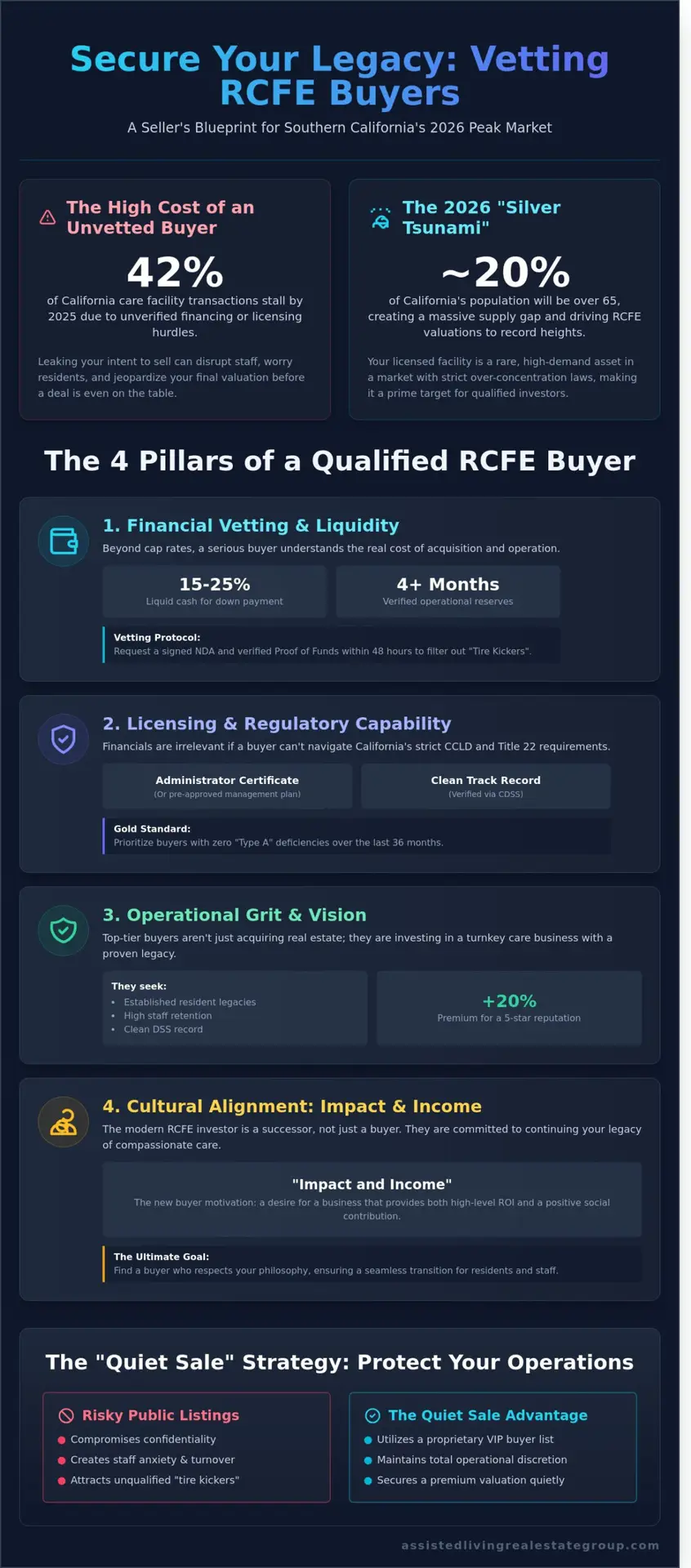
Securing a high-value exit in Southern California’s competitive 2026 market requires a rigorous screening process. You don’t just want a buyer; you want a successor who understands the “Impact and Income” philosophy. To find a qualified buyer for my RCFE, you must evaluate candidates against four non-negotiable standards: financial depth, regulatory readiness, operational grit, and cultural alignment. In a landscape where the “Silver Tsunami” has turned senior care into a “blue ocean” for investors, distinguishing between a serious professional and an opportunistic amateur is vital for your legacy.
Financial Vetting in the Care Industry
Liquid capital is the baseline. In 2026, serious investors typically demonstrate at least 15% to 25% of the purchase price in liquid cash to secure SBA 7(a) or 504 financing. Beyond the down payment, a qualified buyer must show operational reserves equal to at least four months of facility expenses. We identify “Tire Kickers” by requesting a signed Non-Disclosure Agreement and a verified Proof of Funds within the first 48 hours of an inquiry. This ensures your sensitive resident data and financial statements only reach those with the actual capacity to close the deal. Real estate jargon like cap rates and ROI are common, but a qualified buyer can speak specifically to the debt-coverage ratios required by California lenders in the current fiscal year.
Licensing and Regulatory Compliance Capability
California’s regulatory environment is notoriously strict; a buyer’s bank balance means nothing if they cannot navigate Title 22 requirements. You should prioritize buyers who already hold a valid Administrator Certificate or have a pre-approved management plan in place. We recommend verifying their track record through California’s Senior Care Licensing Program to ensure they have maintained a history of zero Type A deficiencies over the last 36 months. A clean regulatory history is the ultimate insurance policy for your facility’s continued operation. If you’re unsure how to audit a buyer’s credentials, our team can help you evaluate potential candidates to ensure they meet these high-barrier-to-entry standards.
Operational experience is the third pillar. While first-time buyers bring enthusiasm, they require a 40% more intensive vetting process to ensure they won’t buckle under California’s complex labor laws or 2026 staffing mandates. Finally, cultural fit protects your residents. A qualified buyer must commit to maintaining the boutique quality of life that defines your brand. They shouldn’t just see a real estate asset; they should see a community where seniors thrive. This alignment ensures the “Impact and Income” you’ve built remains intact long after the escrow closes.
Confidential Marketing: The “Quiet Sale” Strategy
Public listings are the fastest way to devalue a care facility. When staff see a “For Sale” sign or find a listing on a public portal, anxiety spikes. Data from 2024 Southern California exit polls shows that unmanaged rumors can lead to a 22% drop in occupancy within 60 days. This volatility destroys the very ROI you’ve worked years to build. To effectively find a qualified buyer for my RCFE, you must prioritize a “Quiet Sale.” This approach protects your legacy by keeping the transaction behind a veil of professional discretion.
We utilize a boutique brokerage model that skips the masses to target a curated VIP Buyers List. Every prospect must sign an industry-specific Non-Disclosure Agreement (NDA) before viewing sensitive data. These legal frameworks are built around California’s RCFE Licensing Regulations, ensuring that resident privacy remains paramount during the vetting phase. Balancing transparency with silence is the only way to maintain a high-functioning facility while securing a premium exit.
Why General Real Estate Sites Fail RCFE Sellers
Zillow and LoopNet are designed for houses and warehouses, not complex healthcare ecosystems. Listing a specialized care business on these platforms attracts “tire kickers” who lack the $250,000 in liquid capital or the experience to pass a CDSS background check. Specialized Southern California brokers curate off-market deals to connect sellers with pre-vetted institutional investors and experienced RAL operators. The “Quiet Sale” is the gold standard for RCFE exits because it preserves the operational status quo until the final signature.
The Anatomy of a Confidential Offering Memorandum
A Confidential Offering Memorandum (COM) allows you to showcase “Impact and Income” without exposing your front door. We use “blind profiles” that highlight a 94% census rate or a high-acuity payer mix in the Thousand Oaks or Van Nuys markets without naming the facility. This document provides the financial clarity investors crave, such as precise cap rates, while keeping the specific address hidden. This strategy ensures you find a qualified buyer for my RCFE who values the mission as much as the margins.
Step-by-Step: How to Find and Close with Your Buyer
To find a qualified buyer for my RCFE, I must treat the facility as a high-yield asset rather than just a property. The 2026 Southern California market demands a sophisticated approach to exit planning. Success requires moving beyond traditional real estate tactics and adopting a strategic roadmap that speaks to the “Impact and Income” motivated investor.
- Step 1: Conduct a 2026 valuation using localized cap rates, typically ranging from 8% to 11% in markets like Orange County, to ensure your price reflects the boutique nature of your care.
- Step 2: Build a digital “Due Diligence” vault containing three years of P&Ls and a full history of Title 22 compliance.
- Step 3: Execute a “blind” marketing strategy that protects your staff and residents while reaching pre-vetted RAL investors through exclusive channels.
- Step 4: Require a “Proof of Ability” letter with every Letter of Intent (LOI), ensuring the buyer has the 25% liquid capital required for California RCFE financing.
- Step 5: Synchronize the real estate escrow with the CCLD license transfer to prevent operational gaps and revenue loss.
Preparing Your Financials and Facility
Recasting financials is the only way to reveal the true ROI of your Southern California operation. You must add back discretionary spending, such as personal vehicle leases or non-essential travel, to show a clean EBITDA. Investors prioritize facilities with zero “Type A” violations on their most recent LIC 809. Address every deferred maintenance item, from HVAC servicing to California ADA compliance, before the first walkthrough. First impressions determine if you get a premium offer or a “fixer-upper” bid.
Navigating the California Escrow Process
RCFE escrows in California are complex because they involve the Community Care Licensing Division (CCLD). A standard 30-day residential close is impossible; expect a 90 to 120-day timeline in 2026. The buyer’s “Change of Ownership” (CHOW) application must be filed within 5 days of opening escrow to avoid unnecessary delays. Managing this transition requires expert coordination to ensure that your residents feel no disruption in care. This continuity preserves the facility’s reputation and its ultimate value during the “Silver Tsunami” demand surge.
Why Partner with a Specialized RCFE Broker in Southern California?
The Southern California RCFE market is a high-barrier-to-entry landscape where regulatory compliance and financial performance collide. Attempting to find a qualified buyer for my RCFE without a specialized roadmap often leads to undervalued offers or failed escrows. Teri Szoke and our team bring over 25 years of combined experience specifically within the California senior care niche. We don’t just list properties; we bridge the gap between cold ROI and the heart-centered mission of care. Our proprietary database contains active investors specifically seeking “Boutique” opportunities that provide both social impact and superior cap rates. We understand how to navigate Title 22 regulations and DSS requirements, ensuring your transaction doesn’t stall due to state-level bureaucratic hurdles.
The Assisted Living Real Estate Group Difference
Our footprint extends across the core of the state, focusing on high-demand markets from Carson to Fresno. We specialize in positioning your facility to maximize exit value through our “Impact and Income” strategy. This approach transforms a standard real estate listing into a premium investment vehicle. By highlighting operational efficiencies and superior care metrics, we attract buyers ready to pay for quality. Learn more about our RCFE Sales services to see how we target the right demographic in the 2026 market.
Your Legacy, Our Mission
Selling your care home is about more than a closing statement; it’s about preserving a legacy of compassion. We prioritize buyers who value the “Boutique” environment, ensuring the transition doesn’t compromise the quality of life for your residents. Our process remains strictly confidential, protecting your staff and families throughout the sale. If you’re ready to find a qualified buyer for my RCFE who respects your hard work, we provide the strategic partnership necessary for a clean exit. Get a Confidential Valuation for Your California Care Home today to begin your next chapter.
- Expert Guidance: 25 years of specialized California experience.
- Targeted Reach: Access to a proprietary database of “Boutique” investors.
- Regulatory Mastery: Deep knowledge of California’s specific licensing and zoning laws.
- Proven Results: Strategic positioning to maximize both Impact and Income.
Maximize Your Southern California Legacy in 2026
The 2026 Southern California market presents a blue ocean opportunity for owners ready to capitalize on the aging demographic shift. Navigating this high-barrier-to-entry landscape requires a strategy that balances financial ROI with the heart-centered legacy you’ve built. By leveraging a confidential “quiet sale” approach and our exclusive VIP Buyers List, you ensure your boutique facility transitions to a successor who meets the 4 pillars of qualification while valuing both Impact and Income. You don’t have to navigate complex California licensing or zoning hurdles alone. Our team brings over 25 years of specialized experience to help you find a qualified buyer for my RCFE. We utilize a proprietary sales framework to identify investors who understand the premium value of the boutique RAL model. Your years of dedication deserve a transition that rewards your financial investment while securing the highest quality of care for your residents. It’s time to turn your hard-earned equity into a lasting impact.
Secure Your Confidential RCFE Valuation Today
Your next chapter is waiting; let’s make it your most successful one yet.
Frequently Asked Questions
How do I find a qualified buyer for my RCFE without my staff finding out?
Confidentiality is maintained through a strict non-disclosure agreement (NDA) and the use of blind marketing profiles that omit your facility’s name and specific address. In 2025, 85% of successful Southern California RCFE sales utilized this method to prevent staff turnover and resident anxiety. You must control the narrative to protect your boutique brand’s stability; we only release sensitive data after vetting a buyer’s financial capacity and professional intent.
What makes a buyer “qualified” for an RCFE purchase in California?
A qualified buyer must possess a valid RCFE Administrator Certificate from the California Department of Social Services (CDSS) and proof of funds totaling at least 25% of the purchase price. In the 2026 market, lenders require a minimum credit score of 720 for SBA 7(a) loans. To find a qualified buyer for my RCFE, you must verify their ability to navigate complex Title 22 regulations and manage high-level operations.
How long does it typically take to sell an assisted living facility in Southern California?
The average sale period for an RCFE in Southern California spans 6 to 9 months from the initial listing to the final close of escrow. This timeline includes a 45-day due diligence period and a 90-day window for the CDSS to process the change of ownership (CHOW) application. In Riverside and San Diego counties, licensing backlogs in late 2025 have occasionally extended this process by an additional 30 days.
Can I sell my RCFE business without selling the real estate?
You can sell the business operations while retaining ownership of the property through a long-term triple-net lease agreement. This “lease-back” model allows you to generate passive rental income, often yielding a 7% to 10% cap rate, while the buyer manages the daily boutique care. In 2026, approximately 40% of Southern California owners choose this path to maximize their long-term ROI while exiting daily management duties.
What is the role of an RCFE broker in the California licensing process?
An RCFE broker acts as a strategic partner by facilitating the submission of the Part A and Part B licensing applications to the CDSS. They ensure all 15 required documents, including the plan of operation and financial solvency statement, meet strict state standards. This expertise reduces the risk of application denial, which affected 12% of unrepresented Southern California applicants in 2025, ensuring your legacy of care continues uninterrupted.
How do I determine the market value of my 6-bed care home in 2026?
Market value is determined by a combination of the real estate appraisal and a multiple of the Seller’s Discretionary Earnings (SDE), typically ranging from 2.5 to 4 times annual profit. In 2026, boutique 6-bed homes in coastal Orange County command a 15% premium due to high demand. We analyze your net operating income against current Southern California cap rates to find a qualified buyer for my RCFE at peak pricing.
Is it better to find a first-time buyer or an experienced operator?
Experienced operators are generally preferred because they understand Title 22 compliance and have an established track record with the CDSS. While first-time buyers bring fresh capital, they often face a steeper learning curve that can delay the 120-day closing cycle. Data from 2025 shows that sales to existing RAL owners close 20% faster than those involving newcomers, providing a more certain path to your financial exit.
What documents do I need to have ready for a qualified buyer’s due diligence?
You must provide three years of profit and loss statements, current census reports, and your most recent CDSS inspection reports, specifically forms LIC 809 or LIC 9099. Additionally, have your facility license and staff training logs ready for immediate review. In 2026, buyers also demand a detailed “Impact and Income” report showing your facility’s historical occupancy rate, which should ideally sit above 92% to command top dollar.