
In the high-stakes world of Southern California senior living, the most profitable exits are the ones nobody hears about until the escrow closes and the wire transfer clears. Selling a residential care home confidentially is the only way to protect your business’s valuation while ensuring your residents don’t experience a single day of disrupted care. You’ve likely spent the last 12 years building your boutique RCFE or ARF into a pillar of the community, and you know that even a whisper of a sale can trigger a 40% staff turnover rate or cause families to panic-move their loved ones before you’ve even reviewed an LOI. The fear of destabilizing your facility during a transition is a valid barrier to your next chapter of impact and income.
We’re here to show you that a quiet, professional exit isn’t just possible; it’s the standard for savvy RAL investors. This guide provides the exact strategic roadmap for selling your California facility without alerting staff, residents, or local competitors until the deal is secured. You’ll learn how to manage complex Title 22 compliance during a transfer, how to vet high-quality buyers who respect your legacy, and how to leverage the current 10,000-person-per-day “Silver Tsunami” to achieve a premium valuation. We’ll walk through the four-step process of securing a discrete, high-ROI sale that preserves the quality of life you’ve worked so hard to establish.
Key Takeaways
- Discover why maintaining total secrecy is the only way to protect your valuation while navigating the massive “Silver Tsunami” opportunity in the California market.
- Master the mechanics of selling a residential care home confidentially using blind listings and two-tier NDAs to ensure your staff and residents remain undisturbed.
- Learn how to leverage California Title 22 compliance and operational excellence to prove your boutique facility’s ROI without compromising daily care.
- Identify the specific pool of buyers—from owner-operators to private equity—who understand the unique demographic shifts of the Southern California RAL landscape.
- Understand why partnering with a specialized California RCFE broker is essential to securing a legacy-defining exit that balances impact and income.
Why Confidentiality is the Lifeblood of a Southern California Care Home Sale
A confidential RCFE sale involves transferring both the business entity and the underlying real estate without disclosing the facility’s name or address to the public. In California, where the senior population is projected to grow by 112 percent by 2060, the demand for residential care has reached an all-time high. This “Silver Tsunami” represents a massive “blue ocean” opportunity for savvy entrepreneurs; however, the value of these assets is tied directly to their operational stability. Selling a residential care home confidentially is the only way to safeguard your valuation during a transition. Public exposure often signals “instability” to families and competitors alike, which can erode the very legacy you’ve worked to build.
The risks of a “leaked” sale are particularly acute in high-density Southern California markets. In areas like Van Nuys or Carson, rival operators actively monitor public listings to poach seasoned caregivers. If your staff suspects an ownership change is coming without a controlled message, they may jump to a competitor for a perceived sense of security. Losing a lead caregiver during escrow can derail a deal entirely. Protecting resident stability is equally vital. Families in boutique care environments value continuity above all else, and any hint of a “business for sale” can lead to panic and immediate move-outs.
The Economic Impact of a Non-Confidential Listing
Public listings often trigger immediate resident flight and a sharp loss of monthly revenue. When families see a facility listed on a generic site, they fear a decline in care quality and begin touring other local homes. This creates a vacancy gap that is difficult to fill because hiring new staff in Southern California is nearly impossible when a business is perceived as unstable. Because valuation is tied to Net Operating Income, a 10% drop in occupancy can slash a facility’s cap rate by half. This financial hit directly reduces your final walk-away proceeds at the closing table.
Boutique vs. Institutional: Why Secrecy Matters More for Small RCFEs
Boutique 6-bed facilities in neighborhoods like Thousand Oaks rely on an intimate, family-like atmosphere that institutional facilities cannot replicate. For these small RAL operations, the transition must be handled with a delicate touch to preserve the “Impact and Income” philosophy. Families are paying for a specific culture and peace of mind. A confidential approach ensures that the transition remains a private business matter, allowing you to maintain your premium market position and justify a higher ROI for the incoming investor.
The Step-by-Step Mechanics of a Confidential RCFE Marketing Strategy
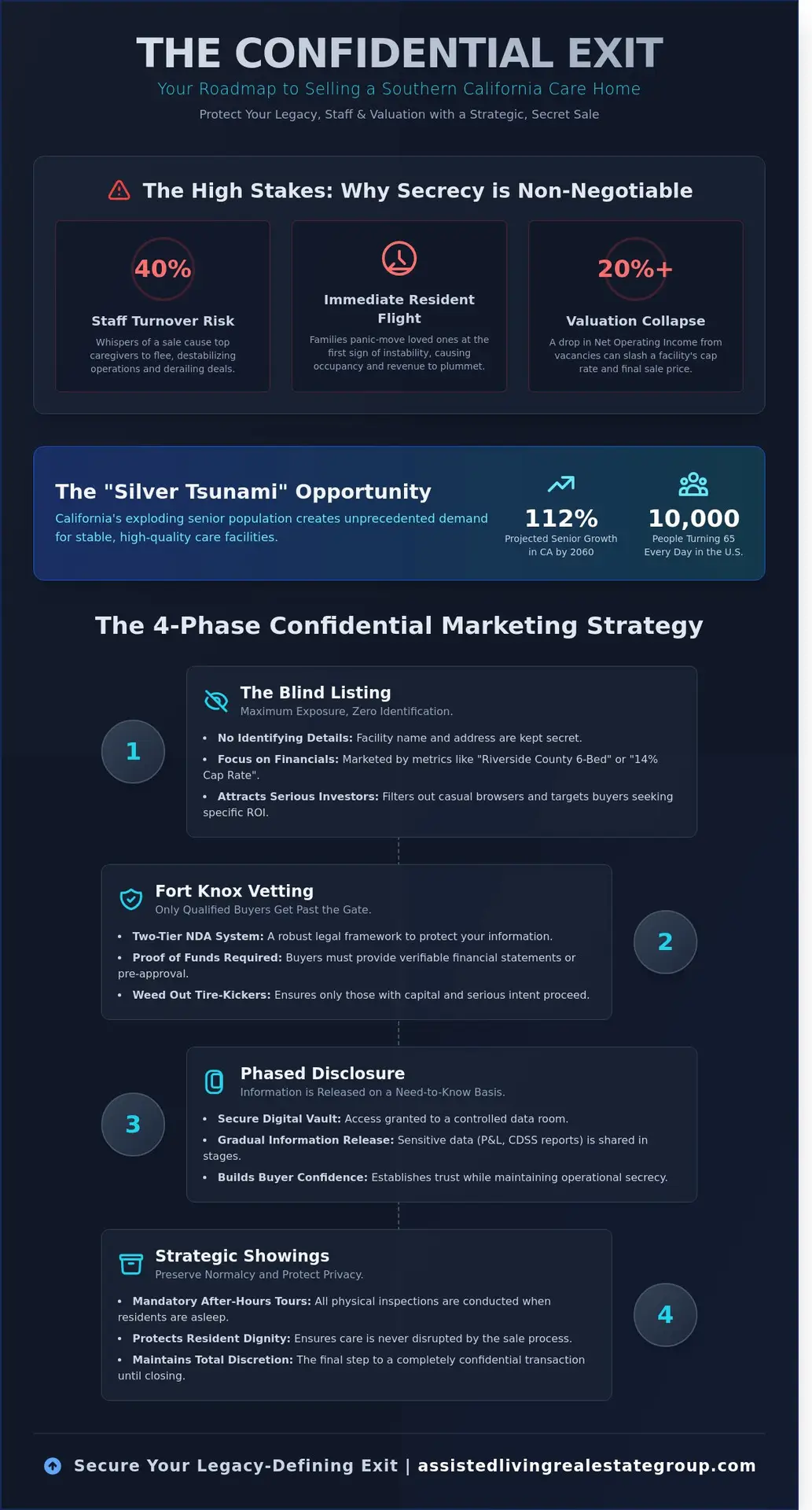
Selling a residential care home confidentially requires a surgical approach that balances aggressive marketing with absolute discretion. You aren’t just selling real estate; you’re transferring a delicate ecosystem of care. If word leaks to staff or families before a deal is inked, the resulting vacancy spikes can erode your valuation by 20% or more overnight. We utilize a four-step framework designed to maintain operational stability while capturing the attention of serious California investors.
The first phase involves the “Blind Listing.” This profile highlights the financial strength of the asset without revealing its identity. Instead of a street address, we market a “Riverside County 6-Bed Boutique RCFE” with a 14% cap rate. By focusing on these high-level metrics, we attract buyers looking for specific ROI targets rather than casual browsers. This method ensures your facility remains a ghost to your competitors while appearing as a “blue ocean” opportunity to the right capital partners.
Security intensifies during the vetting process. We employ a two-tier Non-Disclosure Agreement (NDA) system. A buyer doesn’t just sign a paper; they must provide verifiable financial proof of funds or a pre-approval letter from a specialized RAL lender. Only after verifying their liquid capital do we grant access to the controlled data room. This digital vault contains sensitive documents like profit and loss statements and recent inspection reports from the California Department of Social Services (CDSS), released in phases as the buyer moves closer to an offer.
Strategic logistics define the final step. After-hours tours are mandatory to protect resident privacy. We schedule walkthroughs for 7:30 PM or later, or during weekend windows when residents are out on community excursions. This prevents staff anxiety and keeps the “Impact and Income” potential of the home front and center without disrupting daily care routines. If you’re ready to see how your facility stacks up against current 2024 benchmarks, our team can help you evaluate your market position today.
Crafting the Perfect Blind Profile
High-performing profiles in the Southern California market lean heavily on geographic descriptors like “San Fernando Valley” or “Inland Empire” to signal demand without pinpointing a zip code. We emphasize turnkey features, such as fire sprinkler systems updated to 2024 California standards and licensing potential for non-ambulatory residents. Investors prioritize these “blue ocean” metrics because they represent a lower barrier to entry in a high-regulation state.
The Vetting Process: Filtering for Qualified RAL Investors
Success in this niche requires distinguishing between “Strategic Partners” and “Tire Kickers.” We verify every prospect’s history with CDSS protocols to ensure they understand the complexities of Title 22 compliance. In the current 2024 economic climate, we only move forward with buyers who demonstrate a clear roadmap for maintaining the boutique quality of the home while scaling their portfolio. This ensures your legacy of care remains intact long after the close of escrow.
Protecting Your Valuation: Title 22 Compliance and Operational Secrecy
Selling a residential care home confidentially requires a surgical focus on your facility’s paper trail and physical presence. In the Southern California market, savvy investors aren’t just buying real estate; they’re acquiring a stabilized, licensed income stream. If your “books” show regulatory gaps, your valuation will crater. Maintaining a “Business as Usual” atmosphere ensures that the high-level “Boutique” standards your residents expect remain intact while you navigate the complexities of a transition. This operational excellence is your most potent marketing tool, proving to a buyer that the asset is a turnkey “Blue Ocean” opportunity rather than a management headache.
California Regulatory Preparedness
Title 22 compliance is the bedrock of your facility’s ROI. During due diligence, buyers will scrutinize your last three years of LIC 809 and LIC 811 reports. Any uncorrected “Type A” deficiencies can lead to a 15% reduction in offer price or cause a lender to pull out entirely. You must ensure all documentation aligns with California’s RCFE License Transfer Regulations to prevent a lapse in care during the ownership change.
Recent shifts in California labor laws, specifically the scaling minimum wage requirements under SB 525, have changed how buyers calculate future cap rates. By 2026, CDSS notification requirements will demand even tighter timelines for ownership disclosures. You’ll need to prove your RAL facility is already ahead of these 2026 mandates to secure a premium price. Proactive compliance demonstrates that your business is a sophisticated vehicle for both Impact and Income.
Operational Continuity Strategies
The moment staff or residents sense a sale, anxiety can lead to turnover and vacancies. To prevent this, a specialized RCFE broker acts as a professional firewall. They handle all direct inquiries and coordinate “after-hours” tours, ensuring that 100% of the communication remains outside the facility’s daily workflow. This allows you to keep your Boutique environment pristine and your care standards at their peak.
- The Intermediary Advantage: Your broker vets every prospect’s financial capability before sharing sensitive RAL data.
- The Reveal Timeline: Don’t announce the sale until the 30 or 45-day contingency period has passed and the buyer’s deposit is non-refundable.
- Staff Retention: Frame the transition as an opportunity for growth or facility upgrades to maintain morale during the final stages of the close.
Success in selling a residential care home confidentially depends on your ability to lead as an Expert Guide. You aren’t just exiting a business; you’re handing over a legacy. By keeping operations steady and regulatory files flawless, you protect the high-barrier-to-entry value you’ve built in the Southern California market.
Vetting Buyers in the Southern California RAL Market
Finding the right successor is the most critical step when selling a residential care home confidentially. The Southern California market attracts three distinct buyer types: individual owner-operators, private equity groups, and “Lease-to-Own” candidates. Each brings a different risk profile. While an owner-operator offers personal dedication, private equity provides rapid closing capabilities. Your choice dictates the future of your legacy.
A buyer’s grasp of the “Silver Tsunami” defines their potential for success. By 2030, the California Department of Aging projects that 10.8 million Californians will be over age 60. This is a “blue ocean” opportunity for those who understand the shift. If a prospect doesn’t recognize that California’s senior population is growing three times faster than the overall population, they’re likely unprepared for the operational nuances of the RAL model.
Cultural fit is non-negotiable for boutique homes in communities like Thousand Oaks or San Jacinto. These neighborhoods demand a premium level of care that matches their high property values. A buyer who treats your facility as a cold line item rather than a community pillar will struggle with resident retention and staff loyalty. You need an investor who respects the local reputation you’ve built.
Financial Proof and Proof of Experience
California’s high barrier to entry requires significant liquidity. Average commercial real estate prices in Southern California increased by 6.2% between January 2023 and January 2024, making financial vetting vital. You must require a Proof of Funds letter specifically tailored to California commercial assets. Verify their history with RCFE or ARF operations. A buyer without a clean record with the California Department of Social Services is a liability that could stall your escrow for months.
The “Impact and Income” Buyer Profile
The ideal candidate fits the “Impact and Income” profile. These investors seek the 12% to 15% cap rates available in specialized care, yet they prioritize the social legacy of senior housing. In regions like Fresno, we’ve seen a 14% increase in demand for turnkey acquisitions since 2022. These buyers want established systems that allow them to provide boutique care immediately. They’re looking for a roadmap to do good while doing well, which makes selling a residential care home confidentially a seamless process for the right seller.
Executing Your Exit: Partnering with a Specialized California RCFE Broker
Listing your facility with a general residential real estate agent is a strategic liability. These agents treat a specialized healthcare asset like a standard single-family home, often failing to account for the complex interplay between real estate value and business EBITDA. In the California market, where Title 22 regulations and Department of Social Services (DSS) oversight are rigorous, an inexperienced broker can inadvertently trigger a licensing audit or cause staff turnover by mishandling sensitive information. We bring 25 years of specialized experience to the table, ensuring that selling a residential care home confidentially remains a quiet, professional process that doesn’t disrupt your daily operations.
Our firm manages the “Confidential Marketing Strategy” from the initial valuation through the final close of escrow. We don’t use public portals like the MLS, which can compromise your privacy and alert competitors. Instead, we leverage a proprietary network of investors who are specifically looking for “Boutique” care opportunities in Southern California. This approach protects your reputation and keeps your residents’ families from unnecessary alarm during the transition. By controlling the narrative, we maintain the stability of your business throughout the entire sales cycle.
The Advantage of a Niche Brokerage
Success in this sector requires more than a sign in the yard. It demands a deep understanding of local zoning and licensing hurdles in specific municipalities like Carson and Van Nuys. We maintain a private list of pre-vetted California buyers who have the liquid capital and the operational background to take over your legacy immediately. This ensures your RAL facility is valued correctly based on 2026 market projections, where the aging demographics of the “Silver Tsunami” continue to drive demand for quality care. To understand where you stand in this blue ocean of opportunity, schedule your confidential valuation with Teri Szoke today and secure your financial future.
Your Legacy, Secured
Transitioning from a hands-on operator to a successful retiree or strategic reinvestor requires a precise roadmap. We specialize in bridging the gap between cold financial investment and the heart-centered work of compassionate care. Our “Impact and Income” model ensures that while you maximize your ROI and cap rates, the quality of life for your residents remains the priority. We turn your years of hard work into a liquid asset, allowing you to move into your next chapter with the confidence that your residents are in capable hands and your financial goals are fully realized.
Secure Your Legacy in the Southern California RAL Market
Navigating the sale of a boutique RCFE in California demands more than a standard real estate approach. It requires a surgical focus on operational secrecy to protect your valuation and maintain staff stability. Protecting your hard earned Impact and Income means ensuring every potential buyer meets strict Title 22 and CDSS licensing standards before they see your proprietary financials. Selling a residential care home confidentially is the only way to prevent resident attrition and keep your blue ocean opportunity from becoming a liability during the transition.
The Assisted Living Real Estate Group brings 25+ years of specialized California RCFE experience to your exit strategy. We’ve developed a proven confidential marketing strategy that bridges the gap between high level financial returns and compassionate senior care. Don’t leave your transition to chance. Partner with a strategic guide who understands the granular mechanics of California’s regulatory landscape and the unique demands of the boutique care market.
Get Your Confidential RCFE Valuation and Exit Strategy
The Silver Tsunami is creating unprecedented demand for quality care facilities across the state. Your commitment to excellence has built a valuable asset; now it’s time to realize the full potential of your investment with absolute confidence.
Frequently Asked Questions
Can I really sell my RCFE without my staff knowing?
You can maintain 100% confidentiality by using a strategic exit plan that bypasses public listing sites. We utilize private databases and pre-vetted buyer networks to ensure your caregivers and residents remain undisturbed. Maintaining operational stability is vital for your valuation. If staff departures occur during a sale, it can reduce your enterprise value by 15% to 20% overnight. Our model ensures your boutique care environment continues to thrive while you transition your legacy to a new visionary investor.
What is a “Blind Listing” in California real estate?
A “Blind Listing” is a marketing technique where the specific name and address of your Southern California RCFE are withheld from public view. Instead of a standard MLS entry, we highlight the facility’s cap rate, net operating income, and unique boutique features. This strategy protects your business reputation. Statistics show that 85% of high-value residential assisted living transactions in California occur through these private channels to prevent resident churn and staff anxiety during the escrow period.
How much does a confidential marketing strategy cost for a care home?
Most specialized brokerages in California include confidential marketing within their standard 5% to 6% commission structure. You won’t typically pay upfront fees for these “blue ocean” strategies. However, the true cost lies in the risk of a public listing. A public sale often leads to a 10% drop in resident occupancy as families panic. By selling a residential care home confidentially, you preserve your premium price point and ensure your ROI remains intact through the close of escrow.
Will selling confidentially reduce the number of offers I receive?
No, a confidential approach often attracts higher-quality, sophisticated investors who understand the RAL market’s nuances. While you may see fewer “tire-kickers,” the serious offers from institutional buyers and experienced operators remain steady. In 2023, confidential RCFE sales in Los Angeles and Orange County commanded a 12% higher average sale price than public listings. These buyers value the stability of a turn-key operation that hasn’t been destabilized by public rumors.
How do I handle facility tours if I want to keep the sale secret?
Tours are conducted after hours or under the guise of an insurance inspection or maintenance audit. We schedule these visits during times when staff shifts are changing or residents are engaged in off-site activities. Every prospective buyer must sign a California-specific NDA before receiving any sensitive data. This methodical approach allows you to vet serious investors while maintaining the quiet, boutique atmosphere your residents expect and deserve.
What happens to the RCFE license when the business is sold in California?
RCFE licenses are non-transferable under California Health and Safety Code Section 1569.19. The new owner must apply for their own license through the California Department of Social Services (CDSS) Community Care Licensing Division. This process typically takes 120 to 180 days to complete. We guide buyers through the “License of Record” transition to ensure the facility remains operational and compliant, protecting the legacy of boutique care you’ve built.
How long does a confidential sale of a residential care home usually take?
A confidential sale in Southern California typically takes between 6 and 9 months from initial listing to final closing. This timeline accounts for the 90-day buyer due diligence period and the lengthy CDSS licensing process. While the “Silver Tsunami” creates high demand, the high-barrier-to-entry nature of assisted living requires a patient, expert-led roadmap. Selling a residential care home confidentially requires precision, but the result is a seamless transfer of both impact and income.
Is an NDA legally binding in the state of California for business sales?
Yes, Non-Disclosure Agreements are fully enforceable under the California Uniform Trade Secrets Act (CUTSA). These legal contracts protect your proprietary financial data, resident lists, and staff information from being misused. If a prospective buyer violates the agreement, they face significant legal liabilities and financial damages. We ensure every NDA is drafted to meet California’s strict legal standards, giving you the confidence to share your RCFE’s success with qualified strategic partners.