
The first 90 days of a California RCFE acquisition will either solidify your legacy as a boutique care leader or trigger a costly regulatory spiral that erodes your cap rate before the first month’s rent is even collected. You’ve likely felt the weight of the California CHOW process; a single missing document can delay your licensing transfer by 120 days or more. It’s a high-stakes environment where the “Silver Tsunami” meets the rigorous oversight of the Community Care Licensing Division. To bridge this gap, every savvy investor needs a comprehensive new owner RCFE transition plan that balances clinical excellence with aggressive ROI targets.
We understand that the transition period is often clouded by anxiety over staff turnover and the fear of inherited citations. You believe that achieving “Impact and Income” requires a precise strategic foundation, and you’re right. This guide provides the definitive roadmap to master the complexities of taking over a California care facility while maintaining 100% staff retention. We’ll examine the critical 90-day operational checklist, from securing your surety bond to optimizing your boutique environment for maximum occupancy and long-term stability.
Key Takeaways
- Navigate the critical first 30 days by mastering the California CDSS Change of Ownership (CHOW) process to secure your regulatory foundation.
- Implement a comprehensive new owner RCFE transition plan that prioritizes staff continuity through “Legacy Interviews” and rigorous LIC 508 criminal record audits.
- Protect resident continuity and family trust by systematically reviewing LIC 602 Physician’s Reports and hosting strategic receptions at the 60-day mark.
- Maximize your “Boutique” market positioning in Southern California by updating fire clearances and enhancing common area appeal for high-end families.
- Bridge the gap between current cap rates and pro forma potential by establishing high-value referral partnerships with local California hospitals to drive “Impact and Income.”
Phase 1: Pre-Closing & Regulatory Foundation (The First 30 Days)
Success in the California residential assisted living (RAL) market begins before you ever take the keys. The state’s aging population is growing at an unprecedented rate; 10,000 boomers turn 65 every day. This creates a “blue ocean” opportunity for those who prioritize compliance and quality. A robust new owner RCFE transition plan starts with securing your regulatory foundation with the California Department of Social Services (CDSS). You must finalize the Change of Ownership (CHOW) application immediately to avoid operational gaps that could freeze your cash flow.
- Verify the Administrator Certificate: Check the expiration date on the current certificate. If it expires within the next 90 days, initiate the 40-hour recertification process now to maintain continuous coverage.
- Audit the ‘Plan of Operation’: Review this document against current Title 22 standards. Most legacy facilities operate on outdated protocols that don’t meet the expectations of today’s boutique market.
- Engage your Licensing Program Analyst (LPA): Reach out to your assigned LPA at the local regional office. Building a collaborative relationship ensures you’re viewed as a strategic partner rather than just another file on their desk.
California Licensing & Title 22 Essentials
Submit the LIC 200 form and all required attachments to the Centralized Applications Bureau in Sacramento. Don’t wait for the closing date to discover physical plant issues. Conduct a ‘mock’ Community Care Licensing Division (CCLD) inspection to identify Title 22 deficiencies, such as improper grab bar placement or egress obstructions. Secure a Surety Bond that matches your resident capacity; for a 6-bed facility, California law requires a minimum $1,000 bond to protect resident cash resources.
Financial & Legal Handover
Your goal is “Impact and Income.” This requires a seamless financial handoff that preserves your reputation. Establish new business accounts and merchant processing for resident billing at least 21 days before closing. Transfer utility accounts like PG&E or Southern California Edison to ensure climate control systems remain active for resident safety. Update the Admission Agreement to reflect your new entity name and current market rates. Per Title 22, Section 87507, you must provide residents with a 60-day written notice for rate increases, so integrate this timeline into your new owner RCFE transition plan to hit your ROI targets early.
Phase 2: Staffing & Payroll Transition Checklist
Transitioning an RCFE isn’t just a real estate transaction; it’s a human one. The first 30 days of your new owner RCFE transition plan must focus on stabilizing the workforce that provides the Boutique care your residents expect. Caregivers are the heartbeat of the RAL model, and their buy-in determines your facility’s reputation and long-term ROI.
Start by conducting one-on-one “Legacy Interviews” with every caregiver. These 20-minute sessions allow you to identify who truly embodies your mission of “Impact and Income.” Statistics show that 85% of staff turnover in the assisted living sector occurs during ownership shifts, so listening to their history with residents is vital for retention. Simultaneously, audit all personnel files for updated LIC 508 forms. Every staff member must have a cleared criminal record background check on file before your first unannounced visit from the California Department of Social Services (CDSS).
- Payroll Precision: Implement a payroll system that automates California’s daily overtime laws. In California, any work beyond 8 hours in a single workday requires time-and-a-half pay. Failure to track this accurately can lead to labor board fines exceeding $15,000 per violation.
- Training Compliance: Review the staff training log to ensure every caregiver has completed the 12 hours of initial dementia training required by Title 22. Verify that postural support requirements are documented for any resident utilizing specialized positioning devices.
Securing Staff Loyalty
Hold an all-staff meeting to articulate your vision for a high-end, Boutique environment. Address concerns about tenure and benefits immediately; uncertainty is the enemy of quality care. Identify three “Key Players” who can act as mentors. These leaders bridge the gap between your new operational standards and the established facility culture. If you’re looking to refine your management approach, partnering with an expert guide can ensure your message resonates with seasoned caregivers.
Regulatory Personnel Compliance
Filing the LIC 308 (Designation of Facility Responsibility) is a non-negotiable step in the first 48 hours of operation. You must also verify that 100% of staff have current TB clearances, dated within one year prior to employment or seven days after. Finally, update the LIC 610 Emergency Disaster Plan. This document must reflect your new contact information and updated evacuation protocols to ensure resident safety during a crisis. These steps protect your license and your investment while signaling to the state that you’re a diligent, professional operator.
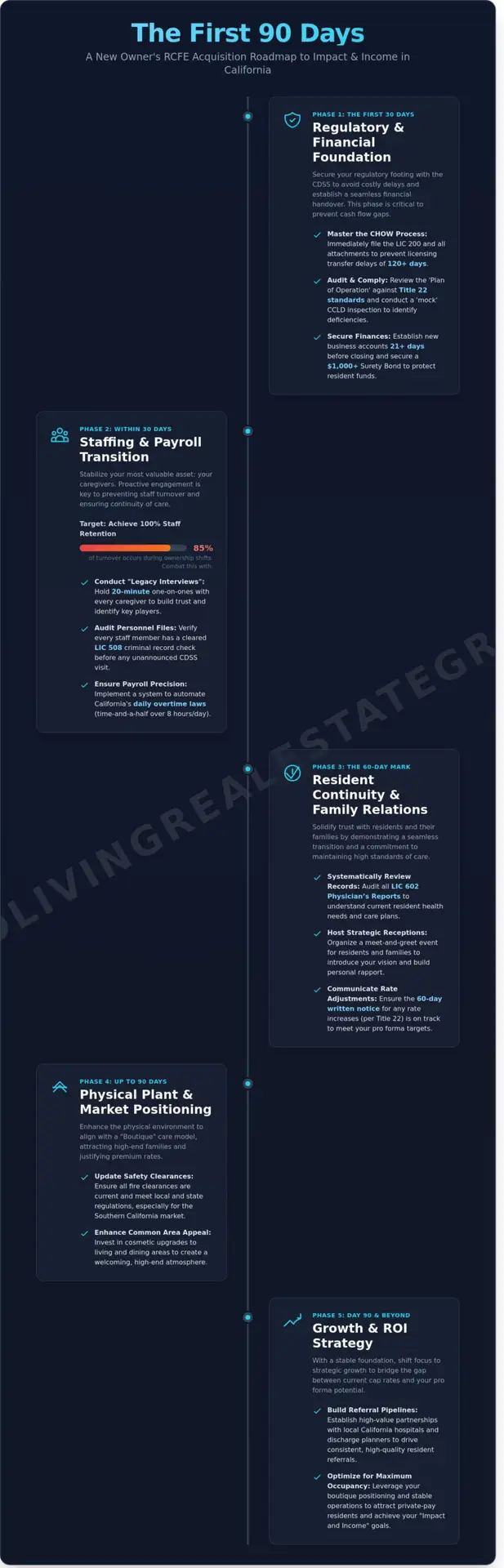
Phase 3: Resident Continuity & Family Relations (The 60-Day Mark)
By day 60, your focus shifts from the ledger to the living room. You’ve secured the asset; now you must secure the trust of those who call it home. This stage of your new owner RCFE transition plan is about bridging the gap between clinical excellence and the boutique experience families expect. Success in the RAL space requires a delicate balance where high-level investment meets heart-centered care.
Your “Meet the New Owner” reception serves as the formal introduction of your vision. Schedule this as a two-hour afternoon event with catered, high-quality refreshments that mirror the premium nature of your facility. It’s a strategic opportunity to articulate your “Impact and Income” philosophy, showing families that their loved ones’ quality of life is the primary driver of your business model. During this phase, you must also execute a deep dive into the following operational pillars:
- Clinical Record Review: Audit every resident’s Appraisal (LIC 603) and Physician’s Report (LIC 602). Ensure these documents are less than 12 months old and accurately reflect the resident’s current acuity level.
- Medication Management: Perform a 100% audit of the Centrally Stored Medication and destruction logs. California Title 22 regulations are strict regarding expired medications and signature gaps; cleaning this up now prevents heavy DSS citations later.
- Lifestyle Programming: Evaluate the activity calendar. Replace passive “TV time” with engagement that justifies a premium price point, focusing on cognitive health and social connectivity.
Building Trust with Families
Transparency is your most valuable currency. Send personalized letters to all family members within the first 14 days of this phase, introducing your management team and detailing your professional background. For residents with high-acuity needs, schedule individual care conferences to discuss specific health goals. If you plan to implement rate adjustments, remember that California law requires a 60-day written notice. Frame these adjustments around tangible facility improvements, such as upgraded common areas or enhanced staffing ratios, to maintain a sense of value.
Care Standards Audit
Regulatory precision is the bedrock of a sustainable new owner RCFE transition plan. You must verify that all postural supports and restricted health conditions have valid, signed waivers on file with the local CCLD district office. Observe a full meal service to ensure dietary restrictions, such as mechanical soft or low-sodium requirements, are followed 100% of the time. Finally, review the LIC 624 incident reporting log for the past 12 months. This reveals patterns in falls or medication errors that occurred under previous ownership, allowing you to implement corrective training before a crisis occurs.
Phase 4: Physical Plant & Southern California Market Positioning
Your real estate is more than a building; it’s a high-performing asset that must command premium rates. In the competitive Southern California market, aesthetics and safety are the twin pillars of your valuation. Successfully executing a new owner RCFE transition plan requires a clinical eye for both the “Boutique” appeal and the rigorous standards of California Title 22. You aren’t just selling care; you’re selling a lifestyle that justifies a high-tier investment.
The Boutique Standard of Care
Families in affluent pockets like Newport Beach or Pasadena expect a residential environment that avoids any hint of institutional coldness. Evaluate your “curb-to-bed” experience immediately. If the landscaping is overgrown or the entryway paint is chipped, you’re losing 15% of your potential lead conversion before the tour begins. Invest in high-impact cosmetic upgrades like premium LVP flooring and modern LED lighting. These aren’t just expenses; they’re strategic moves to justify monthly rates that often exceed $6,500 per resident. Once the physical space reflects excellence, update your digital presence with professional photography that captures this high-end atmosphere.
Safety & Local Compliance
Operational excellence is impossible without unwavering safety protocols. You must coordinate with the local Southern California fire marshal to ensure your fire clearance is current and reflects any recent layout changes. Under California Title 19 regulations, every exit path must be unobstructed and clearly marked. Audit your maintenance logs within the first 30 days. Ensure your HVAC systems are serviced and that water temperatures strictly adhere to the Title 22 mandate of 105°F to 120°F. A robust new owner RCFE transition plan prioritizes these physical plant audits to prevent costly regulatory delays.
Deferred maintenance is a silent killer of cap rates. A faulty emergency call system or a kitchen that fails the 2024 California Retail Food Code standards can trigger a “Type A” deficiency, stalling your momentum. Identifying these issues in the first 60 days allows you to protect your investment and ensure your facility delivers on the promise of “Impact and Income.” Addressing these details now ensures your facility remains a “blue ocean” opportunity rather than a liability.
Phase 5: Growth & ROI Strategy with Assisted Living Real Estate Group
The final stage of your new owner RCFE transition plan shifts focus from stabilization to aggressive optimization. Most investors acquire facilities at a standard 6% to 8% Cap Rate based on historical performance. However, our goal is to move your asset toward a 12% to 15% Pro Forma yield through operational refinements. We analyze your current expenses against Southern California benchmarks to identify where “leakage” occurs, ensuring your boutique RAL operates at peak efficiency.
Occupancy is your lifeblood. We help you move beyond passive lead generation by implementing referral partner programs with major Southern California healthcare systems like UCLA Health, Hoag, and Providence. By targeting discharge planners at these specific hubs, you secure a steady stream of high-acuity leads. This allows you to refine your Ideal Resident Profile, focusing on those who value premium, intimate care over institutional settings. This strategic alignment ensures your facility remains the first choice for families in affluent coastal and suburban markets.
- Analyze the 7% current Cap Rate versus the 14% potential Pro Forma performance.
- Establish formal referral pipelines with discharge planners at Cedars-Sinai and local SoCal hospitals.
- Audit 2024 occupancy trends to ensure your resident mix aligns with your staffing capabilities.
- Utilize our 25 years of California real estate experience to scout your next RAL acquisition.
Maximizing Impact and Income
Generating “Impact and Income” requires a data-driven approach to pricing. In 2023, private pay rates for boutique RCFEs in Los Angeles and Orange County averaged between $6,500 and $9,500 per month. If your rates are lower, you’re missing out on significant NOI. We evaluate the ROI of converting shared rooms into private suites, a move that often increases monthly revenue by $2,000 per room while decreasing the caregiver-to-resident ratio. Every decision serves your long-term Legacy Plan, preparing the asset for a high-value exit or a 1031 exchange into a larger California portfolio.
Your Strategic Partner in California Senior Care
The new owner RCFE transition plan doesn’t end at the 90-day mark. Our consulting services bridge the gap between initial licensing and long-term market dominance. You gain immediate access to our exclusive network of Southern California RCFE vendors, including Title 22 compliance consultants and specialized insurance brokers. We provide the roadmap you need to scale from a single six-bed facility to a multi-location enterprise. Success in this “blue ocean” market requires more than just capital; it requires the seasoned expertise we’ve cultivated over two decades.
Ready to scale your investment? Contact Assisted Living Real Estate Group for a post-closing consultation and secure your position in the California senior care market.
Mastering Your California Boutique Care Legacy
Navigating the first 90 days of facility ownership requires more than just a license; it demands a precise execution of your new owner RCFE transition plan to protect your ROI and your residents. Success in the competitive Southern California landscape hinges on stabilizing staffing within the first 30 days and securing resident trust by the 60-day mark. By the time you reach day 90, your focus must shift from operational survival to market dominance through physical plant upgrades and strategic positioning. Don’t leave your investment to chance when the Silver Tsunami is already reaching California’s shores.
The Assisted Living Real Estate Group brings 25+ years of combined experience to your side, specializing exclusively in the Southern California RCFE and ARF markets. We utilize our proprietary ‘Impact and Income’ roadmap to help you bridge the gap between complex licensing requirements and high-yield financial performance. You can achieve significant cap rate compression while providing the boutique care that California families demand. It’s time to transform your real estate into a mission-driven legacy that serves both your portfolio and your community. We’re ready to guide you through every regulatory hurdle and operational milestone.
Secure Your RCFE Legacy—Schedule a Strategy Session
Frequently Asked Questions
How long does a Change of Ownership (CHOW) typically take in California?
A Change of Ownership (CHOW) in California typically takes between 120 and 180 days from the initial application submission to the California Department of Social Services (CDSS). This timeline depends on the completeness of your LIC 200 form and the current backlog at the local Community Care Licensing Division (CCLD) office. You’ll need to account for this 4 to 6 month window in your new owner RCFE transition plan to ensure a seamless handoff of operations.
Can I operate the RCFE while the license transfer is still pending?
You can’t legally operate under your own entity until the CDSS issues your permanent license; however, you can manage the facility via a formal Management Agreement with the seller. This legal bridge allows you to oversee daily care and financial performance while the state processes your application. Without this agreement, the seller remains 100% liable for all Title 22 compliance and resident safety until the official effective date of your new license.
What are the most common Title 22 citations for new RCFE owners?
The most frequent Title 22 citations for new operators involve Section 87411 regarding Personnel Requirements and Section 87465 for Incidental Medical Services. Data from 2023 CCLD inspections show that 35% of new owners fail to maintain current criminal record clearances or up-to-date TB test results for staff. Another 22% of citations stem from improper medication logging (MARs), which can lead to immediate Type A deficiencies if you don’t correct them within 24 hours.
Do I need to re-hire all the existing staff when I buy a care home?
You’re not legally required to retain the seller’s employees, but keeping seasoned caregivers often preserves the boutique culture and stabilizes resident routines. If you choose to re-hire, every staff member must complete a new criminal record statement (LIC 508) and transfer their fingerprint clearance to your specific facility ID. Your new owner RCFE transition plan should include individual performance reviews during the first 30 days to ensure every team member aligns with your vision.
What is the difference between an RCFE and an ARF in terms of transition?
RCFEs serve adults aged 60 and older under Title 22, Division 6, Chapter 8, while Adult Residential Facilities (ARFs) focus on ages 18 to 59 with developmental disabilities. Transitioning an RCFE requires a focus on dementia care waivers and hospice clearances, whereas an ARF transition often involves Regional Center contracts and individual service plans. The RCFE model typically offers higher ROI potential in California’s current climate as 10,000 seniors turn 65 every single day.
How do I notify the residents’ families about the change in ownership?
California law requires you to provide a written 30 day notice to all residents and their responsible parties before any change in ownership or rate increases occur. We recommend hosting an open house or town hall meeting 14 days after the announcement to introduce your leadership team and discuss your commitment to boutique care. Transparency is the key to maintaining 95% or higher occupancy rates during the transition period and building long term trust.
What specific fire safety clearances are required in Southern California?
You must obtain a fire clearance from the Office of the State Fire Marshal (OSFM) via the STD 850 form before the CDSS will issue your license. In Southern California jurisdictions like Los Angeles or San Diego, inspectors verify that your facility meets R-2.1 occupancy standards, including functional fire sprinklers and interconnected smoke alarms. Expect the fire inspection process to take 30 to 45 days, so schedule your request early to avoid delaying your operational start date.
Is an Administrator Certificate required to be the owner of an RCFE?
You don’t need a California RCFE Administrator Certificate to own the real estate or the business entity; however, you must employ a certified administrator to oversee daily operations. This individual must have completed the 80 hour initial certification program and passed the state exam with a score of 70% or higher. Many savvy investors hire a qualified administrator so they can focus on high level strategy, scaling their portfolio, and maximizing their Impact and Income.