
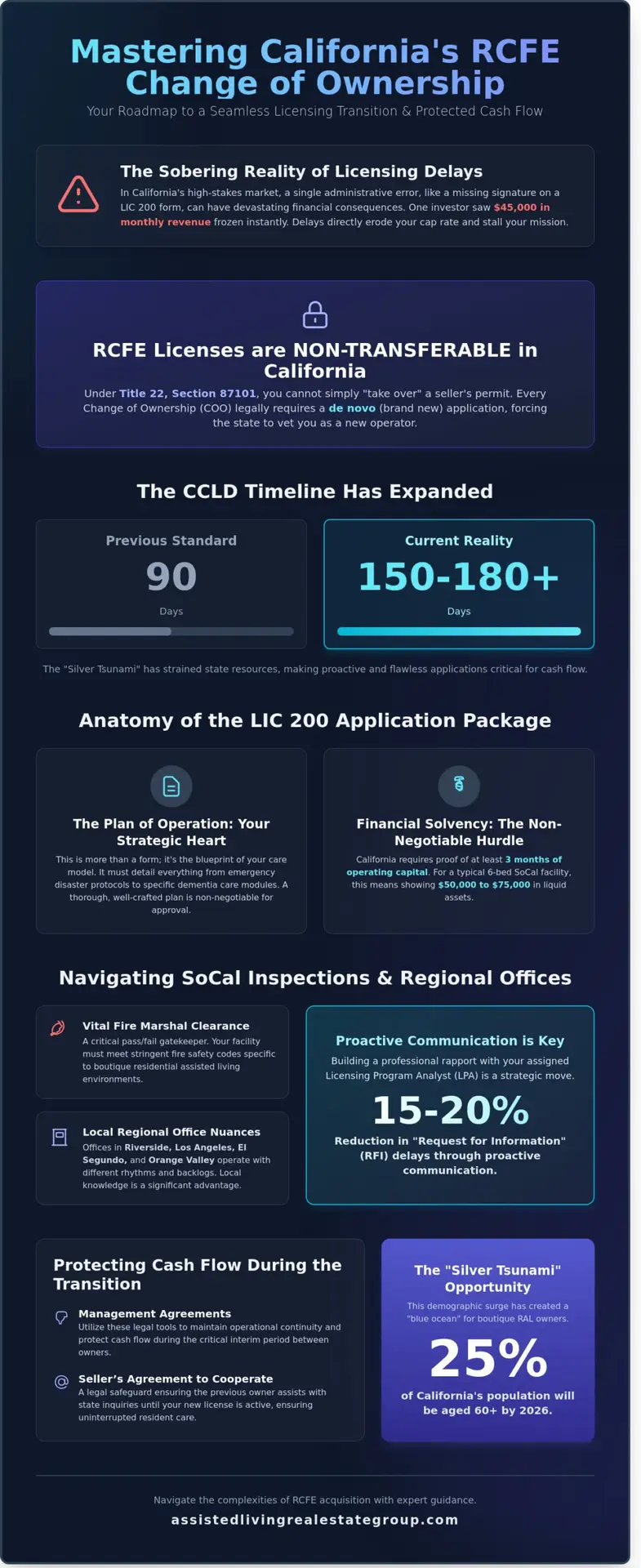
On January 15, 2026, a San Diego investor realized that a single missing signature on a LIC 200 form had effectively frozen $45,000 in monthly revenue. It’s a sobering reality in the high-stakes Southern California market where the “Silver Tsunami” offers a blue ocean of opportunity for those who can master the regulatory gatekeepers. You’ve likely felt the anxiety of staring at a 100-page Title 22 application, knowing that any delay in relicensing an RCFE after purchase directly erodes your cap rate and delays your mission of providing high-end care.
We agree that the licensing process shouldn’t be the bottleneck that stops you from achieving both impact and income. This guide delivers a professional roadmap to master the California Change of Ownership (COO) process, ensuring a seamless transition that protects your facility’s cash flow from day one. You’ll gain a clear 120-day timeline for CCLD approval and specific strategies to pass Fire Marshal inspections in competitive SoCal jurisdictions. We’ll explore the step-by-step requirements to transform a standard acquisition into a fully compliant and highly profitable boutique RAL investment.
Key Takeaways
- Understand why California Title 22 regulations require a de novo application for every change of ownership to ensure your facility remains legally compliant from day one.
- Master the technical complexities of relicensing an RCFE after purchase by prioritizing the “Plan of Operation,” the strategic heart of your LIC 200 application package.
- Navigate the Southern California inspection process, including securing vital Fire Marshal clearances required for boutique residential assisted living environments in local jurisdictions.
- Learn how to utilize Management Agreements to protect your cash flow and maintain operational continuity during the critical interim period between owners.
- Discover how expert RAL brokerage simplifies the “Impact and Income” equation, providing the roadmap needed to capture the massive “Silver Tsunami” opportunity.
Understanding the RCFE Change of Ownership (COO) Process in California
Acquiring a care facility in the Golden State involves two distinct transactions: the physical property and the operational right. Under California Title 22, Section 87101, a Change of Ownership (COO) occurs whenever the legal entity responsible for the facility changes. California law is explicit that RCFE licenses are non-transferable. You cannot simply “take over” a seller’s permit. Instead, relicensing an RCFE after purchase requires a de novo application. This process forces the Community Care Licensing Division (CCLD) to vet you as if the facility were brand new, regardless of its decades-long history in the community.
The “Silver Tsunami” is no longer a distant forecast; it’s a present reality for California investors. By 2026, the California Department of Aging projects that adults aged 60 and older will make up 25% of the state’s population. This demographic surge has created a “blue ocean” opportunity for boutique RAL owners, but it has also strained state resources. Current data shows that processing times at the CCLD have expanded. What used to be a 90-day window now frequently stretches to 150 or 180 days. Understanding these timelines is vital for maintaining your cash flow during the transition. To succeed, you must view Residential Care Facilities for the Elderly as sophisticated healthcare businesses rather than simple rental properties.
The Difference Between Real Estate and Business Licensing
Investors often mistake the deed for the destination. You may own the $2.1 million “bricks and mortar” asset, but the state holds the keys to your revenue. It’s essential to coordinate the close of escrow with the filing of your LIC 200 application. You don’t want a gap where the facility is unlicensed. We recommend a “Seller’s Agreement to Cooperate,” a legal safeguard ensuring the previous owner assists with state inquiries until your new license is active. This protects your ROI and ensures resident care remains uninterrupted.
Identifying Your Local Southern California Regional Office
Your path to licensure runs through specific regional offices in Riverside, Los Angeles, or Fresno. Each office operates with its own rhythm. For instance, the El Segundo office manages a high density of luxury boutique environments and often faces different backlog challenges than the Orange Valley office. Building a professional rapport with your assigned Licensing Program Analyst (LPA) is a strategic move. Data suggests that proactive communication can reduce “Request for Information” (RFI) delays by 15% to 20%. This local expertise is what separates a standard investment from a high-yield legacy project that delivers both impact and income.
The LIC 200 Application: Your Roadmap to a New License
The LIC 200 isn’t just a standard government form. It’s the blueprint for your future boutique care empire. Successfully relicensing an RCFE after purchase requires more than just checking boxes; it demands a strategic presentation of your operational vision. You’ll submit this comprehensive package to the Centralized Applications Bureau (CAB), the California state entity responsible for vetting every new provider. This process is your first opportunity to demonstrate that you can manage the “Silver Tsunami” with both professional excellence and compassion.
Your Plan of Operation serves as the heart of this application. It’s a living document that outlines how you’ll deliver high-quality care while maintaining a profitable RAL model. This plan must detail everything from your emergency disaster protocols to your specific dementia care modules. Investors who treat this as a “fill-in-the-blank” exercise often face lengthy delays. Instead, view it as the foundation of your brand’s legacy.
Financial solvency is a non-negotiable hurdle. California law requires you to prove you have at least three months of operating capital in reserve. For a standard six-bed boutique facility in Southern California, this typically means showing $50,000 to $75,000 in liquid assets, depending on your projected staffing costs and lease payments. If you’re unsure if your current capital stack meets these rigorous requirements, you can consult with our acquisition experts to bridge the gap before you file.
Application fees have increased to reflect the rising costs of state oversight. As of January 1, 2026, the non-refundable application fee for an RCFE with a capacity of 1 to 15 residents is $6,845. Larger facilities with 16 to 49 beds now face a fee of $13,691. These costs represent a small fraction of the potential ROI, but they underscore the need for a “right-first-time” approach to your submission.
Critical Forms You Cannot Afford to Mess Up
Precision is mandatory when handling supplemental documentation. The LIC 215 identifies your administrative structure and board members. It’s vital for ensuring the state knows exactly who’s accountable for the facility’s operations. Meanwhile, the LIC 308 tracks criminal record clearances for every person associated with the home. Finally, the LIC 401 and 403 forms require detailed floor plans and site information. These documents must reflect the physical reality of your boutique environment, including specific measurements for resident bedrooms and common areas.
The Administrator Certification Factor
Your designated administrator is the operational engine of your facility. They must hold a current, valid California RCFE Administrator Certification. When relicensing an RCFE after purchase, you may choose to retain the seller’s administrator or bring in your own. If you’re transferring an administrator, you must submit a formal notice to the Department of Social Services within 30 days. In 2026, all administrators are required to complete 40 hours of continuing education every two years, focusing on evolving topics like antipsychotic medication management and LGBTQ+ resident rights. This ensures your leadership stays at the cutting edge of the industry, maximizing both impact and income.
Southern California Site Inspections: Fire Marshal and Title 22 Compliance
Securing your boutique care home’s future starts with the Pre-Licensing Inspection. This isn’t a mere walkthrough; it’s a rigorous validation of your investment’s safety and viability. Because Title 22 regulations on license transferability state that an RCFE license cannot be handed over to a new owner, relicensing an RCFE after purchase is your first major hurdle. Your Licensing Program Analyst (LPA) will scrutinize your facility to ensure it meets the 2026 standards for dementia-friendly environments. This includes verifying that your physical plant supports the “Impact and Income” model by balancing luxury with high-level safety features like delayed egress and perimeters that prevent wandering.
In jurisdictions like Thousand Oaks, the Fire Marshal’s clearance via the Std. 850 form is the ultimate gatekeeper. Many investors find their timelines stalled by physical plant deficiencies common in older Southern California properties. Homes built before 1980 often lack the 32-inch clear width for doorways required for non-ambulatory residents. You’ll need to address these structural gaps early to capitalize on the “Silver Tsunami” without regulatory delays. Every day your facility sits empty is a day of lost ROI, so your upgrades must be precise and compliant from day one.
Local Fire Marshal Nuances in Southern California
Fire safety codes vary significantly between Riverside and Los Angeles Counties. In San Jacinto, inspectors may focus heavily on brush clearance and exterior defensible space due to high-fire-hazard zones. Conversely, in Carson, the focus often shifts to internal fire suppression and proximity to hydrants. You must call the Fire Marshal at least 30 days before your desired opening date to avoid a bottleneck. For 6-bed RAL homes, an R-3.1 occupancy classification is standard, but if you scale to a 15+ bed facility, you’ll face more stringent R-2.1 requirements. These include specialized fire sprinkler systems that can cost between $15,000 and $40,000 to retrofit.
The Component II and III Inspections
The relicensing process culminates in two distinct phases. Component II is a high-level documentation review and an intensive interview with the applicant. The LPA will test your knowledge of Title 22 and your ability to manage the facility’s unique needs. Component III is the final “Ready for Residents” physical walkthrough. You’ll need to prepare your staff to answer the LPA’s questions about emergency protocols and resident rights with total confidence. Success here transforms your real estate asset into a functioning boutique care environment. It’s the final step in proving that your facility is a “blue ocean” opportunity that provides both superior care and significant financial returns.
Managing the ‘Interim’ Period: How to Operate During a Licensing Transfer
Closing the real estate transaction is only the first milestone. The true challenge lies in the 60 to 120 day window while the California Department of Social Services (CDSS) processes your application. Relicensing an RCFE after purchase requires a precise legal bridge to ensure you don’t lose momentum or revenue. You’re moving from a simple property owner to a steward of a boutique care environment. This interim phase is where savvy investors separate themselves from amateurs by securing cash flow while maintaining strict regulatory compliance.
The Management Agreement Strategy
To keep the doors open and the staff paid, you’ll utilize a Management Agreement. This contract allows you to manage daily operations while the seller remains the “Licensee” of record. It’s a delicate balance. The seller must stay involved enough to satisfy Title 22 requirements, avoiding the “unlicensed operation” citations that can cost $200 per day under California Health and Safety Code 1569.485. You act as the “Operator,” handling the payroll and logistics while the seller provides the regulatory shield. This protects your cash flow and ensures residents receive uninterrupted care. During this phase, you must confirm that your liability insurance covers this specific interim arrangement. Most Southern California carriers require a specific rider that acknowledges the management agreement to prevent coverage gaps during the transition.
Staff Retention and Cultural Transition
Retaining the existing team is essential for a seamless cultural shift. While relicensing an RCFE after purchase, you must audit every Title 22 personnel file to ensure background clearances and health screenings are current. Don’t just keep the status quo. This is your chance to introduce your boutique mission. Use this 90 day period to train staff on higher service standards that justify premium RAL rates. Clear communication with families is equally vital. Transparency about the ownership change builds the trust necessary to prevent resident move-outs during the transition. You’re not just buying a business; you’re inheriting a community. Success means proving that your leadership will enhance their quality of life while securing your investment’s future.
Securing Your Legacy: Why Professional Brokerage Simplifies Relicensing
Southern California’s real estate market is notoriously unforgiving. Success in this niche requires more than just investment capital; it demands a strategic partner who understands that a Residential Care Facility for the Elderly (RCFE) is a complex hybrid of high-stakes healthcare and premium real estate. At Assisted Living Real Estate Group, we specialize in bridging the gap between “Impact and Income.” We ensure your entry into the “Silver Tsunami” isn’t just a financial transaction, but a seamless transition into a high-performing asset.
Selling or buying an active facility requires surgical precision. We utilize confidential marketing strategies to protect the reputation of the business during the transition. If staff or residents discover a sale prematurely, the resulting turnover can decimate your Net Operating Income before you even receive the keys. Our 25-year roadmap provides the expert guidance necessary for a turnkey acquisition, ensuring that relicensing an RCFE after purchase follows a strict, proven timeline that minimizes downtime.
Why a Generalist Realtor is a Risk to Your License
Hiring a standard residential agent for a California care facility is a significant liability. Generalists often overlook critical California Department of Social Services (CDSS) requirements or local Southern California zoning ordinances that restrict fire clearances. These oversights frequently lead to license delays of 180 to 270 days. We identify “red flag” facilities by auditing Title 22 compliance records and inspection reports before you commit. As we approach the 2026 California market, “Boutique” positioning is essential to command premium rates and outperform institutional competitors.
Taking the Next Step in Your RAL Journey
Your success depends on the foundation you build today. Beyond the initial sale, our consulting services guide you through facility setup and operational excellence. We help you navigate the intricate paperwork involved in relicensing an RCFE after purchase while simultaneously optimizing your floor plan for maximum occupancy. Our team ensures your RAL model is built for long-term sustainability and legacy growth.
Build Your Legacy in the Southern California Boutique Care Market
Navigating the LIC 200 application and Title 22 compliance isn’t just a regulatory hurdle; it’s the foundation of your future success. Successfully relicensing an RCFE after purchase requires a 100% commitment to California’s strict Fire Marshal standards and operational continuity. You’ve seen how managing the interim period correctly prevents revenue gaps during the standard 60 to 90 day transfer window. This transition is your chance to transform a simple facility into a high-yield boutique environment that serves the growing Silver Tsunami with excellence.
Don’t leave your ROI to chance in this high-barrier-to-entry market. Our team leverages 25+ years of combined industry experience to guide you through every zoning nuance and licensing requirement. We’re confidential marketing specialists who focus exclusively on California Title 22 compliance to ensure your transition is seamless and profitable. You’re not just buying property; you’re securing a vehicle for significant impact and income. We have the roadmap to help you navigate this blue ocean opportunity with confidence.
Secure Your Southern California RCFE Investment with Our Expert Guidance
Your path to becoming a leader in California’s senior care landscape is ready for you to take the first step.
Frequently Asked Questions
Can I operate an RCFE in California while my license application is pending?
No, you can’t legally operate the facility or provide care until the California Department of Social Services (CDSS) issues a license in your name. Operating without a valid license carries a $200 per day penalty under California Health and Safety Code 1569.40. Most successful investors use a Management Agreement with the seller to maintain operations during the transition. This strategic bridge ensures your boutique RAL continues serving residents while the state processes your paperwork.
How long does the RCFE Change of Ownership process typically take in Southern California?
The relicensing process generally takes between 120 and 180 days to complete. Regional offices in Los Angeles, Orange County, and Riverside handle a high volume of applications, which can impact your specific timeline. You’ll often see delays of 30 to 60 days if your LIC forms contain minor clerical errors. Submitting a meticulous application package is the best way to protect your ROI and hit your operational start dates.
What are the most common reasons CDSS rejects an RCFE license application?
CDSS frequently rejects applications due to insufficient financial reserves or incomplete background clearances. You must prove you have enough liquid capital to cover 100 percent of operating expenses for the first 3 months. Data indicates that 25 percent of Southern California applicants fail because their Plan of Operation doesn’t meet Title 22 standards. Your documentation must be precise to pass this high-barrier entry point and secure your investment’s future.
Do I need a new Fire Marshal clearance if I’m buying an existing licensed facility?
Yes, you must obtain a new fire clearance because the existing one isn’t transferable to a new owner. Even if the building’s physical structure hasn’t changed, the State Fire Marshal must approve the LIC 610FM form specifically for your new entity. Scheduling this inspection in Southern California usually takes 30 to 45 days. This is a critical step in relicensing an RCFE after purchase to ensure resident safety and regulatory compliance.
Is an RCFE license tied to the owner or the property address in California?
The license is tied to both the specific provider and the specific physical location. Under California Health and Safety Code 1569.19, you can’t move a license to a different property or transfer it to a new buyer. This dual-requirement makes relicensing an RCFE after purchase a mandatory hurdle for every entrepreneur. It protects the integrity of the boutique care model by ensuring both the operator and the environment meet state standards.
What is the cost of the RCFE licensing application fee in 2026?
For 2026, the estimated application fee for a 6-bed boutique facility is approximately $3,500, plus an initial annual fee of $1,750. These figures reflect the 10 percent annual increases implemented by the CDSS to manage the growing Silver Tsunami demand. Facilities with 16 to 30 beds should budget over $12,000 for these initial state fees. Accurate budgeting for these costs is vital for maintaining your projected cap rates and overall financial health.
Can I change the facility’s capacity (bed count) during the relicensing process?
You can request a capacity change, but it typically adds 60 to 90 days to your approval timeline. Increasing a 6-bed home to 7 or more residents triggers different fire safety requirements, including R3.1 occupancy standards and expensive sprinkler mandates. Since 85 percent of RAL investors prefer the boutique 6-bed model for its zoning advantages, most experts suggest securing the original license count first before applying for an expansion later.
What happens to the residents if my license application is denied after I purchase the property?
If your application is denied, the seller remains legally responsible for the residents until they’re safely relocated. California law requires a 30-day written notice to residents before a facility can close its doors. To mitigate this risk, your purchase agreement should include a contingency clause linked to the CDSS “Letter of Intent to Approve.” This protects your capital and ensures you’re only committed once the path to “Impact and Income” is clear.