
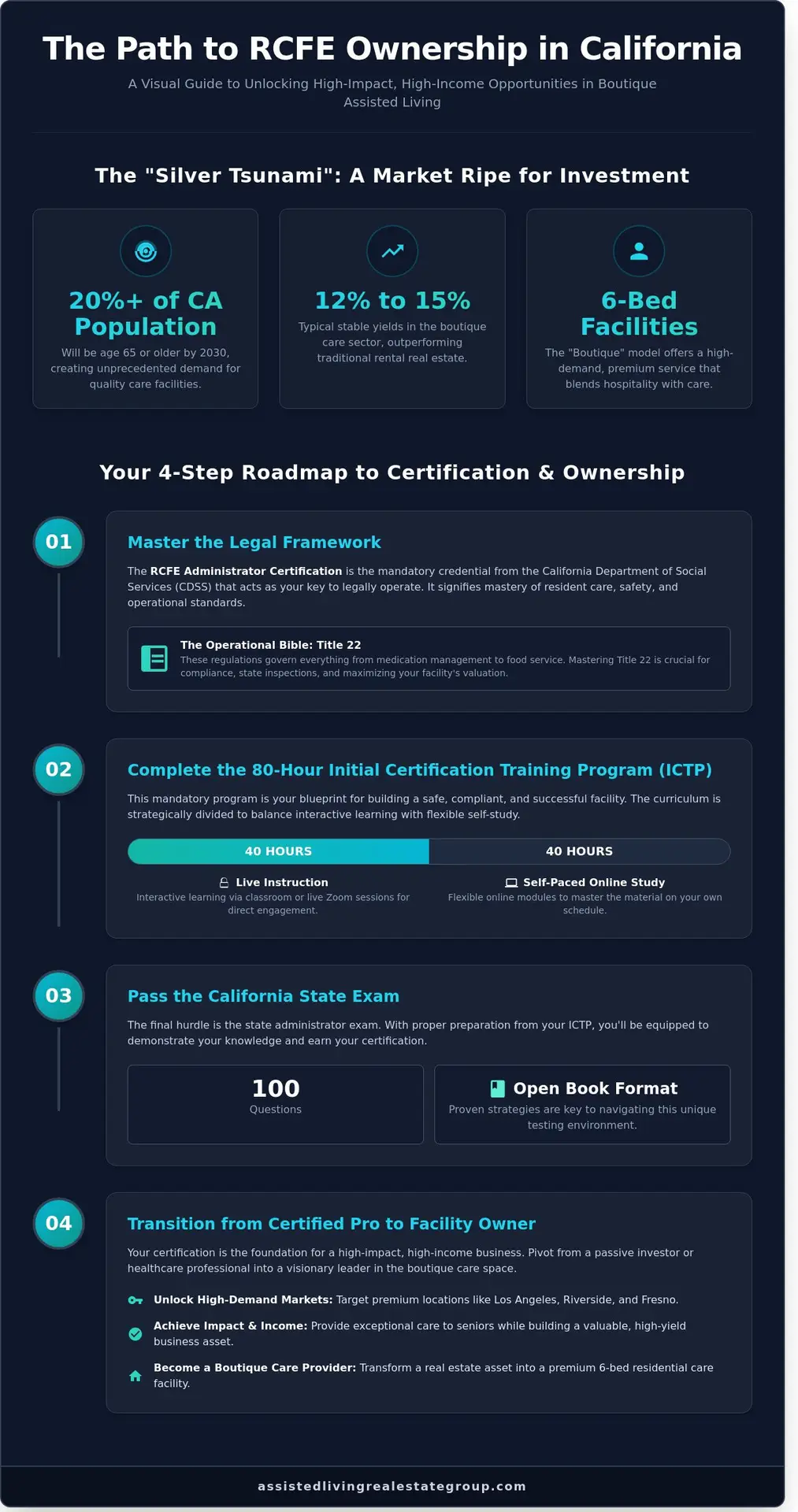
By 2030, over 20 percent of California’s population will be age 65 or older, yet the supply of boutique, 6-bed residential care facilities remains drastically behind the curve. You likely recognize that this demographic shift represents a massive blue ocean opportunity for real estate investors. However, the daunting complexity of Title 22 regulations and the mandatory RCFE administrator certification course often feel like an insurmountable barrier. It’s frustrating to see high-ROI potential sidelined by the fear of failing a state exam or getting lost in the bureaucratic maze of the Department of Social Services.
This guide will provide you with a clear roadmap to secure your license and master the 80-hour training requirement. You’ll learn how this single certificate unlocks the door to owning a premium RAL facility in high-demand markets like Riverside, Los Angeles, and Fresno; this allows you to achieve both impact and income. We’ll break down the 2026 certification requirements, identify the best local vendors, and show you exactly how to pivot from a passive investor to a successful boutique care provider.
Key Takeaways
- Position yourself at the forefront of the “Silver Tsunami” by securing the mandatory CDSS credential required to operate high-ROI boutique care facilities in California.
- Master the breakdown of the 80-hour Initial Certification Training Program (ICTP), including the strategic split between live sessions and self-paced online learning.
- Identify the most reputable CDSS-approved vendors for your RCFE administrator certification course within Southern California’s primary investment hubs like Los Angeles and Riverside.
- Learn how to successfully navigate the 100-question California State Administrator Exam using proven strategies for the unique “Open Book” testing format.
- Transition from a healthcare professional to a visionary owner by using your certification as the foundation for a high-impact, high-income Residential Assisted Living (RAL) business.
What is the RCFE Administrator Certification in California?
The RCFE Administrator Certification is the essential credential for anyone seeking to lead a Residential Care Facility for the Elderly within the state. It’s a mandatory requirement enforced by the California Department of Social Services (CDSS) through the Community Care Licensing Division. This isn’t just a piece of paper. It represents a deep understanding of the health, safety, and psychosocial needs of California’s aging population. For investors, this certification is the gatekeeper to a “blue ocean” opportunity in the Southern California market, where the demand for premium care continues to outpace supply.
The CDSS mandates this credential to ensure that every facility, whether a 100-bed institution or a 6-bed luxury home, maintains a baseline of quality and safety. In the context of Residential Care, the administrator holds the legal responsibility for the facility’s daily operations. They manage the intersection of “Impact and Income” by ensuring residents receive premium care while the business maintains a healthy bottom line. Without this certification, an operator cannot legally oversee the care of even a single resident, making it the foundational step for any RAL venture.
Operating a “Boutique” 6-bed care home is fundamentally different from managing a large-scale hospital or a traditional nursing home. In a boutique environment, the administrator is a hands-on leader who bridges the gap between hospitality and clinical oversight. You aren’t just a cog in a corporate machine; you’re the architect of a resident’s daily experience. This role differs from standard healthcare management because it requires a focus on residential intimacy rather than institutional volume. Completing a state-approved RCFE administrator certification course provides the technical knowledge to navigate this nuanced environment successfully.
The Legal Foundation: Title 22 Regulations
California Title 22, Division 6, Chapter 8 serves as the operational bible for every Southern California operator. These regulations dictate everything from food service standards to medication management protocols. Understanding these rules is critical because compliance directly dictates facility valuation. A facility with a clean CDSS record in Los Angeles or Orange County can command a significantly higher cap rate than one plagued by citations. Investors who master Title 22 transform a simple real estate asset into a high-value RAL business that stands up to rigorous state inspections.
Who Should Get Certified in 2026?
The “Silver Tsunami” isn’t a future threat; it’s a current reality. By January 2026, the demand for high-quality care in Southern California will reach a new peak as 10,000 Americans turn 65 every day. Entrepreneurs should enroll in an RCFE administrator certification course now to capture this market share. Real estate investors are increasingly transitioning into the RAL space to escape the volatility of traditional rentals, seeking the stable 12% to 15% yields common in the boutique care sector.
Family members taking over legacy businesses in Fresno or Van Nuys also need this certification to maintain their family’s “Impact and Income” legacy. With a 20% projected growth in California’s 85+ demographic by 2030, this certification isn’t just a legal requirement. It’s a strategic asset for those who want to do good while doing well. Whether you’re a seasoned real estate pro or a compassionate newcomer, this credential is your roadmap to success in the California care industry.
The 80-Hour Initial Certification Training Program (ICTP)
Securing your seat in a state-approved RCFE administrator certification course is the first move toward capturing the massive potential of the “Silver Tsunami.” The State of California mandates a rigorous 80-hour training protocol designed to ensure that every administrator can balance high-level operations with the delicate needs of senior residents. The ICTP serves as the mandatory gateway to California care facility licensure, ensuring every administrator possesses the technical foundation to manage a safe, compliant environment. This isn’t merely a bureaucratic hurdle. It’s your blueprint for building a legacy of care while securing a high-yield asset in the boutique assisted living space.
The 80-hour requirement is strictly divided to accommodate both structured learning and flexible study. You’ll complete 40 hours in a “Live” format, which currently includes interactive Zoom sessions or traditional in-person classroom settings. The remaining 40 hours are dedicated to self-paced online modules. This hybrid structure respects your time as an entrepreneur while maintaining the integrity of the educational process. As you review the Administrator Certification Initial Procedures, you’ll see that the California Department of Social Services (CDSS) requires this specific split to ensure real-time engagement with instructors. In 2026, the estimated cost for a comprehensive RCFE administrator certification course ranges from $750 to $1,200, depending on the provider’s depth of supplemental resources and post-course support.
Core Curriculum: What You Will Learn
The curriculum is designed to transform investors into sophisticated care providers. You’ll spend 15 hours focused exclusively on dementia care, learning to manage the cognitive and postural support requirements for high-acuity residents. This training allows you to command a premium for specialized memory care services in your boutique facility. Another 8 hours are dedicated to medication management, a critical area where operational precision directly impacts resident safety and facility liability. You’ll also master California labor laws, including specific regulations regarding overtime and shift differentials that differ significantly from other states.
Business operations form a cornerstone of the training. You’ll analyze staffing ratios that optimize care without eroding your ROI. You’ll also learn the intricacies of resident admission agreements, which are the legal backbone of your revenue stream. Because you’re operating in Southern California, the training includes vital emergency preparedness modules. These cover fire safety and seismic requirements specific to the region’s geological risks, ensuring your facility remains a sanctuary even during a crisis. This level of preparation turns a potential liability into a market-leading advantage.
ICTP Requirements and Prerequisites
The prerequisites for enrollment are straightforward but non-negotiable. You must be at least 21 years old and possess a high school diploma or GED. While a background in healthcare or real estate isn’t required, it provides a significant head start. Choosing between a live stream and an in-person experience is a strategic decision. Live stream options provide the convenience required by busy professionals, while in-person classes offer networking opportunities with other Southern California investors. This network is often where the best “off-market” RAL deals are discussed. If you’re ready to move from the sidelines to the center of the action, you can explore our strategic roadmap for launching your first boutique facility. Success in this “blue ocean” market depends on your ability to combine “Impact and Income” through superior education and operational excellence.
Choosing the Right Vendor in Southern California
Selecting a training provider is more than a check-the-box exercise; it’s a strategic investment in your RAL venture. To ensure your 80-hour RCFE administrator certification course holds weight, you must verify the vendor’s current standing with the California Department of Social Services (CDSS). As of late 2024, the CDSS maintains an updated list of approved vendors authorized to provide instruction through 2026. You can verify a vendor’s status by cross-referencing their license number against the Administrator Certification Bureau’s official registry. This step prevents the 15% risk of enrolling in a lapsed program that the state won’t recognize during your licensing phase.
Regional training hubs in Los Angeles, Riverside, and the Central Valley offer distinct advantages for local operators. Los Angeles remains the primary corridor for high-end boutique training, while Riverside serves as a critical nexus for Inland Empire investors. When evaluating reputation, look for vendors with a 4.5-star rating or higher from existing RCFE owners. These peers understand the nuances of the “Silver Tsunami” and can identify which instructors provide practical operational wisdom versus those who merely read from a slide deck.
Tuition fees for a quality RCFE administrator certification course typically range from $550 to $850. While low-cost options exist, top-tier vendors include physical copies of the Title 22 California Code of Regulations handbooks. These manuals are essential for passing the state exam and serve as the daily manual for your facility’s compliance. Choosing a vendor that provides these materials saves you the $40 to $60 cost of purchasing them separately from the state printer.
Local Training Opportunities in the Inland Empire and LA
Proximity matters for networking. Finding classes near San Jacinto, Carson, and Thousand Oaks allows you to build relationships with local Southern California operators who understand the specific zoning and fire safety requirements of these municipalities. Hybrid models are increasingly popular, allowing you to complete 40 hours of online coursework while attending the remaining 40 hours in person. This blend offers the convenience of digital learning with the high-level mentorship found in face-to-face interactions.
Post-Certification Support: Beyond the Classroom
The best vendors don’t disappear once you receive your certificate. Look for partners that offer comprehensive assistance with your initial licensure. This includes providing direct access to the Administrator Certification Application Forms needed to finalize your credentials. A vendor’s ability to help you navigate the LIC 9214 form can reduce application processing times by up to 30 days. This acceleration is vital when you’re carrying the holding costs of a property.
Exceptional training providers also offer a clear path for your 40 hours of required Continuing Education Units (CEUs) every two years. They should demonstrate a deep understanding of the “Boutique” care model, focusing on how to maximize ROI through high-acuity, specialized services. This ensures your education supports both your mission and your bottom line, truly embodying the “Impact and Income” philosophy. Seek out mentors who view certification as the beginning of a long-term strategic partnership rather than a one-time transaction.
The California RCFE State Exam and Application Process
Securing your license is the final hurdle before you can capitalize on the Southern California senior housing market. You’ve completed your 80-hour initial training; now you must prove your competency to the California Department of Social Services (CDSS). The state exam consists of 100 multiple-choice questions designed to test your mastery of Title 22 regulations. While it’s an open-book test, don’t let that fool you into complacency. The clock is your primary enemy. You have a three-hour window to locate specific regulations within massive reference binders. A passing score of 70% is mandatory. If you fail three times, California law requires you to retake the entire initial training program from scratch, costing you both time and capital.
Registration for the exam requires a $100 fee paid directly to the CDSS. Beyond the written test, the state demands a rigorous background check. You must complete a LiveScan fingerprinting process at a certified California DOJ location. This background clearance is non-transferable; even if you hold a professional license in another field, you must clear the Care Provider Management Bureau (CPMB) database specifically for this RCFE role. This ensures every leader in the boutique RAL space meets the highest ethical standards for resident safety.
Exam Preparation Strategies
Success on the state exam depends on your ability to navigate the DSS Evaluator Manual and Title 22 effectively. Smart candidates focus 60% of their study time on high-weight topics like Resident Rights and Medication Management, as these sections carry the most points. You should use a tabbing and indexing system for your reference materials to shave seconds off every question search. Investing in a high-quality RCFE administrator certification course ensures you have these indexed materials ready for the open-book format. Remember, you must take this exam within 60 days of completing your initial training. Missing this window invalidates your training certificate, forcing a total restart of the 80-hour requirement.
Submitting Your Application to the CCLD
Once you receive your passing score via mail, the 30-day countdown begins. You must submit your formal Administrator Certificate Application (Form LIC 9214) to the Community Care Licensing Division (CCLD) within this month-long window. The CCLD acts as the regulatory gatekeeper, overseeing more than 7,500 RCFEs across California. Common mistakes, such as missing signatures or using an outdated LiveScan form, can delay your license by 90 days or more. These delays are expensive when you’re carrying a mortgage on a vacant boutique facility. Ensure your application includes the $100 processing fee and proof of your RCFE administrator certification course completion to avoid administrative bottlenecks. This precision allows you to pivot quickly from a student mindset to an operational leader, ready to provide high-quality care in a competitive market.
The “Silver Tsunami” is creating a massive demand for high-end residential care in Southern California. If you’re ready to master the regulatory landscape and build a legacy of care, now is the time to scale your boutique RAL portfolio with expert guidance.
From Certified Administrator to Facility Owner
Your journey doesn’t end with a certificate; it begins there. Completing an RCFE administrator certification course provides the legal foundation, but the true wealth is built through ownership. Most administrators spend years managing facilities for others, essentially trading their expertise for a fixed salary while the owner captures the equity. Transitioning to a “Boutique” facility owner allows you to control the quality of care while building a legacy of Impact and Income. It’s a shift from being a cog in a corporate machine to becoming the architect of a high-value healthcare asset.
The move from employee to entrepreneur is a strategic pivot. You’re no longer just managing staff; you’re scaling a specialized real estate asset. In Southern California, the demand for intimate, high-end residential assisted living (RAL) far outpaces the supply of institutional nursing homes. This gap creates a blue ocean opportunity for savvy professionals who understand that smaller, 6-bed environments offer the privacy and dignity that modern families demand. These boutique settings often command premium rates, frequently 20% to 30% higher than traditional facilities, because they offer a superior quality of life.
Investing in Southern California Senior Care
California’s demographic shift is undeniable. The California Department of Finance projects the state’s 65 and older population will reach 9.2 million by 2030. This “Silver Tsunami” isn’t a crisis for the prepared; it’s a massive market expansion. In regions like Fresno and Van Nuys, the demand for RCFE beds has seen a 14% increase in inquiries over the last 24 months alone. Investors are currently seeing cap rates between 8% and 11% for stabilized 6-bed residential care homes, which significantly outperforms traditional multifamily real estate in the same zip codes. These properties offer a recession-resistant hedge because the need for care isn’t dictated by the stock market.
Starting a facility from scratch often takes 12 to 18 months when you account for zoning, renovations, and the rigorous CDSS licensing process. Buying an established RCFE allows you to bypass these hurdles. You acquire a turnkey operation with existing residents, trained staff, and a history of cash flow. It’s the fastest way to move from a student in an RCFE administrator certification course to a profitable business owner. By purchasing an existing facility, you’re buying time, which is the most valuable asset in a rapidly growing market.
Your Strategic Partner in RCFE Sales
Assisted Living Real Estate Group acts as your expert guide through this complex landscape. We leverage 25 years of specialized experience to connect you with opportunities that never hit the public market. Our portfolio includes confidential listings and unique lease-to-own arrangements that lower the barrier to entry for first-time owners. We understand the nuances of California Title 22 regulations and how they impact the valuation of a property. Our team vets every listing to ensure the physical plant and the business operations meet our high standards for ROI and care quality.
We don’t just sell buildings; we facilitate the acquisition of a mission-driven business. Whether you’re looking for a luxury estate in Van Nuys or a high-occupancy home in Fresno, our team provides the roadmap for your transition. The opportunity to do good while doing well is waiting for those ready to take the lead. Ready to find your first RCFE facility? Browse our California listings today.
Own the Future of California Senior Housing
The “Silver Tsunami” isn’t just a trend; it’s a massive shift that will redefine the state’s housing landscape by 2026. Completing your RCFE administrator certification course is the vital first step to navigating the California Department of Social Services (CDSS) mandatory 80-hour training and state exam. This credential transforms you from a spectator into a qualified leader ready to manage a “Boutique” 6-bed residential assisted living facility. Success in this high-barrier-to-entry market requires a roadmap that balances strict Title 22 compliance with sophisticated real estate acquisition. We focus on the “Impact and Income” model, ensuring your investment serves a greater purpose while delivering superior returns. Leveraging our 25+ years of combined experience in the California care facility sector, we guide you through the transition from a certified administrator to a confident facility owner. Our team provides the confidential marketing expertise necessary to secure your legacy in this blue ocean opportunity.
Start your journey toward RCFE ownership with our expert brokerage services.
The California market is waiting for visionary leaders like you to step up and build something truly meaningful.
Frequently Asked Questions
How long does it take to get RCFE certified in California?
Expect to spend 4 to 6 weeks completing the mandatory 80-hour RCFE administrator certification course and passing the state exam. California’s Department of Social Services (CDSS) mandates 40 hours of live instruction and 40 hours of self-study. Once you finish the training, you’ll schedule the exam, which typically occurs within 30 days of your application submission. This timeline represents the first step toward capturing the boutique care market in Southern California.
Can I take the RCFE administrator course entirely online in 2026?
You can complete 50% of the training online, but California law still requires 40 hours of live, in-person or real-time webinar instruction. By 2026, the CDSS continues to uphold these rigorous standards to ensure high ROI for residential assisted living investors. You won’t find a 100% self-paced online option because the state demands interactive learning for those managing high-barrier-to-entry boutique environments. It’s a necessary commitment to ensure your facility stands out in the blue ocean of senior care.
What happens if I fail the California RCFE state exam?
If you fail the exam, you have two additional opportunities to retake the test within 60 days of your initial course completion. Each retake requires a $100 fee paid directly to the CDSS. If you don’t pass after three attempts, you’re required to repeat the entire 80-hour training program. Success is vital to navigating the Silver Tsunami and securing your position in the profitable RAL sector, so thorough preparation is your best strategy for long-term impact and income.
How much does the RCFE administrator certification cost in total?
The total investment for certification ranges from $1,200 to $1,800 depending on your choice of training provider. This budget includes approximately $600 for the RCFE administrator certification course, a $100 state exam fee, and $110 for Department of Justice and FBI fingerprinting. While these upfront costs exist, they’re a minor fraction of the potential cap rates achievable in a well-managed Southern California boutique care facility. This small entry price opens the door to a massive real estate opportunity.
Do I need to be a nurse to be an RCFE administrator in California?
You don’t need a nursing degree or a medical background to become a certified RCFE administrator in California. The state requires you to be at least 21 years old and possess a high school diploma for facilities with 15 or fewer residents. For larger boutique environments, you’ll need 2 years of college or equivalent experience. This accessibility allows savvy entrepreneurs to achieve significant financial returns without a clinical license, focusing instead on high-level management and compassionate care.
How often do I need to renew my RCFE administrator certificate?
You must renew your RCFE administrator certificate every 2 years to remain compliant with California Title 22 regulations. Renewal requires completing 40 hours of continuing education units (CEUs) and paying a $100 fee to the CDSS before your current certificate expires. Staying current ensures your facility maintains its premium market position. It also ensures you continue to provide a high quality of life for seniors while protecting your financial legacy and investment portfolio.
What is the difference between RCFE and ARF certification?
Residential Care Facilities for the Elderly (RCFE) serve residents aged 60 and older, while Adult Residential Facilities (ARF) focus on adults aged 18 to 59 with disabilities. Choosing the RCFE path positions you to capitalize on the aging demographics of the Silver Tsunami in California. The RCFE model is specifically designed for the boutique assisted living market. It offers a clear roadmap to higher ROI through specialized senior care and luxury residential environments.
Can I manage multiple RCFE facilities with one certification?
You can manage more than one facility if the total number of residents across all locations doesn’t exceed 15 people. For larger operations, the CDSS requires a designated manager for each site to ensure safety and operational excellence. This structure allows strategic partners to scale their boutique care portfolio across Southern California while maintaining the high standards that justify premium pricing. It’s a proven way to expand your impact and income within a niche market.