
The “Silver Tsunami” is no longer a distant forecast; it’s a 2026 reality that has transformed Southern California’s residential care market into a high-stakes blue ocean opportunity. Knowing how to value an assisted living facility in this climate is the difference between a standard exit and a legacy-defining windfall. You understand that running a boutique 6-bed RCFE in cities like Van Nuys or Fresno is a delicate dance between Title 22 compliance and operational excellence. You’ve likely felt the pressure of calculating a precise EBITDA while worrying if a single staff departure might devalue your investment in a market where a 1% shift in cap rates can equal a $200,000 swing in value.
This guide provides the specialized roadmap you need to bridge the gap between cold financial metrics and heart-centered care. You’ll learn exactly how to synthesize real estate value with business performance to achieve a defensible valuation for your next financing round or exit. We’ll explore current market data to help you maximize “Impact and Income” while navigating the high-barrier-to-entry world of California RAL.
Key Takeaways
- Identify the “Hybrid Asset” advantage and why Department of Social Services (DSS) compliance is the foundation of your facility’s legitimacy in the California market.
- Master the financial mechanics of how to value an assisted living facility by applying 2026-specific EBITDA multiples and cap rates tailored for the Southern California market.
- Unlock the “Compliance Premium” to learn how a deficiency-free record and high occupancy velocity can add significant percentage-based gains to your final sale price.
- Navigate the specialized Broker Price Opinion (BPO) process to bridge the gap between technical financial ROI and your heart-centered legacy of boutique care.
Understanding Assisted Living Valuation in the California Market
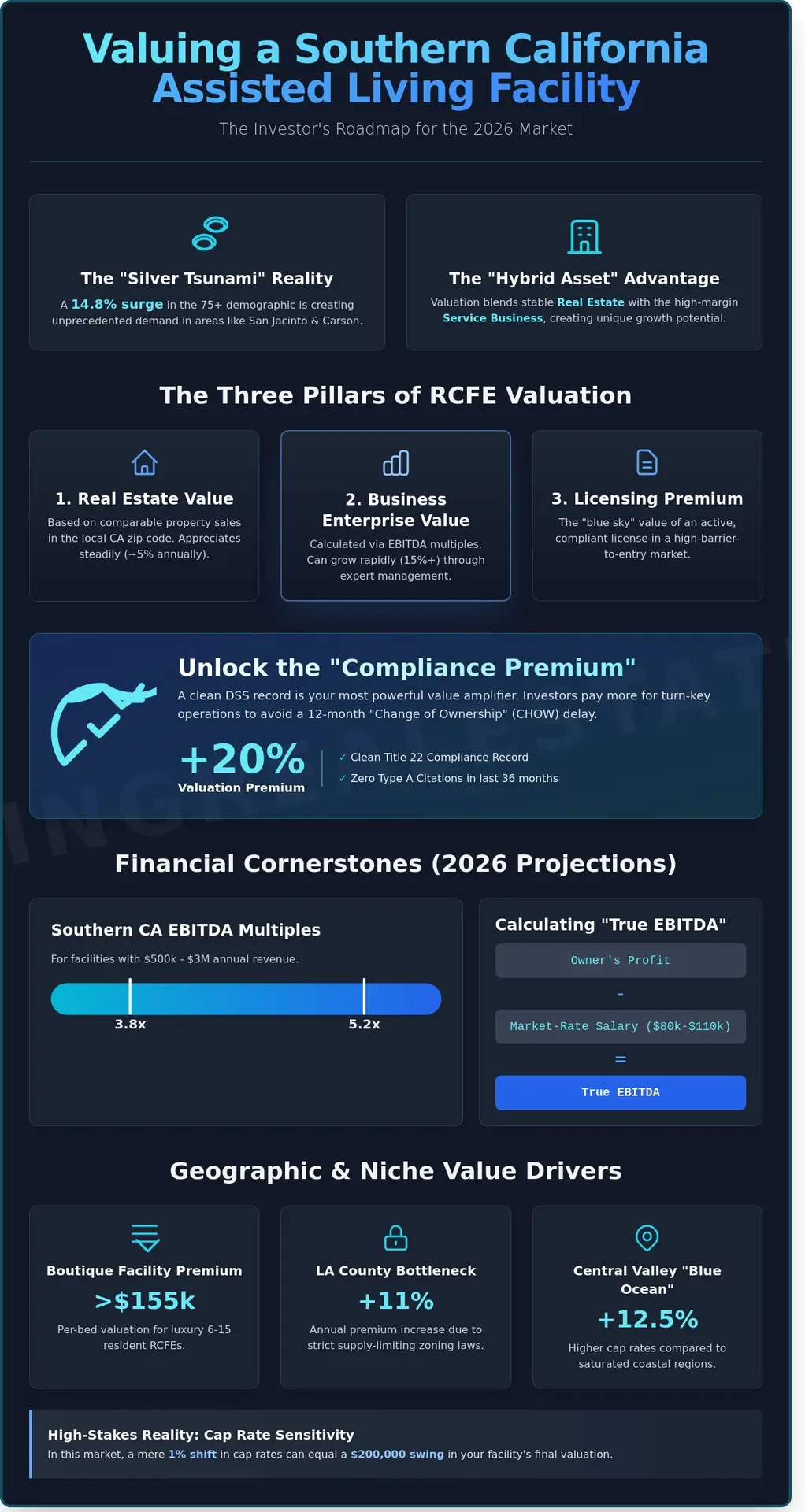
Valuing a Residential Care Facility for the Elderly (RCFE) in California requires a specialized dual-lens approach. You aren’t just looking at a property; you’re evaluating a “Hybrid Asset.” This unique classification blends the stability of commercial real estate with the high-margin potential of a service-based business. Understanding What is an Assisted Living Facility? helps clarify that the value lies in the specialized care provision as much as the physical structure. To determine how to value an assisted living facility, an investor must separate the bricks-and-mortar appraisal from the business enterprise value, which includes the license, goodwill, and resident contracts. These two components often move in different directions. While the real estate might appreciate at 5% annually, a well-managed RAL operation can see revenue growth of 15% or more through strategic rate increases and occupancy management.
The California Department of Social Services (DSS) acts as the ultimate gatekeeper of asset legitimacy. A facility with a clean Title 22 compliance record and zero Type A citations over the last 36 months commands a 20% premium over distressed counterparts. By 2026, Southern California market dynamics will shift even further toward rewarding these “clean” operations. New investors are increasingly wary of the 12-month wait times associated with “Change of Ownership” (CHOW) applications in Los Angeles or Orange County. They’ll pay a significant premium for a turn-key business that demonstrates a legacy of care and a clear paper trail. This focus on compliance ensures that your investment provides both impact and income without the looming threat of regulatory shutdowns.
- Real Estate Value: Based on comparable sales of similar residential or commercial structures in the local California zip code.
- Business Enterprise Value: Calculated using a multiple of Seller’s Discretionary Earnings (SDE) or EBITDA, specifically tied to the RCFE license.
- Licensing Premium: The “blue sky” value of an active, compliant license in a high-barrier-to-entry market like Santa Monica or Irvine.
RCFE vs. ARF: Does the License Type Affect Value?
RCFEs typically command higher EBITDA multiples than Adult Residential Facilities (ARFs) because the private-pay senior market offers more scalable revenue than state-funded models. In Thousand Oaks, the demand for memory care has outpaced general assisted living by 22% since 2022. “Boutique” facilities, serving 6 to 15 residents in luxury residential settings, see per-bed valuations exceeding $155,000. These specialized RAL models allow owners to charge premium rates while maintaining lower overhead than institutional 100-bed facilities.
The “Silver Tsunami” and Southern California Demographics
The “Silver Tsunami” isn’t a future threat; it’s a current catalyst for wealth. San Jacinto and Carson are seeing a 14.8% surge in the 75+ demographic leading into 2026. In Los Angeles County, strict zoning laws have created a supply bottleneck, driving up facility premiums by 11% annually. Conversely, Fresno and the Central Valley represent “Blue Ocean” territories with 12.5% higher cap rates than coastal regions. Knowing how to value an assisted living facility in these micro-markets requires analyzing local bed-to-senior ratios to identify where the highest demand exists.
The Financial Cornerstones: Multiples, EBITDA, and Cap Rates
The Silver Tsunami has arrived. It’s transformed the California Residential Assisted Living (RAL) market into a blue ocean of opportunity for those who understand the underlying math. To capture significant financial returns, you must move beyond surface-level accounting. Understanding how to value an assisted living facility begins with EBITDA, Earnings Before Interest, Taxes, Depreciation, and Amortization. This metric acts as the pulse of your investment’s health, stripping away capital structure variables to reveal the raw earning power of the care home.
In 2026, Southern California facilities generating between $500,000 and $3 million in annual revenue are trading at multiples between 3.8x and 5.2x EBITDA. These figures aren’t arbitrary. They reflect the high-barrier-to-entry nature of the California market. To find your “True EBITDA,” you must normalize owner-operator salaries. Many boutique owners don’t pay themselves a market-rate wage. If you’re acting as the Administrator but only drawing a nominal fee, a buyer will subtract a professional salary, typically between $80,000 and $110,000 in 2026 dollars, to see the actual profit potential. This adjustment ensures the business can function as a passive or semi-passive investment for the next owner.
Calculating Net Operating Income (NOI) for Care Homes
California presents unique operational hurdles that directly impact your Net Operating Income. Labor is your largest line item. It often accounts for 48% to 55% of gross revenue due to strict mandatory staffing ratios and the state’s aggressive minimum wage trajectory. You must also account for Title 22 compliance costs. Liability insurance premiums for RCFEs in California have seen a 12% increase since 2024. Smart sellers identify “Add-Backs” to bolster their NOI. These include one-time legal fees for licensing amendments, personal vehicle leases run through the business, or non-recurring facility upgrades. Identifying these costs correctly can increase your valuation by hundreds of thousands of dollars.
Revenue Multiples vs. EBITDA Multiples
Small 6-bed RCFEs often still trade on a revenue multiple, typically 1.0x to 1.5x annual gross income, because their margins are predictable. However, the 2026 trend shows institutional buyers and sophisticated investors moving exclusively toward EBITDA multiples. This shift prioritizes operational efficiency over sheer volume. Location creates the most dramatic variance in these metrics. A facility in Thousand Oaks might trade at a 6.5% cap rate because of its affluent demographics and scarcity of boutique care options. Conversely, a similar facility in San Jacinto may carry an 8.5% cap rate. The higher cap rate in the Inland Empire reflects the increased risk and lower private-pay thresholds compared to coastal markets.
Investors rely on senior housing data and analytics to benchmark these cap rates against national averages. California consistently commands a premium because the demand for “Impact and Income” is higher here than anywhere else in the country. If you want to maximize your exit, you must prove your facility operates at peak efficiency. Our team helps you identify these hidden levers through a strategic portfolio analysis that aligns your financial goals with market realities. Every dollar of expense you save through better systems is worth five dollars or more at the closing table. Success in this niche requires a roadmap that balances the cold reality of ROI with the heart-centered mission of providing premium boutique care.
Operational and Regulatory Value Drivers in California
Your RCFE isn’t just a real estate asset; it’s a mission-driven engine for Impact and Income. Understanding how to value an assisted living facility in the California market requires looking beyond the profit and loss statement. You must evaluate the intangible operational strengths that protect an investor’s capital. In the eyes of a sophisticated buyer, a “Deficiency-Free” report from the California Department of Social Services (DSS) acts as a high-level insurance policy. This gold-standard compliance record typically commands a 10% to 15% premium on the final valuation. Buyers will pay more for a facility that doesn’t come with the “hidden tax” of future regulatory remediation.
Occupancy velocity serves as your most persuasive marketing tool during the sale. A consistent 95% occupancy rate is the baseline, but a documented waitlist functions as a tangible financial asset. If you have three families ready to move in as soon as a bed opens, you’ve effectively eliminated the “lease-up” risk for the new owner. This stability allows you to defend a lower cap rate and a higher asking price. In a state where the “Silver Tsunami” is driving demand to record highs, your waitlist proves that your specific “Boutique” model has captured the local market’s trust.
Staffing stability is the silent driver of ROI. California’s labor market is notoriously difficult, especially with the 2024 implementation of SB 525, which sets a new trajectory for healthcare minimum wages. If your caregivers have been with you for over three years, you’ve solved the industry’s biggest pain point. Low turnover reduces training costs and preserves the “heart-centered” culture that families pay a premium for. A stable team suggests that the business can run without the owner’s constant intervention, making it a “turnkey” opportunity for passive investors.
Title 22 Compliance as a Value Multiplier
California’s Title 22 regulations are some of the strictest in the nation. To maximize your valuation, you must audit-proof your facility at least 12 months before listing. A single “Type A” violation regarding immediate safety risks can be a deal-killer or lead to a 20% price reduction during due diligence. Ensure your Administrator Certificate is current and that your staff training logs are flawless. This regulatory hygiene proves to a buyer that the facility is a safe, scalable investment rather than a liability waiting to happen.
Physical Plant and Amenity Packages
The physical structure of your RAL determines your per-bed rate ceiling. In cities like San Jacinto, grandfathered zoning for 6-bed residential models is incredibly valuable because new local ordinances often make starting from scratch nearly impossible. High-end upgrades like walk-in showers and smart monitoring systems aren’t just luxuries; they’re ROI accelerators. However, be cautious of deferred maintenance. An aging HVAC system or a roof nearing its 20-year limit will result in a dollar-for-dollar deduction from the offer price. When learning how to value an assisted living facility, remember that “Boutique” means every square foot must justify its premium price tag through quality and function.
The Step-by-Step Valuation Process for Southern CA Owners
The “Silver Tsunami” isn’t a crisis for the prepared owner; it’s a blue ocean opportunity. As 10,000 baby boomers turn 65 every single day, the demand for high-end, boutique residential care is skyrocketing across the Golden State. To capture this value, you must understand how to value an assisted living facility through a lens that balances cold financial data with the heart-centered mission of your care model. A generic real estate appraisal won’t suffice here. You need a specialized roadmap that accounts for the high-barrier-to-entry nature of the California RCFE market.
- Step 1: Conduct a confidential internal financial and compliance audit. Transparency is your greatest asset. We recommend reviewing 36 months of profit and loss statements alongside your most recent 2024 LIC 809 and LIC 802 forms. Since 92% of deal delays stem from undisclosed Title 22 compliance issues, fixing these “paperwork leaks” before a buyer sees them preserves your asking price.
- Step 2: Engage a specialized RCFE broker for a Broker Price Opinion (BPO). Generalist brokers often miss the “Impact and Income” potential of a facility. A BPO from a specialized consultant identifies the specific cap rates, often between 6% and 8.5% for Southern California, that investors are currently paying for stabilized assets.
- Step 3: Analyze local “Comps” in your specific California sub-market. Real estate is hyper-local. A 6-bed RAL in Irvine doesn’t trade the same way as a 15-bed facility in San Bernardino. We look at 2023 and 2024 closed sales data to ensure your valuation reflects current market velocity.
- Step 4: Adjust for intangible assets. Your reputation is a line item on the balance sheet. We quantify the value of your established referral networks with local medical groups and your facility’s brand equity. A boutique home with a consistent 95% occupancy rate over two years commands a 15% to 20% premium over a struggling competitor.
- Step 5: Finalize the “Impact and Income” report. This is your pitch deck for high-level investors. It transitions the conversation from “buying a house” to “acquiring a legacy-driven cash flow engine.”
The Importance of Confidentiality in Valuation
Publicizing a “For Sale” status can devalue your facility overnight. If staff members sense instability, turnover can spike by 25% in a single month. Residents and their families may also panic and seek more “stable” long-term options. We utilize “blind listings” and rigorous NDAs to ensure that your sensitive financial data only reaches vetted, 1031-exchange ready investors. This approach protects your daily operations while we build your exit strategy behind the scenes.
Local Market Spotlights: Fresno to Carson
The California landscape offers diverse entry points. Fresno is currently seeing a 12% surge in RCFE investment because entry costs are roughly 40% lower than coastal regions, allowing for higher ROI on mid-market care. In Van Nuys, facilities carry a $500,000 premium because they sit within a 5-mile radius of major medical hubs. Meanwhile, in Thousand Oaks, city-specific zoning hurdles have created a “protected monopoly” for existing owners, as new licenses are increasingly difficult to obtain. Knowing these nuances is essential when learning how to value an assisted living facility in a competitive environment.
Ready to discover the true market worth of your boutique care home? You can request a professional valuation analysis from our team to see how your facility measures up against current Southern California benchmarks.
Maximizing Your Exit: Why Specialized Brokerage is Essential
Selling your RCFE is a high-stakes transaction that requires more than a standard MLS listing. Many sellers mistakenly hire general residential realtors who lack the technical knowledge to defend a premium price point. These generalists often struggle with the core question of how to value an assisted living facility; they frequently rely on residential comps instead of the business’s actual EBITDA and cap rate. In California, your real estate is only half the story. The license, the census history, and the Title 22 compliance record are what drive the highest multiples.
A specialized broker understands that a boutique care home is a turnkey business acquisition. By 2026, the demand for these beds will reach a fever pitch as the oldest Baby Boomers hit their 80s. We position your facility to attract sophisticated investors who value impact and income. This means navigating the intricate California relicensing process during escrow. We manage the handoff with the Department of Social Services to ensure the buyer’s application moves through the system without the typical 120-day delays that plague unguided sales.
Specialized brokerage bridges the gap between cold financial ROI and the heart-centered care you’ve provided for years. Investors want to see a 15% to 20% return, but they also want to know the “soul” of the facility is intact. We translate your years of service into a data-driven narrative that justifies a premium valuation.
The Teri Szoke Advantage: 25 Years of California Care Expertise
Teri Szoke brings 25 years of specialized California care expertise to every transaction. This deep history allows us to tap into an exclusive network of off-market buyers who are ready to move quickly without the public scrutiny of a traditional listing. We also provide creative exit strategies, such as lease-to-own opportunities for younger, mission-driven operators who have the talent but lack initial capital. Our philosophy is simple: we help you do good while doing well. We ensure your legacy of care continues under new leadership while you capture the full value of your hard work.
Next Steps: Get Your Confidential Valuation
Preparing for a sale starts with a professional review of your books. You’ll need at least 24 months of clean profit and loss statements and a current census report to accurately determine how to value an assisted living facility in today’s shifting market. In the current California landscape, the timeline from initial valuation to a successful close typically spans six to nine months. Don’t leave your exit to chance. It’s time to see what your life’s work is truly worth.
to begin your journey toward a successful and profitable exit.
Secure Your Legacy in the 2026 California Care Market
Valuing an RCFE in Southern California isn’t just about real estate; it’s about the boutique care model you’ve built. By 2026, California’s 65+ population will hit 8.4 million people, turning your facility into a high-demand asset. You’ve learned that mastering EBITDA multiples and RCFE-specific cap rates is the only way to capture true market value. Understanding how to value an assisted living facility requires a deep dive into your P&L and the specific licensing nuances of the California Department of Social Services. Don’t leave your exit to chance with a generalist broker who doesn’t understand our Impact and Income philosophy. We bring 25 years of specialized experience to the table, ensuring your life’s work is protected through our Proprietary Confidential Marketing Strategy. Whether you’re operating in San Diego, Orange County, or Los Angeles, the window to maximize your ROI is open. Our Southern California market experts are ready to guide your transition.
Get a Confidential Valuation for Your California Care Home
You’ve built a legacy of care; now it’s time to realize the financial reward you deserve.
Frequently Asked Questions
How much is a 6-bed RCFE worth in Southern California in 2026?
A 6-bed RCFE in Southern California is projected to command between $1.5 million and $3.2 million by 2026. This valuation accounts for a 5% annual appreciation in coastal real estate and the increasing demand from the 8.4 million Californians who will be over age 65 by 2030. Premium boutique facilities in markets like Newport Beach or Santa Monica will sit at the top of this price range.
What is the average EBITDA multiple for assisted living facilities in California?
Understanding how to value an assisted living facility requires looking at EBITDA multiples, which typically range from 3.0x to 5.5x in the California market. Smaller 6-bed RAL operations usually trade at the lower end of this spectrum. Larger facilities with 15 or more beds or those with specialized memory care programs often secure multiples exceeding 6.0x due to their scalability and operational efficiencies.
Does the real estate or the business license hold more value in a sale?
Real estate typically accounts for 65% to 80% of the total transaction value in California RCFE sales. While the RCFE license is the engine that generates the income, the underlying property provides the collateral and stability investors crave. A boutique facility in a high-demand zip code like 90210 often sees its real estate value appreciate faster than its operational net profit, providing a dual-layered investment return.
How does a DSS citation history affect the market value of my care home?
A history of Type A citations from the Department of Social Services (DSS) can decrease your facility’s market value by 15% to 25%. Buyers view frequent citations as a liability that increases the risk of license revocation or costly compliance monitors. Clean records from the last 36 months are essential for achieving a premium valuation during the due diligence phase of your sale.
Can I sell my RCFE business without selling the underlying real estate?
You can sell the RCFE business operations while retaining ownership of the real estate through a long-term lease agreement. This “Impact and Income” strategy allows you to collect monthly rent while cashing out on the business goodwill. In California, these business-only sales typically trade for 2.0x to 3.5x Seller’s Discretionary Earnings plus the value of all furniture, fixtures, and equipment included in the facility.
How long does the valuation and sale process typically take in California?
The process from initial valuation to final closing usually takes between 6 and 10 months in California. This timeline is largely dictated by the California Department of Social Services (CDSS) and their 90 to 120-day window for processing Change of Ownership (CHOW) applications. Preparing your financial documents and operational manuals 12 months in advance ensures a smoother transition for the incoming provider and protects your equity.
What are the current cap rates for senior housing in the San Fernando Valley?
Cap rates for senior housing in the San Fernando Valley currently fluctuate between 6.5% and 8.2% depending on the facility’s age and location. Boutique RAL homes in neighborhoods like Encino or Sherman Oaks often trade at lower cap rates because of their high-barrier-to-entry status and affluent resident base. Investors accept these lower yields in exchange for the long-term stability of the Los Angeles demographic shift.
Why is confidential marketing so important when valuing a care facility?
Confidentiality is the cornerstone of preserving your RCFE’s value because public knowledge of a sale can trigger staff turnover and resident move-outs. A 10% drop in occupancy during the listing period can decrease your final sale price by hundreds of thousands of dollars. We use non-disclosure agreements and blind profiles to protect your legacy while identifying qualified investors who understand the boutique care model and the blue ocean opportunity.