
What if the 12% increase in California healthcare labor costs since 2023 isn’t a threat to your bottom line, but actually the ultimate filter that keeps amateur competitors out of the lucrative Southern California senior care market? You know that the “Silver Tsunami” is transforming the Golden State, yet you’re likely wary of how Thousand Oaks labor costs or Van Nuys zoning hurdles might compress your NOI. It’s difficult to separate the intrinsic real estate value from the cash-flowing business operation when the stakes are this high, making it easy to feel paralyzed by the complexity of assisted living cap rates.
This guide will empower you to decode the financial metrics of the 2026 California market, providing a clear framework to calculate true ROI while you conquer a high-barrier-to-entry landscape. We’re here to help you move beyond uncertainty and discover how to evaluate high-yield RCFE and ARF investments that deliver both impact and income through the boutique RAL model. You’ll gain access to specific regional benchmarks and a strategic roadmap for your next California acquisition, turning a complex demographic shift into your own blue ocean opportunity.
Key Takeaways
- Master the financial language of the California senior housing market to accurately assess the intrinsic value of RCFE and ARF investment opportunities.
- Learn the precise formula for assisted living cap rates in California, including how to identify critical “add-backs” that reveal the hidden profitability of a care home.
- Navigate the 2026 landscape by comparing cap rate compression in elite coastal markets like Thousand Oaks against high-yield “blue ocean” opportunities in the Central Valley.
- Discover how to optimize your “impact and income” by transitioning basic care facilities into high-margin, boutique memory care environments.
- Secure your investment’s legacy by utilizing specialized California brokerage strategies that protect your valuation through confidential marketing and niche expertise.
What Are Assisted Living Cap Rates and Why Do They Matter in California?
California real estate is notoriously expensive; however, savvy investors are looking beyond traditional apartments to find yield. The Capitalization Rate, or cap rate, serves as the primary metric to evaluate the profitability of these specialized assets. In the world of California senior housing, specifically Residential Care Facilities for the Elderly (RCFE) and Adult Residential Facilities (ARF), the cap rate represents the ratio of Net Operating Income (NOI) to the property’s purchase price. It’s the universal language that translates a facility’s operational efficiency into a clear investment value.
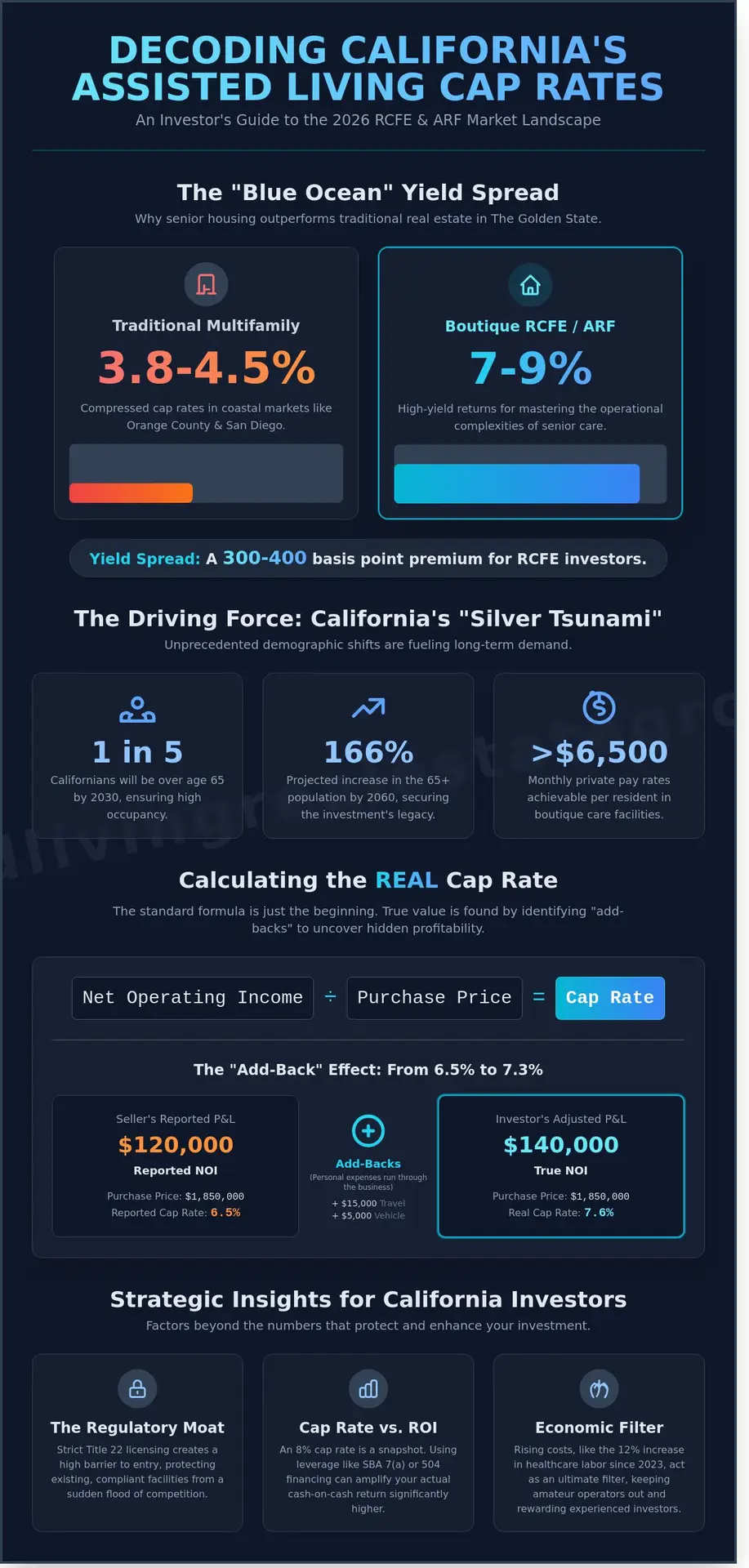
The “Blue Ocean” opportunity in the Golden State is undeniable. Traditional multifamily assets in coastal markets like Orange County or San Diego often trade at compressed cap rates between 3.8% and 4.5%. In contrast, assisted living cap rates for boutique RCFEs frequently range from 7% to 9%. This spread represents a massive premium for investors willing to master the operational complexities of care. You aren’t just buying a building; you’re acquiring a high-yield business engine protected by significant barriers to entry.
Distinguishing between the real estate asset and the business operation is vital for California investors. A standard appraisal might value a six-bed home in Santa Clara based on comparable residential sales. An RCFE investor, however, values that same property based on its licensed capacity and monthly service fees. In California, where the “Silver Tsunami” is projected to result in a 166% increase in the 65 plus population by 2060, the income potential of the business often far outstrips the appreciation of the dirt it sits on.
The Impact and Income Connection
Cap rates in the RCFE space measure how effectively a provider delivers high-quality care. In the California market, “Boutique” service levels allow operators to command private pay rates exceeding $6,500 per month per resident. This premium pricing directly inflates the NOI, driving higher yields. By 2030, one in five Californians will be over age 65. This demographic shift ensures that well-positioned boutique facilities maintain high occupancy, securing long-term investor returns while providing a vital social service.
Cap Rate vs. ROI: What California Investors Get Wrong
A cap rate is a snapshot in time; it doesn’t account for the power of leverage. While assisted living cap rates might sit at 8%, your actual cash-on-cash return can be significantly higher when utilizing SBA 7(a) or 504 financing programs common in California. Many investors also overlook Title 22 compliance. In California, a single licensing violation can halt operations. This “invisible factor” means a 10% cap rate on a non-compliant facility is actually a high-risk gamble, not a bargain. True value lies in the marriage of a high-yield metric and a pristine regulatory record.
- California Demographics: 10.8 million residents will be 60 or older by 2030.
- Yield Spread: RCFE cap rates typically sit 300-400 basis points above local multifamily averages.
- Regulatory Moat: Title 22 requirements create a high barrier to entry, protecting existing owners from sudden competition.
Calculating the Real Cap Rate: The California RCFE Formula
The math behind assisted living cap rates in California is often misunderstood by residential investors entering the specialized care space. At its core, the formula is straightforward: divide your annual Net Operating Income (NOI) by the total Purchase Price. However, in the high-stakes California market, the “Real Cap Rate” requires a surgical examination of what actually constitutes income versus what constitutes the owner’s lifestyle expenses. We view this as the bridge between “Impact and Income,” where the quality of your care directly dictates the strength of your yield.
Smart investors look for “Add-Backs” when reviewing a seller’s profit and loss statement. In many 6-bed RCFEs, owners run personal expenses like vehicle leases, family cell phone plans, or discretionary travel through the business. To find the true NOI, you must strip away these non-essential costs. If a facility in Torrance shows an NOI of $120,000 but includes $15,000 in personal “business trips,” your actual NOI is $135,000. This adjustment can move your cap rate from a 6.5% to a much more attractive 7.3% overnight.
Projecting returns for 2026 requires accounting for California’s aggressive labor climate. With healthcare minimum wage mandates like Senate Bill 525 pushing toward $25 per hour for many workers, your pro forma must reflect rising payroll costs. Analyzing 2026 senior housing market trends shows that while expenses are climbing, the demand for high-quality, boutique care allows for significant rate increases. This “blue ocean” opportunity exists because the aging population is growing faster than the supply of licensed beds, providing a natural hedge against inflation.
Determining True NOI in an RCFE
Title 22 of the California Code of Regulations dictates strict staffing ratios that you can’t ignore. For a 6-bed RAL, you’re often looking at a 1:3 ratio during peak hours to maintain safety and compliance. You must also factor in “Level of Care” (LOC) pricing. A resident requiring memory care in a Southern California facility might pay $8,500 monthly, while a base-level resident pays $5,800. Your NOI calculation should be based on a weighted average of these tiers, factoring in a 5% to 8% vacancy rate to remain conservative. Don’t forget that Workers’ Comp premiums in California’s healthcare sector can take a 10% bite out of your gross payroll if not managed correctly.
Purchase Price: Real Estate vs. Business Value
In cities like Carson or Long Beach, real estate appreciation has led to significant cap rate compression. You aren’t just buying a residential property; you’re buying a licensed business entity. Typically, we see a value allocation where 70% of the price sits in the real estate and 30% resides in the “Blue Sky” or business license value. Turnkey acquisitions command a premium because they bypass the 12 to 18 month licensing backlog currently experienced at the California Department of Social Services (CDSS). This immediate cash flow justifies a lower cap rate for many “Expert Guides” in the investment world. If you’re ready to secure your legacy, you can analyze your potential RCFE acquisition with our team to ensure your assisted living cap rates reflect reality rather than optimistic projections.
2026 California Market Trends: Regional Cap Rate Benchmarks
California’s RCFE landscape in 2026 is defined by a widening spread between high-barrier coastal enclaves and high-yield inland corridors. While interest rates remained volatile through late 2025, the fundamental demand for senior housing has acted as a floor for valuations. This resilience is fueled by the U.S. Census Bureau data on aging, which confirms that the 65+ demographic in California will grow by 30% by the end of the decade. This demographic shift transforms a potential crisis into a blue ocean for savvy investors looking for Impact and Income.
In Thousand Oaks and Westlake Village, we’re seeing significant cap rate compression. Investors are currently accepting yields as low as 5.5% to 6.2% for boutique facilities. These assets are prized for their 95% average occupancy rates and premium private-pay residents who demand luxury environments. Conversely, the Central Valley offers a different math. Fresno currently provides assisted living cap rates between 8.5% and 9.5%, rewarding risk-tolerant investors who can manage larger operational footprints in less affluent zip codes. While the yields are higher, the management intensity often scales accordingly.
The Inland Empire has emerged as a powerhouse for the RAL model. San Jacinto and surrounding cities have seen a 12% increase in RCFE property values since January 2025. This surge is driven by families seeking quality care at a price point that doesn’t exhaust their inheritance. The ‘Silver Tsunami’ isn’t just a buzzword here; it’s a daily reality that keeps cap rates stable even when the broader commercial real estate market fluctuates. This stability allows our partners to build a legacy of care while securing their financial future.
Southern California Regional Comparison
Thousand Oaks and Westlake Village represent the pinnacle of luxury boutique yields. These markets prioritize intimacy, where 6-bed RAL homes command monthly rates exceeding $8,500 per resident. In Van Nuys and the San Fernando Valley, high density allows for massive operational efficiency. Clustering multiple homes within a 3-mile radius reduces staffing overhead by 15%. Meanwhile, Carson and the South Bay offer the entry-level sweet spot. With property prices 20% lower than the Westside, investors can achieve double-digit cash-on-cash returns while serving a diverse middle-market demographic.
Institutional vs. Residential Cap Rates
The market treats 100-bed institutional facilities and 6-bed RAL homes as two distinct asset classes. Large facilities often face higher vacancy risks and 25% higher turnover in staff compared to smaller homes. Assisted living cap rates for residential care homes remain attractive because these properties offer a liquidity premium. They’re significantly easier to exit because they can be sold to both investors and traditional homebuyers. By December 2026, we forecast a stabilization of cap rates as the market absorbs the current supply of new developments. This creates a window of opportunity for investors to lock in high-performing assets before the next cycle of compression begins.
Optimizing Your Cap Rate: How to Increase Value in California Care Homes
Maximizing your Net Operating Income (NOI) is the most direct lever for compressing assisted living cap rates and boosting your property’s terminal value. In the 2024 California market, the distinction between a mediocre investment and a high-yield asset lies in operational precision. You aren’t just buying real estate; you’re acquiring a platform for high-level care. By focusing on “impact and income,” savvy investors transform standard RCFEs into boutique powerhouses that command premium valuations during the exit phase.
The “Silver Tsunami” creates a blue ocean of opportunity for those who understand that quality care drives financial performance. When you move beyond basic custodial services into specialized memory care, the revenue shift is profound. Data from 2023 indicates that California facilities offering specialized dementia programs can command a 35% premium over traditional RCFE rates. This transition requires a commitment to Title 22 compliance and enhanced staffing, but the resulting increase in NOI significantly lowers the risk profile for future buyers.
Revenue Enhancement Strategies
In the Los Angeles basin, particularly in high-demand pockets like Van Nuys, the shift from SSI-dependent models to 100% private pay is transformative. While SSI rates are strictly capped, private pay residents in Southern California often pay between $5,500 and $9,500 monthly. Implementing a tiered pricing model based on acuity levels ensures that you’re compensated for the actual care provided. This prevents “margin creep” as residents age in place and require more intensive support.
- Acuity-Based Pricing: Use a 3-tier system to adjust monthly fees as resident needs increase.
- Hyper-Local Marketing: Focus digital spend on a 5-mile radius around cities like Van Nuys to capture local families.
- Private Pay Focus: Target the 72% of California seniors who have sufficient home equity to fund boutique care.
Expense Management for Investors
Operational efficiency in California requires a sophisticated approach to labor and legislative constraints. Staffing is your largest line item, often consuming 40% to 50% of gross revenue. A heart-centered staffing model reduces the “revolving door” of caregivers. Replacing a single staff member in California costs an average of $4,200 in recruitment, background checks, and training. Retaining high-quality caregivers isn’t just a moral choice; it’s a fiscal necessity that protects your assisted living cap rates from volatile labor spikes.
Smart investors also leverage California’s unique tax landscape. Proposition 13 provides a significant advantage for long-term holders by capping property tax increases at 2% annually, regardless of market appreciation. This predictable expense allows for more accurate long-term forecasting. Additionally, investing in “boutique” upgrades like quartz countertops, circadian lighting, and smart monitoring systems justifies higher rents while reducing long-term maintenance costs.
- Energy Efficiency: Install solar panels to mitigate California’s high utility rates, which have risen by 12% in some regions since 2022.
- Compliance Technology: Utilize digital charting to ensure Title 22 compliance, reducing the risk of costly state citations.
- Strategic Renovations: Focus on common areas and curb appeal to maintain 95% occupancy in competitive Southern California markets.
Success in this niche requires a roadmap that balances financial rigor with compassionate service. If you’re ready to scale your portfolio and capture the massive demand for premium care, it’s time to align with experts who understand the California landscape. Build your boutique care legacy and secure your position in this high-growth market today.
Securing the Best Cap Rate: The Role of a Specialized California Broker
General commercial brokers often stumble when valuing Residential Care Facilities for the Elderly (RCFE). They see a building; we see a complex, regulated business where the real estate is merely the shell for a high-yield operational engine. Standard brokers rely on multifamily metrics that fail to account for the “care” component of the income stream. This oversight typically leads to mispriced assisted living cap rates, causing sellers to leave six figures on the table or buyers to overpay for a facility with compliance red flags. Our specialized approach ensures that every dollar of Net Operating Income (NOI) is documented, defended, and maximized.
Confidentiality is your greatest asset during a sale. When a listing becomes public knowledge on a standard site, staff anxiety rises and resident families begin looking for the exit. This sudden churn can gut your NOI in 30 days, destroying your valuation before you even reach escrow. We utilize a proprietary, “blind” marketing strategy that protects your facility’s reputation. By vetting buyers through strict non-disclosure agreements before sharing sensitive data, we maintain operational stability while driving competitive offers. This method is essential for preserving the premium assisted living cap rates that boutique Southern California facilities deserve.
Finding “off-market” high-yield opportunities is where the Assisted Living Real Estate Group excels. We track the “Silver Tsunami” demographics across California, identifying facilities that aren’t yet on the market but are primed for transition. We navigate the specific regulatory hurdles of the Southern California landscape, including local zoning ordinances and fire safety requirements. Our team understands how to bridge the gap between a seller’s legacy and a buyer’s vision for “Impact and Income.”
The Advantage of 25 Years of California Experience
Success in the RCFE and Adult Residential Facility (ARF) space requires more than a real estate license; it requires a deep understanding of Title 22 regulations. We maintain a curated network of qualified investors specifically seeking California assets. In October 2022, we worked with an investor on a Fresno facility. By restructuring their staffing model and payer mix to align with current market demand, we boosted their annual NOI by $54,000. This operational optimization added over $650,000 in exit value, proving that the right roadmap turns a standard facility into a high-performance asset.
Your Next Steps in the California Senior Housing Market
Securing your financial future starts with a clear-eyed look at your current position. We provide confidential valuations for Southern California facility owners that go beyond simple comps. Our team performs a deep-dive due diligence process to verify every NOI claim, ensuring that the cap rate you see on paper is the yield you’ll actually realize. Don’t rely on generic pro-formas that ignore the realities of California labor laws or insurance spikes. It’s time to leverage our expertise to build your legacy in this “blue ocean” market. Explore our current California Assisted Living listings to see the boutique opportunities available today.
Mastering Your 2026 California Care Portfolio
The “Silver Tsunami” isn’t a distant forecast; it’s a current reality for Southern California investors. Navigating assisted living cap rates in 2026 requires more than a standard spreadsheet. It demands a deep dive into how boutique 6-bed RCFEs can generate higher yields than institutional models by focusing on premium, high-acuity care. You’ve seen that optimizing your operational efficiency in markets like Los Angeles or Riverside can shift your valuation by 10 to 15 percent when calculated correctly. Success depends on your ability to bridge the gap between financial ROI and compassionate service.
We’ve spent 25 years specializing in California RCFE and ARF sales, helping operators achieve the perfect balance of “Impact and Income.” Our confidential marketing experts ensure your Southern California facility transitions smoothly while maintaining its maximum market value. You’ve got the vision to lead this industry. We have the roadmap and the exclusive listings to make it happen. Ready to find your next high-yield investment? View our exclusive California RCFE listings today.
Your journey toward a high-performing care portfolio starts with a single strategic move. The opportunity to build a lasting legacy in California is yours for the taking.
Frequently Asked Questions
What is a typical cap rate for an RCFE in Southern California in 2026?
Investors should expect typical assisted living cap rates in Southern California to range between 6.5% and 8.0% by 2026. This projection stems from the 10.8 million Californians reaching age 65 or older by 2030, which fuels high demand for Boutique RAL facilities. While interest rates fluctuate, the essential nature of senior housing keeps these yields stable compared to volatile retail sectors.
How do California labor laws affect the cap rate of an assisted living facility?
California labor laws, particularly Senate Bill 525 which mandates a $25 per hour minimum wage for healthcare workers, directly compress cap rates by increasing operating expenses. Since labor typically accounts for 55% of an RCFE’s total costs, owners must optimize staffing ratios to maintain a healthy Net Operating Income. Efficiently managed facilities offset these costs by positioning themselves as premium, high-care providers.
Is it better to buy a facility with a high cap rate in Fresno or a low one in Thousand Oaks?
Buying a facility in Thousand Oaks with a 6% cap rate often yields better long-term wealth than a 9% cap rate in Fresno. While the Central Valley offers higher immediate cash flow, the Ventura County market provides superior real estate appreciation and a wealthier demographic capable of paying $8,000 monthly rents. Wealthy coastal markets offer a strategic “Impact and Income” balance that mitigates vacancy risks.
Does the real estate value or the business value drive the cap rate more in California?
The business value and operational efficiency drive the cap rate more than the underlying real estate in the California market. It’s common to see assisted living cap rates move based on the facility’s ability to maintain 95% occupancy and high private-pay ratios. A well-run RAL business turns a standard residential property into a high-yield commercial asset, significantly outperforming traditional rental properties.
How does Title 22 compliance impact the Net Operating Income (NOI) of a care home?
Title 22 compliance directly impacts NOI by preventing costly citations and potential license revocations that can exceed $500 per day. Maintaining 100% compliance ensures operational continuity and attracts high-net-worth families who prioritize safety. Strategic operators view compliance as a foundational asset rather than a burden, as it secures the facility’s reputation and long-term financial health for the owner.
Can I increase my cap rate by converting a standard RCFE to a Memory Care facility?
Converting a standard RCFE to a Memory Care facility can increase your cap rate by 150 to 250 basis points. Specialized dementia care allows owners to charge a premium of $2,000 or more per month compared to basic assisted living. This transition maximizes the “Silver Tsunami” opportunity, meeting a critical need while significantly boosting the facility’s Net Operating Income and overall valuation.
Why do Southern California assisted living cap rates differ from multifamily real estate?
Southern California RCFE cap rates are generally 2% to 3% higher than multifamily assets because they include a complex operational business component. While a Santa Monica apartment might trade at a 4% cap, a nearby RAL facility often trades at 7% to reflect the management intensity. This risk premium rewards investors who don’t shy away from navigating California’s rigorous licensing and staffing requirements.
What are the biggest risks to cap rate stability in the California senior housing market?
The biggest risks to cap rate stability are unpredictable regulatory shifts and rising professional liability insurance premiums, which increased by 20% for many California providers in 2023. Additionally, a shortage of qualified administrators can lead to higher turnover and increased recruitment costs. Savvy entrepreneurs mitigate these risks by partnering with experts who understand the specific nuances of the California Department of Social Services.