
By 2026, Southern California will face a projected 45% shortfall in licensed care beds for adults aged 65-85, creating an unprecedented investment vacuum. You’ve likely felt the complexity of this market firsthand. The labyrinth of Title 22 regulations, the frustrating search for compliant properties in competitive markets like Van Nuys, and the sheer confusion between ARF and RCFE licensing can feel insurmountable. It’s a high-barrier-to-entry market, and that’s by design.
This guide is your roadmap to bypass those barriers. We will demystify the process of launching a high-yield, boutique adult residential facility California needs, transforming regulatory hurdles into your competitive advantage to deliver both impact and income. Inside, we’ll break down the essential licensing steps, reveal high-potential zip codes from the San Fernando Valley to Thousand Oaks, and provide the framework for partnering with a specialist broker to secure your first legacy asset.
Key Takeaways
- Discover the untapped market demand in Southern California, driven by a critical shortage of care facilities for adults with developmental disabilities.
- Strategically compare the ROI of an ARF versus an RCFE to determine the most profitable investment path for your portfolio in the California market.
- Master the Title 22 compliance essentials required to successfully license and operate an adult residential facility California, turning regulatory hurdles into a competitive advantage.
- Uncover a proven framework for acquiring your facility, from identifying turnkey business opportunities to conducting critical due diligence on licensing and financial history.
The Growing Demand for Adult Residential Facilities in Southern California
The term “Silver Tsunami” barely scratches the surface of California’s care crisis. This isn’t just about an aging population; it’s about a rapidly growing demographic of adults under 60 with developmental or physical disabilities who require 24-hour, non-medical supervision. The system is failing them. In Southern California markets from Carson to San Jacinto, a critical shortage of licensed beds has created a chasm between need and availability, with Los Angeles County alone facing a projected deficit of over 5,000 ARF beds by 2025.
This gap isn’t a problem; it’s a profound opportunity. The state’s massive, institutional nursing homes are becoming relics of a bygone era, replaced by a powerful preference for intimate, home-based care. For the savvy investor, this shift represents a chance to meet a desperate community need while building a legacy of both impact and income. This model directly addresses California’s housing and care crisis, converting single-family homes into high-yield assets that generate significant, recession-resistant ROI.
The Southern California Market Opportunity
The demand is not abstract; it’s hyper-local. In areas like Van Nuys in the San Fernando Valley, the need for a quality adult residential facility California can provide is acute, with regional center waitlists growing by an estimated 12% year-over-year. While most investors focus on the crowded Residential Care Facilities for the Elderly (RCFE) market, the ARF sector remains a genuine “blue ocean.” It’s a space with higher barriers to entry due to specialized licensing, but this complexity creates a protective moat, leading to less competition and superior cap rates for those who have the right strategic partner. With market projections indicating a 15% surge in demand for ARF beds by 2026, the time to establish a foothold in the Southern California care sector is now.
Boutique vs. Institutional Models
The future of care is small. The boutique model reimagines residential care by transforming a standard single-family home into a licensed 6-bed facility, a stark departure from the clinical, impersonal environments of 100-bed institutions. This approach prioritizes quality of life, offering residents private rooms, shared family-style meals, and an industry-leading staff-to-resident ratio, often as low as 1-to-3. These specialized Residential care facilities don’t just feel different; they perform differently. Data consistently shows that smaller, 6-bed facilities achieve better patient outcomes, higher family satisfaction scores, and greater operational efficiency, which translates directly to more predictable and profitable returns for investors.
A Boutique ARF is a high-margin, intimate care alternative to institutional settings, designed to deliver superior quality of life for residents and exceptional returns for investors.
Understanding ARF Licensing and Title 22 Regulations in California
For the strategic investor, regulatory complexity isn’t a barrier; it’s a competitive moat. In California, an Adult Residential Facility (ARF) is licensed to provide 24-hour, non-medical care and supervision to adults aged 18 through 59 who are unable to live independently. This model serves a vital and often overlooked demographic, from individuals with developmental disabilities to those with physical or mental health challenges.
Oversight is rigorous. The California Department of Social Services (CDSS), through its Community Care Licensing Division (CCLD), enforces the stringent regulations that govern every adult residential facility California has to offer. This is a critical distinction from a Residential Care Facility for the Elderly (RCFE), which is licensed to serve adults 60 and over. Understanding this difference is the first step in targeting your investment toward a specific, high-need market segment. Adherence to these state-mandated rules, specifically Title 22 of the California Code of Regulations, is what separates a professional, high-return operation from the unprepared competition.
Navigating the CDSS Application Process
Securing an ARF license in California is a methodical, three-phase process. It begins with a mandatory Orientation, moves to the comprehensive Application submission, and culminates in a final, meticulous Pre-licensing inspection by a CCLD analyst. Common delays, which can stall a project for months, often stem from incomplete financial disclosures, unresolved zoning issues, or an inadequate Plan of Operation. This plan is your operational blueprint; it must detail everything from staffing and training to resident admission procedures and emergency protocols, proving your capacity for excellence to the state.
Title 22 Essentials for Investors
Title 22 regulations are the DNA of your facility’s daily operations and physical structure. They dictate specific staffing ratios to ensure adequate resident supervision, mandating that direct care staff complete at least 40 hours of initial training and 20 hours of continuing education annually. The physical plant requirements are just as demanding, covering everything from fire clearances and sprinkler systems to minimum bedroom square footage (typically 60 sq. ft. for a single occupant) and ADA accessibility. A complete breakdown of these standards is outlined in the official California ARF licensing regulations, which form the compliance backbone of your investment.
Critically, Title 22, Division 6, Chapter 6 of the California Code of Regulations mandates that every licensed adult residential facility in California must be managed by an operator holding a valid, 80-hour ARF Administrator Certificate, ensuring a baseline of professional competency in every boutique home. Mastering these stringent operational requirements and integrating them into a profitable, mission-driven business model is how you achieve both Impact and Income, a process we specialize in guiding investors through at Assisted Living Real Estate Group.
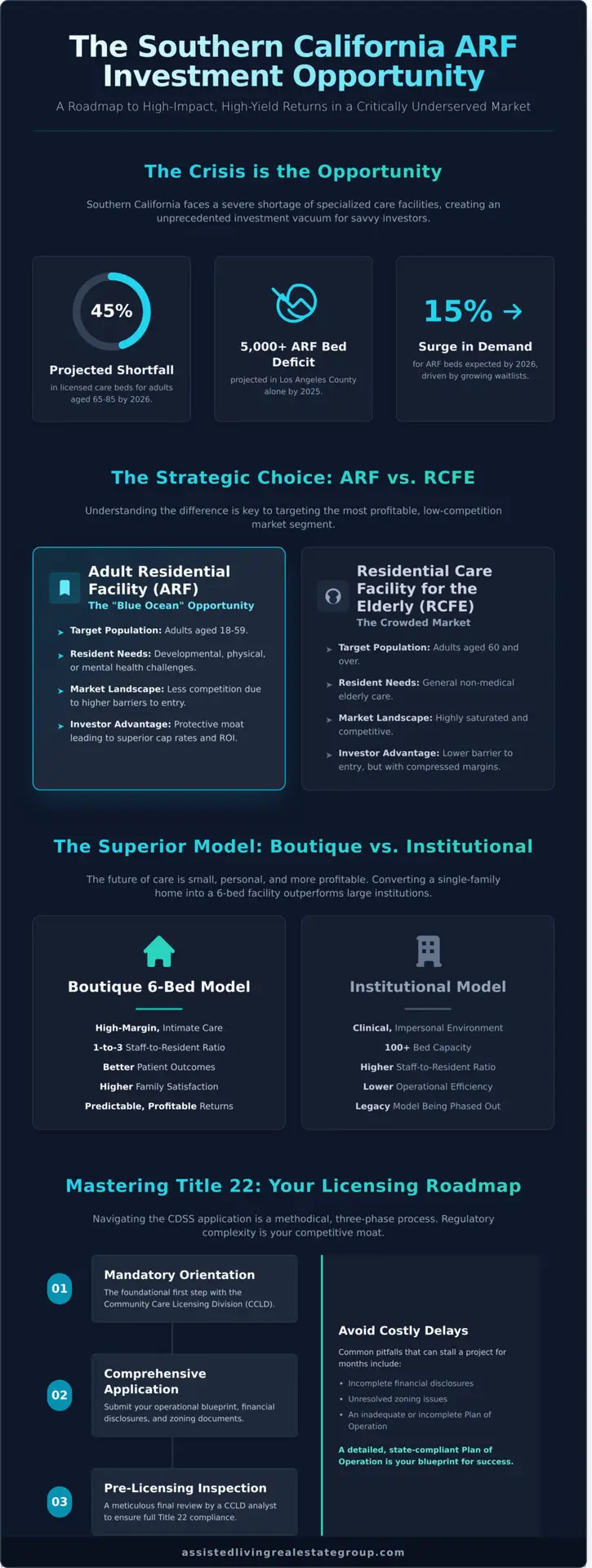
ARF vs. RCFE: A Strategic Comparison for Southern California Investors
The path to a successful real estate investment in California’s care industry forks sharply at one key decision: Adult Residential Facility (ARF) or Residential Care Facility for the Elderly (RCFE)? While both models leverage residential homes to provide boutique care, their operational DNA, target demographics, and reimbursement structures create vastly different opportunities for achieving both impact and income.
Consider a hypothetical 6-bed facility in Thousand Oaks. As an RCFE, your business model relies heavily on private-pay clients, often commanding rates of $6,000 to $9,000 per month. This offers high top-line revenue but also exposes you to market volatility, vacancy risks, and significant marketing expenses. In contrast, a 6-bed ARF in the same home, serving adults with developmental disabilities, operates on a completely different financial chassis. Its revenue is secured through contracts with a state-funded Regional Center, creating a stable and predictable income stream.
While RCFEs cater to the well-documented “Silver Tsunami”-a dramatic increase in the state’s older adult population that creates undeniable demand-ARFs serve an equally vital and state-supported demographic. The choice isn’t just about who you serve; it’s a strategic calculation of risk, stability, and long-term ROI. For savvy investors, the zoning advantages in Southern California are a powerful tailwind. State law treats licensed care homes for six or fewer residents as a standard single-family home, streamlining the conversion process and protecting your investment from many local zoning hurdles.
Regional Center Funding and Stability
This is where the ARF model truly shines. California’s 21 Regional Centers act as your primary client, providing a recession-proof income stream backed by state and federal mandates. Unlike private-pay models, you don’t hunt for residents; the Regional Center, like the North Los Angeles County Regional Center, refers them to you. This guarantees near-100% monthly occupancy. Reimbursement is determined by the resident’s acuity, categorized into “Levels 1-4.” A Level 4I (intensive needs) resident can generate over $6,000 per month in guaranteed, non-discretionary funding, creating a powerful and predictable bottom line.
Market Saturation Analysis
Opportunity lies in unmet demand. Our data shows that markets like Fresno and Van Nuys remain prime locations for new ARF development due to a strategic blend of affordable real estate and a high need for specialized housing. Identifying “under-bedded” ZIP codes-areas with a documented shortage of licensed beds relative to the Regional Center’s client population-is the first step to de-risking your investment. Your choice of an adult residential facility California model must also align with the local labor market; a high-acuity Level 4 facility requires skilled caregivers, making an area like Van Nuys, with its deep healthcare labor pool, a more strategic choice than a remote, underserved community.
The Acquisition Framework: Buying or Leasing an ARF in California
Acquiring an ARF isn’t just buying property; it’s investing in a legacy. The demographic “Silver Tsunami” has created a blue ocean opportunity for entrepreneurs who want to achieve both impact and income. But success demands a disciplined, strategic approach. The path to owning a successful adult residential facility California requires a multi-phased framework that moves from initial identification to final licensure.
Understanding this five-phase process is critical to mitigating risk and maximizing your return on investment.
- Phase 1: Identify Your Path. First, you must decide between a “turnkey” business acquisition or a real estate conversion. A turnkey purchase offers immediate cash flow and existing licensure but means inheriting the facility’s culture and potential liabilities. A conversion offers a blank slate to build your boutique care model from the ground up but requires navigating complex local zoning and a longer timeline to profitability.
- Phase 2: Conduct Forensic Due Diligence. This goes far beyond a standard real estate inspection. You’ll scrutinize profit and loss statements, census history, and, most importantly, the facility’s compliance with California’s Title 22 regulations.
- Phase 3: Navigate Confidential Marketing. Unlike typical commercial real estate, ARF sales are handled with extreme discretion. This “confidential marketing” process protects the residents from anxiety and prevents staff turnover, preserving the very asset you’re trying to acquire.
- Phase 4: Structure the Deal. Will you pursue an outright purchase of the business and real estate, or a lease-to-own opportunity? An outright purchase secures the underlying asset, a cornerstone of wealth creation. A lease option can lower the initial capital barrier but offers less long-term control and equity.
- Phase 5: Execute the Licensing Transfer. The final step is managing the Change of Ownership (CHOW) application with the California Department of Social Services (CDSS). This is a meticulous, non-negotiable process that can take 90-120 days to complete.
Due Diligence for Care Facilities
The biggest risks are the ones you can’t see on a spreadsheet. The “secret sauce” of a premier ARF is its reputation and staff longevity; high turnover is a red flag signaling deeper operational issues. A critical step is visiting the local CCLD Regional Office to review the public “Facility File,” which contains a history of all complaints and citations. Be prepared for hidden costs like ADA-compliance retrofits, which can exceed $50,000, or mandatory fire sprinkler systems, which in many Southern California cities can add $25,000-$40,000 to your budget.
Financing the Dream
Securing capital for an adult residential facility California requires specialized knowledge. The Small Business Administration (SBA) offers powerful tools; the 7(a) loan is ideal for business acquisitions and working capital, while the 504 loan is designed for purchasing the real estate. Partnering with specialized lenders who understand the California senior care space is essential, as they can navigate the unique underwriting criteria of a licensed business. Most California care facility lenders require a minimum 10-20% down payment for business-only acquisitions. Explore your ARF financing options with a strategic partner who understands how to structure deals for success.
Achieving Impact and Income with Assisted Living Real Estate Group
You understand the regulations. You see the demographic demand. Now it’s time to translate that knowledge into a powerful asset. Investing in an adult residential facility California is more than a transaction; it’s a strategic move to build a legacy of both profit and purpose. This isn’t a venture for the unprepared. It’s a high-stakes, high-reward market where the right guidance is the difference between a thriving boutique care home and a costly, vacant property.
This is where our philosophy of “Impact and Income” becomes your roadmap. We believe that exceptional financial returns are a direct result of providing exceptional care. Partnering with a specialized broker like Teri Szoke isn’t just a recommendation; it’s a critical first step. With over 25 years of experience focused exclusively on California’s care facility sector, we provide the strategic oversight needed to navigate the state’s complex regulatory landscape, from San Diego’s specific zoning overlays to the nuances of Los Angeles County’s licensing requirements.
Too many first-time investors are sidelined by predictable hurdles. Our role is to help you bypass these “rookie mistakes” entirely. We see them time and again:
- Licensing Delays: A single misstep on your application to the Community Care Licensing Division (CCLD) can trigger delays of 6 to 12 months, erasing potential profits. We provide resources to streamline this process from day one.
- Hidden CapEx: A property might look perfect, but failing to budget for mandatory ADA-compliant bathroom retrofits or a new fire sprinkler system required by the local Fire Authority can cost upwards of $50,000 post-purchase.
- Operational Miscalculations: Underestimating California’s uniquely high staffing costs and workers’ compensation insurance rates can destroy your pro forma and sink your investment before it ever gets started.
Our experience provides the foresight you lack. More importantly, it grants you access. The most desirable opportunities in Thousand Oaks, Carson, and other prime Southern California markets are rarely found on the public market. We connect our clients with a pipeline of off-market, confidential listings, giving you a decisive advantage in a competitive field.
Our Strategic Mentorship Model
A successful care home is not built on a single transaction. We move beyond the sale to become your long-term strategic partner. This means providing you with proven resources for the relicensing process and offering critical guidance on facility setup to ensure you’re operational and profitable faster. Your success is our benchmark. Explore our current RCFE and ARF listings in California to see the quality of opportunities we represent.
Ready to Build Your Legacy?
The demand is not coming; it’s here. With California’s senior population projected to grow by four million by 2030, the shortage of quality boutique care facilities presents a blue ocean opportunity. The time to act is now. Your first step is a confidential consultation to assess your goals or value your current property. Let’s build your legacy of impact and income together. Schedule your confidential consultation today.
Your 2026 Blueprint for Impact and Income in California
The path forward is clear. California’s senior population is set to expand by over 4 million by 2030, creating an unprecedented demand for boutique care environments. Navigating this opportunity requires more than just capital; it demands a precise understanding of Title 22 regulations and a strategic framework for acquiring the right adult residential facility California license for your investment goals. You’ve seen the roadmap from licensing complexities to acquisition strategies.
But a map is useless without an expert guide. Don’t navigate this high-barrier market alone. The team at Assisted Living Real Estate Group brings over 25 years of combined experience specifically within California’s care facility landscape. We offer unparalleled expertise in Title 22 and CDSS licensing and a confidential marketing strategy that protects your reputation and assets. It’s time to transform this market knowledge into your legacy.
Join the “Impact and Income” movement-Contact Assisted Living Real Estate Group and build a future that delivers both profit and purpose.
Frequently Asked Questions About Adult Residential Facilities
What is the age limit for residents in an Adult Residential Facility in California?
Adult Residential Facilities (ARFs) in California are licensed to serve adults between the ages of 18 and 59. This specific age range distinguishes ARFs from facilities for the elderly. Investors targeting this market are serving a vital niche for adults who may have developmental disabilities, chronic mental illness, or physical disabilities requiring non-medical, 24-hour supervision and support. Understanding this demographic is the first step to building a successful, high-impact care business.
Can I operate an ARF in a standard residential neighborhood in Southern California?
Yes, you can absolutely operate a small ARF in a residential neighborhood. California state law, specifically the Community Care Facilities Act, requires local governments to permit licensed facilities serving six or fewer residents in any single-family residential zone. This powerful state-level protection prevents NIMBY-ism and local zoning hurdles, unlocking the potential to convert prime residential real estate into high-cash-flow boutique care homes in desirable Southern California communities.
How much does it cost to get an ARF license in California?
The initial application fee for a 1-6 bed ARF license is $1,573 as of 2024, payable to the California Department of Social Services (CDSS). This is just one component of your startup costs. You must also budget for the required 40-hour Administrator Certification Program, which typically costs $400-$600, plus fees for background checks, a fire safety inspection, and proof of at least three months of operating capital.
What is the difference between an ARF and an RCFE?
The fundamental difference is the resident population they are licensed to serve. An ARF (Adult Residential Facility) provides care for adults aged 18-59, while an RCFE (Residential Care Facility for the Elderly) serves seniors aged 60 and older. Though both are licensed by the CDSS and often look similar, the care plans, staffing training, and daily programming are distinctly tailored to the needs of these two separate age groups.
Do I need a medical degree to own an Adult Residential Facility?
No, a medical degree is not required to own an ARF in California. The state requires the designated facility administrator to complete a 40-hour certification course and pass a state exam, a credential focused on operations and regulatory compliance, not clinical practice. This creates a massive opportunity for savvy investors and mission-driven entrepreneurs to own a valuable business, hiring qualified caregivers to provide direct resident support while they focus on achieving operational excellence.
How long does the California ARF licensing process typically take?
The ARF licensing process in California generally takes between six and nine months from the submission of a complete application. The timeline is heavily influenced by the accuracy of your paperwork, the responsiveness of your local fire authority, and the specific caseload of your assigned CDSS analyst. A meticulously prepared application is the most critical factor in avoiding delays and accelerating your timeline from investment to income generation.
What are the staffing requirements for a 6-bed ARF in California?
For a 6-bed facility, California regulations mandate at least one qualified staff member must be on-site and on duty 24/7. During daytime hours, the staff-to-resident ratio must be sufficient to meet the specific care needs outlined in each resident’s service plan. For overnight shifts, one awake staff person is required unless no residents have nighttime needs, in which case the staff member can be asleep. Proper staffing is the cornerstone of a successful and compliant adult residential facility California operation.
Is an ARF a better investment than a standard rental property in Southern California?
An ARF can generate substantially higher returns than a traditional rental property. While a typical Southern California single-family rental may produce a 4-5% cap rate, a fully occupied 6-bed ARF can achieve cap rates of 10% or higher. You are not just a landlord; you are an operator of a high-demand service business. This model provides superior monthly cash flow and allows you to build a legacy of both “Impact and Income.”