
The sale of your California RCFE won’t be the culmination of your life’s work. It will be the final exam. You’ve poured years into building more than just a business; you’ve created a community, a legacy of compassionate care. The thought of transferring that legacy is understandably daunting, filled with anxieties about staff loyalty, resident stability, and the labyrinth of Title 22 compliance.
This is where preparation meets opportunity. We’ve developed the definitive preparing a business for sale checklist specifically for California RCFE owners targeting a 2026 exit. This comprehensive roadmap is designed to help you achieve a maximum-value, high-multiple sale while ensuring the continuity of care your residents deserve. We will guide you through the critical steps, from solidifying your financials and navigating licensing transfers to confidently positioning your boutique care home to capture the full potential of the “Silver Tsunami.”
Key Takeaways
- Learn why California’s “Silver Tsunami” creates a peak opportunity window in 2026 for RCFE owners to achieve a premium valuation.
- Discover how to properly recast your financials, identifying key “add-backs” to showcase your facility’s true profitability to sophisticated buyers.
- Understand the common Title 22 and CCLD compliance pitfalls that can kill a deal during due diligence and how to become “inspection-ready” now.
- Access a strategic, California-specific preparing a business for sale checklist that outlines the essential first steps for a confidential and lucrative exit.
Why Southern California Facility Owners Must Start Exit Prep Today
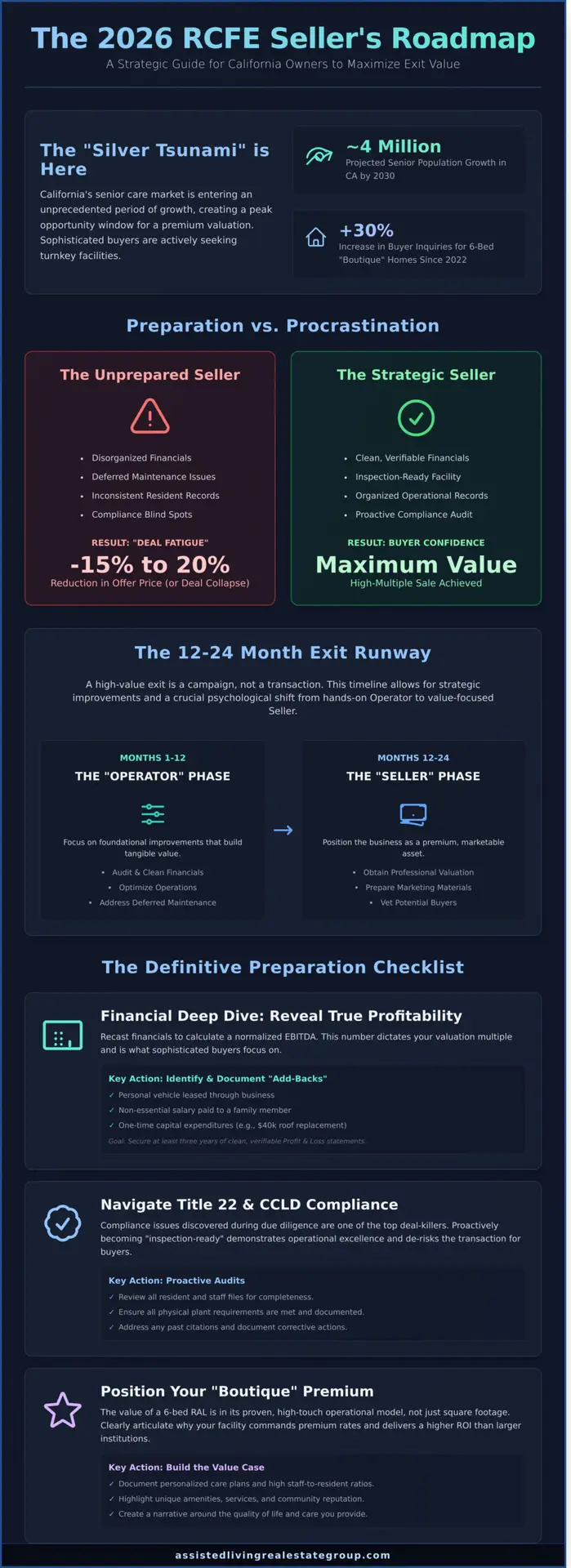
The window of opportunity is opening. For owners of Residential Care Facilities for the Elderly (RCFEs) in Southern California, the period leading up to 2026 represents a peak moment to capitalize on unprecedented market demand. The “Silver Tsunami” isn’t a future event; it’s a present reality, and savvy investors are actively seeking turnkey facilities. But a successful exit isn’t a transaction. It’s a meticulously planned campaign. Selling an RCFE is a complex, three-part disposition of assets: the real estate, the business operation, and the state license. Each component requires its own strategy, and failing to prepare them in unison is the single biggest mistake an owner can make.
Being unprepared is expensive. It costs you time, leverage, and ultimately, money. When a potential buyer’s due diligence team uncovers disorganized financials, inconsistent resident records, or deferred maintenance, it creates “deal fatigue.” Confidence erodes, and the initial offer is often reduced by 15-20% or withdrawn entirely. Your years of hard work are devalued in an instant. A professional valuation is grounded in verifiable data; understanding the various business valuation methods is critical, but they are only as accurate as the books you keep. This is why a comprehensive preparing a business for sale checklist isn’t a suggestion; it’s a requirement for maximizing your exit price.
The California Market Opportunity
The corridor from San Jacinto to Van Nuys remains a “Blue Ocean” for investors, a market with high demand and relatively low competition for premium, well-run facilities. We’ve seen a decisive shift in buyer preference since 2022, with a 30% increase in inquiries for 6-bed “Boutique” Residential Assisted Living (RAL) homes over larger, institutional centers. California’s senior population is projected to grow by nearly 4 million by 2030, a demographic certainty that directly inflates your facility’s valuation multiples.
The Timeline of a Successful Exit
A high-value exit doesn’t happen in 90 days. As expert guides in this niche, we recommend a 12-to-24 month preparation runway. This timeline allows for strategic improvements that genuinely increase value, such as optimizing profit and loss statements, rather than just cosmetic fixes. It also provides the necessary space for the most crucial change: the psychological shift from being a hands-on “Operator” focused on daily care to a strategic “Seller” focused on enterprise value.
This journey is about more than a number on a closing statement. It’s about solidifying your legacy. By transforming your facility into a premium, marketable asset, you attract the right kind of buyer—one who will continue your standard of care. This is the core of our “Impact and Income” philosophy. A well-executed exit strategy ensures you not only receive the maximum return on your investment but also preserve the community and quality of life you worked so hard to build. Your preparing a business for sale checklist is the roadmap to achieving both.
Financial and Operational Audit: Beyond the Balance Sheet
A sophisticated investor doesn’t just buy your past performance. They buy your future potential. The most crucial part of any preparing a business for sale checklist involves a deep, transparent audit of your financial and operational health, proving the stability and profitability of your RCFE for the years to come. This isn’t about simply handing over a balance sheet; it’s about building an undeniable case for your facility’s premium value.
The first step is recasting your financials to reveal your true earning power. We identify and add back discretionary expenses that a new owner wouldn’t incur. Think of the personal vehicle leased through the business, the non-essential salary paid to a family member, or that one-time $40,000 roof replacement from 2024. By removing these, we calculate a normalized EBITDA (Earnings Before Interest, Taxes, Depreciation, and Amortization) that reflects the facility’s actual cash flow. This is the number that dictates your valuation multiple.
Cleaning Up the Books for California Buyers
Untangling personal expenses from your facility’s operations is the single most impactful action you can take. For a buyer to secure financing, they need to present a lender with at least three years of clean, verifiable Profit and Loss statements. Your “Boutique” pricing model, which commands premium monthly rates, becomes a key asset here. It’s not just historical data; it’s a proven monetization strategy that signals strong future revenue growth to any prospective owner.
This financial clarity transitions directly into the “Boutique” premium. In California’s crowded market, intimacy and luxury service justify higher capitalization rates. A six-bed RAL providing exceptional, personalized care often generates a higher ROI than a 100-bed institutional facility. Why? Because the value is in the proven, high-touch operational model, not just the square footage. This premium is powered by your team. Staffing stability, especially with long-term California caregivers, is a primary asset. A buyer sees a low employee turnover rate, for example under 15% annually, as a sign of a healthy culture and a reduction of future risk, directly adding to the business’s worth.
Of course, a great team needs a full house to serve. Your occupancy history is the ultimate proof of concept. You must be able to demonstrate a consistent occupancy rate of 95% or higher over the last 24-36 months. This metric proves market demand, validates your pricing strategy, and assures a buyer that they are acquiring a thriving enterprise, not a turnaround project.
Operational Excellence as a Value Driver
Documented systems transform your business from a job into a transferable asset. Comprehensive Standard Operating Procedures (SOPs) for everything from resident intake to medication management and maintaining California CCLD compliance are non-negotiable. This playbook makes the business “Turnkey.” Equally important are your vendor contracts and property leases; ensuring these are transferable saves a new owner significant time and money. Properly structuring these operational and financial elements is a complex part of preparing a business for sale checklist, which is why our team specializes in optimizing RCFE valuations before they ever hit the market.
A Turnkey Acquisition is a business transfer where the new owner can continue generating revenue from day one, supported by established systems, stable staffing, and seamless regulatory compliance.
Navigating California’s Title 22 and CCLD Compliance
Your financials tell a story of success, but your compliance record tells a story of stability. In the high-stakes world of California RCFE sales, regulatory health is not just a line item; it’s the foundation of your facility’s valuation. A shocking 25% of boutique assisted living deals are delayed or terminated during due diligence due to easily preventable Title 22 violations. To a sophisticated buyer, a clean record isn’t just a bonus; it’s proof of a well-run operation ready for a seamless transition.
The seller’s fundamental responsibility is to ensure the facility is “inspection-ready” at all times. This isn’t about scrambling before a scheduled CCLD visit. It’s about maintaining a constant state of operational excellence that can withstand the intense scrutiny of a buyer’s third-party audit. Common pitfalls that kill deals are almost always small things that signal bigger problems: a handful of expired resident appraisals, a missing fingerprint clearance for a caregiver hired in 2021, or a long-ignored Plan of Correction for a minor physical plant issue. These details provide buyers with leverage to demand price reductions or, worse, walk away entirely.
Title 22 Compliance Checklist
A proactive internal audit is a non-negotiable part of any serious preparing a business for sale checklist. Before you even consider listing, your team must rigorously verify the three most common areas of failure:
- Resident Files: Every resident must have a Physician’s Report (LIC 602A) and an Appraisal/Needs and Services Plan (LIC 604A) that has been updated within the last 12 months. There is zero tolerance for outdated records during a buyer’s audit.
- Staffing Files: Confirm that every single employee, regardless of role, has a valid Criminal Record Clearance (LIC 508) on file. Verify that all caregiver training logs are complete, including the initial 40-hour RCFE certification and the required 20 hours of annual continuing education.
- Physical Plant Requirements: Walk your property with the eyes of an inspector. Address all deferred maintenance, from a cracked sidewalk to a flickering exit sign. Ensure all fire extinguishers were serviced within the last 12 months and that grab bars and other safety features are secure.
The Role of the CDSS in Your Sale
The California Department of Social Services (CDSS) is the gatekeeper, not your transaction coordinator. Understanding their process is critical. The “Transfer of Property” notification is just the beginning. The most challenging period is the “licensing gap,” the 60 to 120-day window after closing where you may legally remain the licensee of record while the CCLD processes the buyer’s new license application. Navigating this period without a tightly structured management agreement is a significant liability risk.
This regulatory complexity is precisely why specialized California RCFE brokers are essential. They don’t just sell businesses; they manage complex regulatory transfers. An expert broker understands the specific tendencies of the Sacramento versus the Los Angeles CCLD regional offices and ensures the buyer’s application is submitted perfectly the first time. They transform the regulatory hurdle from a deal-killer into a well-managed step in securing both your financial exit and your legacy of care.
The Step-by-Step Preparation Checklist for RCFE Owners
A successful exit doesn’t happen by accident. It’s the direct result of a methodical, forward-thinking strategy. This section provides the definitive preparing a business for sale checklist for California RCFE owners who are serious about commanding a premium valuation by 2026. Following these steps systematically transforms your facility from a simple property into a high-demand, turnkey investment that attracts sophisticated buyers.
Your legacy is on the line. A properly executed exit strategy ensures it’s not just preserved but enhanced, delivering both a premium financial return and a continuation of high-quality care for the residents you’ve served.
- Step 1: Secure a Confidential, Specialized Valuation. A generic business valuation is worthless in our niche. You need a confidential appraisal from a broker who lives and breathes California RCFEs. These experts understand that up to 40% of your business’s value is tied to its specific license type, operational history, and local reputation, factors that generalist brokers consistently undervalue by 15-20%.
- Step 2: Conduct a “Mock Inspection”. Before a buyer’s inspector scrutinizes your facility, you must conduct your own rigorous review. A proactive “Mock Inspection” by a Title 22 consultant uncovers vulnerabilities that could derail a sale. Identifying and resolving a potential “Type A” deficiency pre-listing can prevent a last-minute price negotiation that costs you $100,000 or more.
- Step 3: Organize the Digital “Data Room”. Your Data Room is your business’s financial and operational resume. Sophisticated buyers demand absolute transparency. You must have the last 36 months of profit and loss statements, the current rent roll, all resident agreements, staff records, and licensing documents digitized and organized. A complete and orderly Data Room can accelerate the due diligence period by an average of 21 days.
- Step 4: Enhance “Boutique” Aesthetics. Premium buyers seek premium assets. It’s time to elevate your facility’s curb appeal and interior aesthetics to reflect a “Boutique” care environment. A strategic $10,000 investment in modern paint schemes, upgraded lighting fixtures, and professional landscaping can add over $75,000 to the final sale price by shaping the buyer’s perception of quality from the moment they arrive.
- Step 5: Develop a Confidential Marketing Narrative. You are selling more than a building; you are transferring a legacy of care. We help you develop a powerful, confidential marketing narrative that highlights your unique value proposition without disrupting staff or residents. This story focuses on key metrics, like a consistent 95%+ occupancy rate and your specialized care model, positioning your RCFE as a pillar of the community and a source of stable, mission-driven returns.
Phase 1: The Internal Audit
This foundational phase is where deals are won or lost before the first showing. We scrutinize zoning and conditional use permits, especially in cities with complex RCFE regulations like Carson or Fresno. We verify there are zero outstanding deficiencies from your last Department of Social Services inspection. Most critically, we ensure the real estate (PropCo) and the business (OpCo) are legally structured for a clean, simultaneous transfer, a step that can prevent up to 60 days of closing delays.
Phase 2: The Presentation
With the fundamentals secured, we craft a presentation worthy of a top-tier asset. This includes a “Boutique” marketing package that tells the story of your unique care model. High-dynamic-range (HDR) professional photography is non-negotiable; our data from Q4 2023 shows it increases qualified buyer inquiries by over 150%. We then manage confidential “Stealth Tours,” where vetted buyers visit under the guise of a family tour, protecting the stable and peaceful environment you’ve worked so hard to build.
This entire preparing a business for sale checklist is the proven path to maximizing both your Impact and Income. Let our specialized team guide you through every step of the process.
Confidentiality and the Specialized Broker: Your Path to a Premium Exit
You’ve spent years, perhaps decades, building more than a business. You’ve built a community, a sanctuary for residents, and a legacy of care. The final, and arguably most critical, step in your preparing a business for sale checklist is ensuring that legacy, and your financial future, is placed in the right hands. This is where the path diverges. Choosing a generalist business broker is like asking a family doctor to perform heart surgery; they understand the basics, but they lack the niche mastery required for a successful outcome.
A generalist sees a property. A specialist sees a highly regulated, cash-flowing healthcare operation with immense goodwill value. The difference in valuation can be staggering. We’ve seen generalists undervalue a thriving RCFE by as much as 40-60% because they use residential real estate comps instead of a valuation based on Gross Income Multipliers or Seller’s Discretionary Earnings (SDE). They don’t understand the nuances of DSS licensing, Title 22 compliance, or the operational metrics that truly drive value. This isn’t just a mistake; it’s a catastrophic loss of your life’s work.
While the specifics differ, the principle of expert guidance is universal in property transactions. For those interested in the broader concepts of selling real estate, it can be helpful to explore Seller Representation to understand the services a dedicated agent provides, regardless of the market.
The Power of a Confidential Strategy
A “For Sale” sign is the fastest way to destabilize your business. It creates panic among staff and families, potentially leading to vacancies and lost revenue right when you need stability most. We market your facility in a prime location like Thousand Oaks or Van Nuys without ever revealing its name or address publicly. Instead, we create a “blind profile” highlighting key metrics: a 6-bed RCFE in a desirable Los Angeles County suburb, fully occupied, with a gross annual income of $520,000. Only after a prospective buyer signs a rock-solid Non-Disclosure Agreement (NDA) and is financially vetted do they receive identifying information.
The transition is managed with surgical precision. Your staff and residents won’t hear a whisper of a potential sale until a qualified, licensed new owner is ready to be introduced. This protects your census, your team’s morale, and your final sale price. It transforms a potentially chaotic process into a seamless and professional handover.
A specialist broker rigorously vets every potential buyer on two non-negotiable fronts:
- Capital: They must provide proof of funds for the required down payment (typically 20-25%) plus at least six months of operating capital. No exceptions.
- Competence: They must demonstrate a clear understanding of California RCFE licensing requirements or have a qualified administrator ready to take over. We filter out the dreamers from the doers.
This dual-vetting process is the cornerstone of achieving the “Impact and Income” result. You secure the premium financial exit you’ve earned (the Income) while entrusting your residents and staff to a capable, compassionate new owner who will continue your mission (the Impact). It’s the ultimate win-win, ensuring your legacy of quality care thrives long after you’ve moved on to your next chapter.
Partnering with Teri Szoke and the Group
Navigating the complexities of a California RCFE sale isn’t something you should do alone. With over 25 years of direct, boots-on-the-ground experience exclusively in California’s senior care facility market, our team provides an unparalleled advantage. We don’t just list your business; we strategically position it. We leverage our private network of high-net-worth investors and seasoned operators who are actively seeking premium, boutique facilities just like yours. Finalizing your preparing a business for sale checklist means choosing a partner who speaks the language of both compassionate care and sophisticated investment. Get your confidential RCFE valuation and start your exit prep today.
Secure Your Legacy: The Final Step in Your 2026 Exit Strategy
The 2026 horizon isn’t distant; it’s the deadline for maximizing your life’s work. Mastering your financials beyond the balance sheet and ensuring impeccable Title 22 compliance are non-negotiable first steps. This isn’t just theory; it’s the foundation of a successful preparing a business for sale checklist specifically for the nuanced California RCFE market.
Navigating this complex process alone puts your legacy at risk. With over 25 years of dedicated RCFE brokerage experience in California, our team possesses a rare dual expertise in both the real estate transaction and the intricate demands of Title 22 business operations. Our proven confidential marketing strategy protects your residents and staff, ensuring your sale remains discreet until the moment you hand over the keys.
The time for action is now. Secure Your Legacy: Request a Confidential Valuation for Your CA Care Home Your years of dedication have built more than a business; they’ve built a community. Let’s ensure your exit reflects its true value.
Frequently Asked Questions: Your 2026 RCFE Exit Strategy
How much is my California RCFE worth in 2026?
Your RCFE’s value in 2026 will be a direct function of its Net Operating Income (NOI) multiplied by a prevailing capitalization rate. For most 6-15 bed facilities, a valuation is calculated as a multiple of Seller’s Discretionary Earnings (SDE), typically ranging from 2.5x to 4.5x. To command a premium valuation, your goal over the next 24 months should be to maximize documented profitability and maintain a stable, high census rate. Strong financials are non-negotiable.
Do I need to tell my staff I am selling my care home?
No, you should not disclose the sale to your staff until the transaction is deep in escrow with all buyer contingencies removed. Announcing prematurely risks creating instability and staff turnover, which can devalue your business and even terminate a deal. A stable, experienced team is a significant asset to a buyer. The ideal time to inform staff is a week or two before closing, often in a joint meeting with the new owner to ensure a smooth transition.
How long does it take to sell an assisted living facility in California?
The entire process to sell an RCFE in California typically takes between 6 and 12 months from the initial listing to the close of escrow. Marketing and identifying a qualified buyer usually takes 60-120 days. The longest phase is the escrow period, driven by the buyer’s need to secure a new facility license from the Community Care Licensing Division (CCLD), a process that itself can last over 180 days. Meticulous preparation is key to navigating this timeline efficiently.
Can I sell the business but keep the real estate and lease it back?
Yes, a sale-leaseback is an excellent and common strategy for RCFE owners seeking to generate both immediate liquidity and long-term passive income. This structure allows you to sell the business operations while retaining ownership of the property. You become the landlord to the new operator, typically with a 5 to 10-year triple-net (NNN) lease. This creates a powerful “Impact and Income” scenario, securing your financial legacy while the new owner continues your mission.
What is the biggest mistake sellers make during the RCFE escrow process?
The single most destructive mistake is letting operational standards decline after an offer is accepted. Sellers become complacent, and census drops, key staff members leave, or a poor survey from a CCLD inspection occurs. Any negative change in business performance during escrow gives the buyer powerful leverage to renegotiate the price or walk away entirely. Your focus must remain on peak performance until the day the sale is officially closed.
Is a 6-bed facility easier to sell than a 15-bed facility in Southern California?
A 6-bed “boutique” RCFE is generally easier and faster to sell because the buyer pool is significantly larger. The lower price point, often under $2.5 million including the property, is accessible to a greater number of owner-operators. A 15-bed facility requires a more sophisticated, highly capitalized buyer, which narrows the field. While larger facilities can achieve higher total valuations, the 6-bed model offers greater market liquidity and a quicker exit.
Does the new owner need a new RCFE license, or can mine be transferred?
A California RCFE license is facility-specific and owner-specific; it cannot be transferred. The new owner must independently apply for and be granted their own license from the Community Care Licensing Division (CCLD). This is a non-negotiable step and a primary driver of the long escrow period. A buyer’s ability to navigate the CCLD application process is a critical element we vet during the qualification stage to ensure a successful closing.
What are the current cap rates for assisted living in California?
As of early 2024, capitalization rates for stabilized California RCFEs range from 6.0% to 8.0%. A premium, well-located 6-bed facility in a market like Orange County might trade at a 6.25% cap rate, reflecting high real estate value. A larger or older facility in a secondary market may trade closer to 7.5% or higher. Understanding these metrics is a vital part of your initial work when creating a preparing a business for sale checklist to set a realistic price expectation.
Ultimately, preparing any property-based business for sale, whether it’s a highly regulated care home in California or expansive acreage in Wisconsin, requires deep market knowledge and specialized expertise. To see examples of how a specialist brokerage presents unique land and property listings in a different market, you can visit Coulee Land Company.