
California’s senior housing market presents a paradox for many investors: a demographic gold rush shrouded in regulatory fog. You see the immense potential, but the complexities of Title 22 licensing, the challenge of valuing an operational care business, and the leap from passive real estate can feel insurmountable. These hurdles are precisely why invest in senior housing in the Golden State is such a powerful move for those with the right roadmap. It creates a high-barrier-to-entry market ripe for savvy entrepreneurs ready to achieve both Impact and Income.
An RCFE (Residential Care Facility for the Elderly) provides non-medical custodial care in a home-like, “boutique” setting. This is distinct from in-home services like Comfort At Home Homecare LLC, which bring assistance directly into a senior’s private residence. In contrast, a traditional nursing home, or Skilled Nursing Facility (SNF) in California, is an institutional medical facility for individuals requiring 24/7 skilled nursing care. RCFEs focus on quality of life and social engagement, which is a key reason why invest in senior housing, while SNFs focus on intensive, post-acute medical treatment.
This 2026 investor’s guide is that roadmap. Forget generic data. We will dive deep into the specific financial drivers and demographic trends unique to California, revealing the financial power behind the ‘Boutique’ Residential Assisted Living (RAL) model. You will gain the confidence that this demand is real and long-term, and see a clear path to entering a market that offers not just exceptional ROI, but a profound personal legacy.
Key Takeaways
- Understand how California’s massive demographic shift-the “Silver Tsunami”-creates an unprecedented supply and demand imbalance for savvy investors in key markets.
- Discover the powerful California RCFE model and see how its multiple revenue streams can generate significantly higher returns than a standard residential rental property.
- Uncover the core reasons why invest in senior housing is considered a recession-resistant strategy, driven by non-discretionary demand that remains stable in any economy.
- Learn the first critical steps to entering this market, from defining your investor profile to navigating California’s specific Title 22 regulations for a true “Impact and Income” investment.
The California ‘Silver Tsunami’: An Unprecedented Market Opportunity
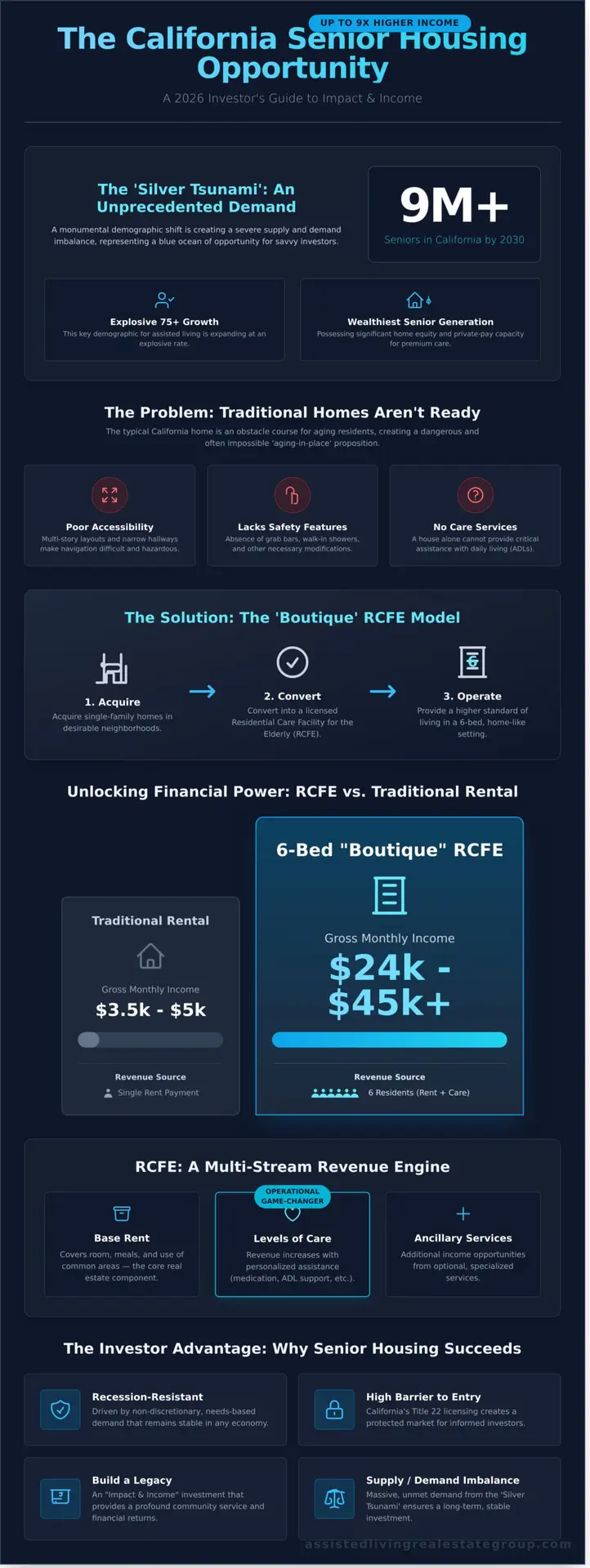
A monumental demographic shift is underway, and for the savvy investor, it represents a blue ocean of opportunity. California is at the epicenter of the “Silver Tsunami,” a wave of aging baby boomers creating unprecedented demand for specialized housing. By 2030, the state’s senior population is projected to swell to over 9 million, fundamentally reshaping the real estate landscape. This isn’t a distant trend; it’s a present-day reality creating a severe supply and demand imbalance in high-value markets like Los Angeles and Orange County.
The core challenge is clear. The vast majority of our state’s housing stock is dangerously unprepared for this aging population. This gap between what is needed and what is available is precisely why invest in senior housing is no longer a niche strategy but a mainstream imperative for building a lasting legacy and substantial returns.
California’s Demographic Gold Rush
While the overall senior population growth is staggering, the most critical segment for assisted living-the 75+ age group-is projected to grow at an explosive rate. This demographic is not only expanding but is also one of the wealthiest in California’s history, with many possessing significant home equity. This financial strength provides them with the private-pay capacity to afford the premium, boutique care they desire, creating a recession-resistant asset class for investors who can meet their needs.
Why Traditional Housing Fails California’s Seniors
The typical California single-family home is an obstacle course for an aging resident. Multi-story layouts, narrow hallways, and a lack of accessibility features make aging-in-place a dangerous and often impossible proposition. Furthermore, a house alone cannot provide the critical assistance with daily living (ADLs) that many seniors require. This failure of traditional housing creates a powerful opportunity for investors to:
- Acquire existing single-family homes in desirable neighborhoods.
- Convert them into licensed, 6-bed Residential Care Facilities for the Elderly (RCFEs).
- Provide a higher standard of living in an intimate, home-like setting.
This model directly addresses the market’s shift away from large, impersonal institutions. Families are actively seeking out boutique Residential Assisted Living (RAL) homes, which offer a stark contrast to the traditional Retirement community model of the past. This convergence of demographic need and consumer preference is the engine driving the most compelling real estate investment of the decade-a chance to achieve both Impact and Income.
Beyond Property Value: The RCFE Business Model in California
A savvy investor understands that true wealth isn’t just built on appreciation, but on powerful, consistent cash flow. This is the fundamental reason why invest in senior housing through California’s Residential Care Facility for the Elderly (RCFE) model. You are not just acquiring a property; you are launching a high-demand, mission-driven business that generates revenue far beyond what a traditional rental ever could. This is the key to unlocking both Impact and Income.
The financial distinction is staggering. Let’s compare a standard single-family rental with a licensed 6-bed “boutique” RCFE in a comparable California neighborhood:
| Metric | Traditional Single-Family Rental | 6-Bed RCFE (Residential Assisted Living) |
|---|---|---|
| Gross Monthly Income | $3,500 – $5,000 | $24,000 – $45,000+ |
| Revenue Source | Single Rent Payment | 6 Residents (Rent + Care Fees) |
| Cash Flow Potential | Low to Moderate | Substantially Higher |
Understanding RCFE Revenue Streams
The RCFE model transforms a single-family home into a multi-stream revenue engine. Unlike a standard lease, your income is layered, reflecting the comprehensive value you provide to residents and their families.
- Base Rent: This covers the resident’s private or semi-private room, meals, and use of common areas-the core real estate component.
- Levels of Care: This is the operational game-changer. Revenue increases directly with the level of personalized assistance a resident requires, from medication management to daily living support.
- Ancillary Services: Additional income opportunities include transportation to appointments, specialized memory care programs, incontinence supplies, and premium activities, creating a customized and more profitable service package.
Key Financial Metrics for California Investors
This robust business model directly translates into superior financial performance. While a traditional rental might struggle to produce positive cash flow, a well-run RCFE in California can generate a significant Net Operating Income (NOI), often exceeding $10,000-$15,000 per month. This powerful cash flow is driven by the state’s immense demand. The “Silver Tsunami” is not a future event; it’s a present reality, and compelling aging U.S. population statistics confirm this demographic wave will only grow, keeping occupancy rates for quality facilities consistently high-often above 90%.
This stability and high yield are why investors are turning to this asset class. In California, capitalization rates for senior housing typically outperform other real estate sectors, reflecting the strength of the underlying business. The combination of real estate appreciation and operational income creates a truly compelling Return on Investment (ROI). For investors asking why invest in senior housing, the answer lies in this uniquely powerful financial structure. To dig deeper into the numbers, see our guide on ROI in Senior Care: What Investors Should Know.
Recession Resistance: A Needs-Based Investment in Any Economy
When economic uncertainty looms, savvy investors seek assets that are insulated from market volatility. While sectors like commercial office space or retail can suffer from discretionary spending cuts, senior housing operates on an entirely different principle: it is a non-discretionary, needs-based service. The demographic forces driving this sector are powerful and predictable, offering a compelling answer to the question of why invest in senior housing for long-term portfolio stability.
The demand for quality care in California is not tied to quarterly earnings reports or consumer confidence indexes. It is driven by the unceasing reality of aging. This creates a powerful undercurrent of demand that has historically kept occupancy rates stable even during significant economic downturns. As the “Silver Tsunami” continues to reshape the state, authoritative California’s aging population projections from the Public Policy Institute of California forecast a near doubling of the 65+ demographic by 2040, solidifying this asset class as a true “blue ocean” opportunity for decades to come.
Why Demand is Inelastic
The decision to move a loved one into assisted living is driven by health and safety, not financial speculation. Families prioritize quality care above almost all other expenses, ensuring that Residential Assisted Living (RAL) facilities maintain consistent revenue streams. This inelastic demand translates directly into predictable cash flow and resilient property values, providing a defensive hedge against the cyclical nature of traditional real estate investments. The long-term nature of residency further stabilizes income, making it a cornerstone for achieving both Impact and Income.
California’s Regulatory Moat
In California, this inherent market stability is amplified by a significant barrier to entry: state regulation. The rigorous and complex licensing process for a Residential Care Facility for the Elderly (RCFE) under Title 22 standards prevents the market from becoming oversaturated with new competition. This regulatory moat protects the value and profitability of existing, compliant facilities. For an investor, this is a critical advantage, making the acquisition of a turnkey, licensed RAL home a far more strategic and secure path to market entry. Learn more by Navigating the RCFE License Process in California.
The ‘Impact & Income’ Advantage: Building a Legacy, Not Just a Portfolio
Modern investors demand more than just a strong ROI; they seek a return on purpose. This is the core of our ‘Impact and Income’ philosophy: the principle of doing good while doing well. Investing in assisted living real estate isn’t just a transaction involving cap rates and zoning permits. It’s an opportunity to build a meaningful legacy, creating a business that directly improves the lives of California’s most vulnerable seniors and their families. For many forward-thinking entrepreneurs, the most compelling reason why invest in senior housing is this unique fusion of profound community contribution and exceptional financial performance.
Solving a Critical Social Need
You are directly answering a crisis. California faces an unprecedented shortage of quality senior care options as the “Silver Tsunami” crests. Your investment creates a safe, dignified home for residents, offering immense relief to families who have been searching desperately for a local solution. Imagine a daughter in San Diego finally finding a place for her father that feels like home, not a hospital. Beyond the residents, your facility becomes a vital community asset, creating stable, local jobs for skilled caregivers and support staff.
The Power of Boutique Care Environments
Our focus is on the “boutique” Residential Care Facility for the Elderly (RCFE) model-intimate homes with 6-15 beds, not institutional “big box” facilities. This model is the future of senior care. It allows for a higher staff-to-resident ratio, personalized attention, and a genuine home-like atmosphere that drastically improves quality of life. This superior care experience isn’t just a moral victory; it’s a strategic business advantage that commands premium pricing, attracts private-pay residents, and builds a powerful, trusted brand in your community.
Ultimately, this isn’t just another property in your portfolio. It is a testament to your values and a tangible asset that generates both consistent income and profound personal satisfaction. When you ask why invest in senior housing, the answer lies in building a business that truly matters. Learn more about creating your own impact investment by exploring the opportunities at assistedlivingrealestategroup.com.
Building a diverse portfolio often involves exploring various types of tangible assets. While senior housing offers a unique combination of impact and income, some investors also look to land for its long-term value. For those interested in seeing examples of land and recreational properties in the Midwest, you can visit Coulee Land Company.
Similarly, the market for unique rural and lifestyle properties is another area of interest for those diversifying their holdings. For instance, specialized platforms like Colorado Horse Property cater to investors looking for equestrian estates and ranches, demonstrating the breadth of opportunities available in niche real estate.
This interest in lifestyle-focused assets sometimes extends to personal planning, with many investors exploring retirement destinations abroad. For those looking into international options, resources like Expat Retirement Chronicles offer insights into popular destinations like Thailand.
Your Path to Entry: How to Start Investing in California Senior Housing
The immense opportunity of the “Silver Tsunami” is clear. But translating that potential into a successful portfolio of Impact and Income requires a strategic, methodical approach. The question for savvy investors is no longer why invest in senior housing, but how to do so successfully within California’s high-barrier-to-entry market. This roadmap provides the critical first steps.
Your journey begins with a clear, four-step process designed to navigate the complexities and unlock the potential of this rewarding asset class:
- Step 1: Define Your Investment Goals. First, determine your role. Will you be a passive landlord, owning the property and leasing it to a proven operator for steady cash flow? Or will you be an active owner-operator, directly managing the boutique care business to maximize returns? This fundamental decision shapes every subsequent step.
- Step 2: Get Educated on State Regulations. In California, Residential Care Facilities for the Elderly (RCFEs) are governed by the Department of Social Services under a complex set of rules known as Title 22. A deep understanding of these state-level licensing, staffing, and care requirements is non-negotiable and foundational to your success.
- Step 3: Secure Specialized Financing. Conventional lenders often fail to grasp the value of an RCFE. You need to connect with specialized lenders in the healthcare facility space who can accurately underwrite a loan based on the combined value of the real estate and the operational business cash flow.
- Step 4: Partner with a Specialist Broker. Navigating this niche is not a solo endeavor. A specialized broker acts as your strategic partner, providing the market intelligence and transactional expertise essential for a successful acquisition.
Choosing Your Investment Strategy
Your entry point can be tailored to your capital, risk tolerance, and operational experience. The most common paths for investing in California’s boutique RAL (Residential Assisted Living) market include buying the real estate and securing a triple-net (NNN) lease with an experienced operator, acquiring a fully operational and licensed turnkey RCFE, or starting from scratch by converting a suitable property and navigating the entire state licensing process yourself.
Why a Specialized Broker is Essential
A generalist realtor cannot unlock this market. The right partner provides a decisive advantage, offering access to confidential, off-market listings and the expertise to value the business component-often worth as much as the real estate itself. They guide you through the intricate due diligence and licensing transfer process, protecting your investment and ensuring a smooth transition. This partnership is the key to turning your vision of Impact and Income into a tangible reality.
Begin your confidential search with California’s RCFE specialists.
The Time is Now: Secure Your Future in California Senior Housing
The convergence of California’s massive demographic shift and the unique RCFE business model presents a rare blue ocean opportunity for savvy investors. This guide has laid out the definitive case for why invest in senior housing: it is a recession-resistant asset class that allows you to build a legacy of both impact and income. You are not just acquiring property; you are meeting a critical, growing need within our communities while securing significant financial returns.
Navigating this high-barrier-to-entry market requires a strategic partner. With over 25 years of specialized experience in California, our team provides the expertise in both real estate and business operations you need, all handled with confidential marketing to protect your interests. When you are ready to transform this opportunity into your reality, we are here to guide you.
Explore current senior housing investment opportunities in California.
Frequently Asked Questions About Investing in Senior Housing
Is investing in senior housing profitable in California?
Absolutely. California’s demographic shift, the “Silver Tsunami,” creates immense demand against a limited supply of quality senior housing. This imbalance drives high occupancy rates and strong ROI, particularly for boutique Residential Assisted Living (RAL) models. For savvy investors, this isn’t just a profitable venture; it’s a chance to build a legacy of “Impact and Income” in one of the nation’s most lucrative real estate markets, answering a critical need while achieving significant financial goals.
What are the biggest risks when investing in senior housing?
The primary risks are regulatory compliance and operational management. Navigating California’s stringent Title 22 regulations, managed by the Department of Social Services, is non-negotiable and requires expert guidance. Additionally, securing and retaining qualified, compassionate staff is critical to maintaining your license and ensuring high-quality care. These high barriers to entry are precisely what protect the investment for those who have the right strategic partner to guide them through the complexities of this specialized market.
Do I need a healthcare background to own an RCFE in California?
No, a healthcare background is not a prerequisite for ownership. The key is to operate as a savvy investor and business owner, not a day-to-day caregiver. California law requires that every RCFE has a certified Administrator responsible for operations and compliance. Your role is to own the asset and the business, while you hire a qualified professional to manage the licensed care component. This strategic separation allows you to focus on the investment’s performance and growth.
How much capital is required to buy an assisted living facility in California?
Capital requirements in California are significant, reflecting the high value of the underlying real estate. For a typical 6-bed boutique RCFE in Southern California, expect an all-in acquisition cost ranging from $1 million to $2.5 million or more, depending on location. This includes the property, the business license, and initial working capital. Investors typically utilize a combination of down payment (20-25%) and specialized financing, such as an SBA loan, to structure the deal.
What is the difference between an RCFE and a traditional nursing home?
An RCFE (Residential Care Facility for the Elderly) provides non-medical custodial care, such as assistance with daily living activities, in a home-like, “boutique” setting. In contrast, a traditional nursing home, or Skilled Nursing Facility (SNF) in California, is an institutional medical facility for individuals requiring 24/7 skilled nursing care. RCFEs focus on quality of life and social engagement, which is a key reason why invest in senior housing, while SNFs focus on intensive, post-acute medical treatment.
Can I use an SBA loan to finance the purchase of an RCFE?
Yes, using an SBA loan is a powerful and common strategy for acquiring an RCFE in California. Both the SBA 7(a) and 504 loan programs can be used to finance the purchase of the real estate and the business operations. These loans are attractive because they often require a lower down payment (as little as 10-15%) and offer longer amortization periods than conventional loans, which significantly improves cash flow for investors tackling the high-value California market.
How does California’s Title 22 affect my investment?
California’s Title 22 is the regulatory framework that governs every aspect of your RCFE’s operation, from staffing ratios and resident rights to physical plant requirements. For an investor, it is not a hurdle but the blueprint for excellence and compliance. Adhering to Title 22, overseen by the Community Care Licensing Division, is essential for maintaining your license and mitigating risk. Mastering these regulations is a key barrier to entry that protects dedicated, professional operators from casual competition.
What are the first steps to finding an RCFE for sale in Southern California?
The first, most critical step is to partner with a specialized brokerage firm that focuses exclusively on RCFE transactions in Southern California. General real estate agents lack the nuanced understanding of licensing, operations, and valuation. A specialist provides access to off-market opportunities and guides you through financial pre-qualification and defining your investment criteria. This ensures you are prepared to act decisively when the right “Impact and Income” opportunity arises in this competitive market.