
The decision to buy an assisted living facility in California is more than a real estate transaction; it’s an entry into a high-barrier, high-reward market where legacy and profit intersect. Yet, many visionary investors are stopped cold, overwhelmed by the labyrinth of Title 22 regulations, the complexities of operational due diligence, and the critical choice between acquiring the business versus the real estate. They see the vast “blue ocean” opportunity of the Silver Tsunami but lack the chart to navigate its promising waters.
This guide is that chart. We will provide the definitive, step-by-step roadmap to master the entire acquisition process with confidence. You will learn to analyze financials, secure specialized financing, and navigate the critical licensing transfer to ensure a seamless transition from day one. Prepare to transform your ambition into a thriving enterprise that delivers both exceptional impact and income, building a true legacy of compassionate care and superior returns.
Key Takeaways
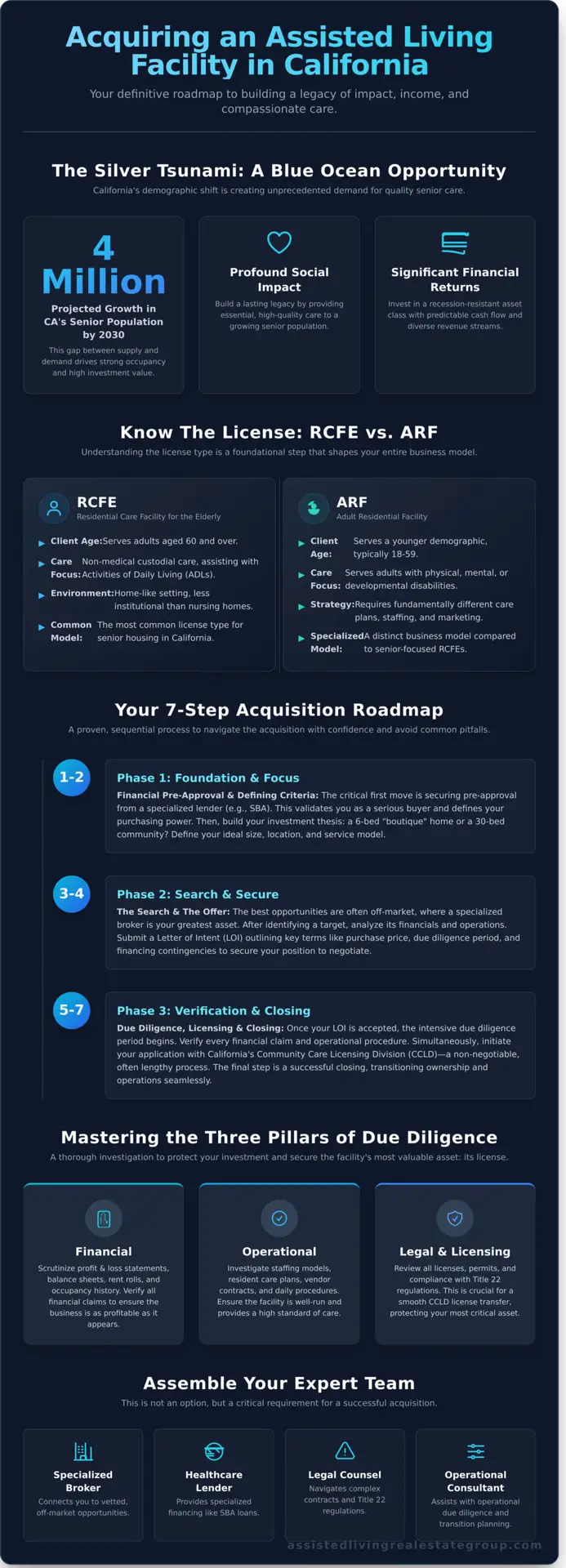
- California’s “Silver Tsunami” presents a rare opportunity to build a legacy of both significant financial returns and profound social impact.
- To successfully buy an assisted living facility in California, you must follow a strategic acquisition roadmap that demystifies the process from initial analysis to closing.
- Master the three pillars of due diligence-financial, operational, and legal-to protect your investment and secure the facility’s most valuable asset: its state license.
- Assembling a specialized team of legal, financial, and operational experts is not an option but a critical requirement for a successful acquisition.
The California Opportunity: Why Invest in an Assisted Living Facility?
The demographic shift is here. California’s “Silver Tsunami” isn’t a looming crisis; it’s a blue ocean opportunity for savvy investors ready to meet a critical market need. The decision to buy an assisted living facility in California is more than a real estate transaction-it is an entry into a stable, recession-resistant asset class that delivers both significant financial returns and profound social value. This is the dual mission of ‘Impact and Income’ in action, where you build a lasting legacy by providing essential, high-quality care.
Unlike traditional real estate, this sector offers a unique chance to control both the property and the operating business, creating powerful, predictable cash flow. The key is understanding the landscape, from intimate, six-bed ’boutique’ homes that offer premium, personalized care to larger, more traditional facilities. Each model presents distinct operational challenges and financial rewards.
Understanding the Market Dynamics
The numbers speak for themselves. California’s senior population is projected to grow by four million by 2030, creating an unprecedented gap between the supply of and demand for quality senior housing. This imbalance drives strong occupancy rates and provides a defensive moat for your investment. Financially, this translates to attractive capitalization rates and diverse revenue streams beyond basic rent, including tiered levels of care, medication management, and other ancillary services that increase per-resident value.
RCFE vs. ARF: Know The Difference
Before you can buy an assisted living facility in California, you must understand its license type, which dictates your entire business model. The two primary licenses are:
- RCFE (Residential Care Facility for the Elderly): This is the most common license for senior housing, serving adults aged 60 and over. The focus is on non-medical custodial care, assisting with activities of daily living (ADLs) in a home-like setting. The core concept of this model, as detailed in this overview of what is assisted living, is to provide a less-institutional alternative to nursing homes.
- ARF (Adult Residential Facility): This license serves a younger demographic, typically adults aged 18-59, who may have physical, mental, or developmental disabilities. The care plans, staffing requirements, and marketing strategies for an ARF are fundamentally different from an RCFE.
Choosing the right license is a foundational step that will shape your resident profile, operational strategy, and ultimate success.
Your Acquisition Roadmap: A 7-Step Process to Buying a CA Facility
The path to acquiring a profitable care facility is paved with strategic decisions, not guesswork. This proven 7-step roadmap demystifies the journey, guiding you from initial financial planning to a successful closing. Following this sequence is essential when you buy an assisted living facility in California, helping you avoid the common pitfalls that derail even the most promising transactions and ensuring you build a legacy of both impact and income.
Steps 1-2: Financial Pre-Approval & Defining Your Criteria
Your journey begins not with a property search, but with your finances. Securing pre-approval from a lender specializing in healthcare or SBA loans is the critical first move. It validates you as a serious buyer and defines your purchasing power. With capital confirmed, you can build your investment thesis: Are you targeting a 6-bed “Boutique” Residential Assisted Living (RAL) home or a larger, 30-bed community? Define your ideal size, location, and service model to focus your search with precision.
Steps 3-4: The Search & The Offer
The most lucrative opportunities are often off-market. This is where a specialized broker becomes your greatest asset, connecting you to a pipeline of unlisted, vetted facilities. Once you identify a target, you’ll analyze its financials, occupancy rates, and operational history. Your next step is submitting a Letter of Intent (LOI)-a non-binding offer outlining key terms like purchase price, a defined due diligence period, and financing contingencies. A well-crafted LOI sets a professional tone and secures your position to negotiate.
Steps 5-7: Due Diligence, Licensing & Closing
Once your LOI is accepted, the intensive due diligence period begins. This is your chance to look under the hood, verifying every financial claim and operational procedure. Simultaneously, you must initiate your application with California’s Community Care Licensing Division (CCLD). This is a non-negotiable, often lengthy process that requires a deep understanding of California’s Licensing Requirements and operational standards. With due diligence cleared and licensing in progress, you will finalize the binding Purchase and Sale Agreement, paving the way for a smooth closing and transition of ownership that protects the well-being of residents and staff.
Mastering Due Diligence: What to Investigate Before You Buy
The offer is accepted. The real work begins now. Due diligence is your non-negotiable shield against a poor investment, transforming a promising opportunity into a predictable asset. This is where you move beyond the seller’s pro-forma and uncover the true operational health and financial viability of the business. It’s the single most critical phase that determines whether you will achieve both impact and income.
Your investigation should be structured around three core pillars: financial stability, operational excellence, and legal compliance. Getting this right is the difference between acquiring a thriving community and inheriting a costly liability.
Financial and Operational Review
A facility’s true story is written in its numbers and daily operations. Your goal is to verify the seller’s claims and identify opportunities for optimization. A deep dive into the financials is a core component of successfully Investing in Assisted Living, as detailed by industry experts. Scrutinize every line item to build an accurate picture of the asset’s performance and potential.
- Financial Statements: Request at least three years of Profit & Loss (P&L) statements, balance sheets, and rent rolls. Look for trends in revenue, key expenses like staffing and food, and overall profitability. Are the numbers stable, growing, or declining?
- Occupancy & Market Position: How does the facility’s current occupancy rate compare to the local California market average? High resident turnover or deep discounting to fill beds are significant red flags that may signal care quality or management issues.
- Capital Expenditures (CapEx): Assess the physical condition of the property. A professional inspection is essential to identify immediate needs (e.g., a new roof, HVAC system) and budget for future replacements. These hidden costs can decimate your ROI if not planned for.
- Staffing Analysis: Your staff delivers the care that justifies your premium rates. Review payroll records, staff retention rates, training logs, and any contracts for key employees like the administrator. High turnover is a costly problem that often signals deeper operational issues.
Legal and Licensing Compliance
In California, compliance is everything. A facility with a poor regulatory history is a liability waiting to happen, regardless of its profitability. When you buy an assisted living facility in California, you are also acquiring its compliance record. Ensuring a clean slate is paramount to protecting your investment and your future license.
- CDSS Licensing History: Public records from the California Department of Social Services (CDSS) will reveal the facility’s entire history of inspections, citations, and any filed complaints. This is your objective measure of quality and risk.
- Title 22 & Zoning: Verify that the property and its operations are in full compliance with California’s Title 22 regulations. Separately, confirm that local zoning laws permit the facility’s current use and any future expansion plans you may have.
This process is meticulous and leaves no room for error. To ensure you cover every critical detail, consider consulting with experts like the Assisted Living Real Estate Group, who can provide a comprehensive roadmap for your investigation.
Navigating California’s Licensing Labyrinth: A Buyer’s Overview
When you set out to buy an assisted living facility in California, you are acquiring more than real estate and a business model. You are pursuing its most valuable asset: the license to operate. This is the key that unlocks your ability to generate both Impact and Income. However, navigating the state’s regulatory framework is a high-stakes process where preparation is paramount.
The entire process is overseen by the Department of Social Services, Community Care Licensing Division (CCLD). Their mandate is to ensure the health and safety of residents, and they take this responsibility seriously. A critical, often misunderstood, fact is that a facility’s license is non-transferable. The seller’s license becomes void upon the sale; you must apply for and be granted a completely new license in your name. This is not a simple paperwork transfer-it is a comprehensive vetting of you as a new operator. Missteps here can lead to months of costly delays, jeopardizing your investment before you even open your doors.
The Licensing Application Process
Your journey begins with a detailed application packet submitted to the CCLD. This is your first impression and must be flawless. Key components typically include the Application for a Community Care Facility License (LIC 215), financial capacity verification (LIC 400), and detailed plans of operation. A mandatory applicant orientation course provides the foundational knowledge of Title 22 regulations. The CCLD will meticulously review your qualifications, operational plans, and financial statements to ensure you have the capital and competence to provide exceptional care and run a sustainable business.
Preparing for the Site Visit
After your application is accepted, a Licensing Program Analyst (LPA) will schedule a comprehensive site visit. This is not a cursory walkthrough. The LPA will inspect the physical plant for safety compliance, review personnel and resident records, and ensure all operational protocols meet state standards. Common areas of focus include fire safety systems, medication management procedures, and resident privacy. Any identified deficiencies must be corrected promptly, and a solid plan of correction is crucial for moving forward toward approval.
Working with a Specialized Broker
This is where an expert guide becomes indispensable. A specialized broker does more than find properties; they orchestrate the entire transaction around the licensing timeline. They act as the central coordinator between you, the seller, escrow, and the CCLD, ensuring every milestone is met in the correct sequence. Leveraging their deep experience, a seasoned partner can help you anticipate regulatory hurdles and proactively assemble an application packet designed for success. This strategic guidance transforms the labyrinth into a clear, manageable path. To learn how we streamline this process for our clients, explore our advisory services.
Assembling Your Expert Team: Who You Need for a Successful Acquisition
Attempting to buy an assisted living facility in California is not a solo endeavor; it’s a team sport where the stakes are your capital and your future legacy. The most successful investors understand that assembling a specialized team isn’t an expense-it’s the single most important investment you can make. Each professional plays a critical, distinct role in navigating the complexities of the transaction, protecting you from costly oversights, and positioning your acquisition for long-term success. Think of your specialized broker as the quarterback, directing the play and ensuring every team member executes their role flawlessly.
The Core Three: Broker, Attorney, and Accountant
Your journey begins with a foundational trio of experts who will form the strategic core of your acquisition team. Skimping here is not an option if you are serious about achieving both Impact and Income.
- Specialized Healthcare Broker: This is your guide and strategist. Beyond just finding off-market deals, a top-tier broker provides valuation analysis, negotiates on your behalf, and manages the entire due diligence and closing process, keeping the transaction on track.
- Healthcare Attorney: Your legal shield. This professional scrutinizes purchase agreements, lease contracts, and partnership documents. Crucially, they advise on California’s specific licensing regulations, liability exposure, and compliance pitfalls unique to the senior care industry.
- CPA / Accountant: Your financial sentinel. A CPA with experience in healthcare businesses will conduct deep financial due diligence, verifying the seller’s P&L statements and uncovering the true financial health of the facility. They also provide vital counsel on tax implications and the optimal ownership structure for your goals.
Additional Key Partners
Beyond the core three, several other professionals are essential to bringing your acquisition across the finish line and ensuring it operates smoothly from day one.
- Commercial Lender: Your capital partner, providing the financing necessary to close the deal. A lender experienced in the assisted living sector will understand the business model and offer more favorable terms.
- Insurance Agent: Your risk manager, responsible for securing the appropriate professional liability, property, and casualty insurance required to operate a care facility in California.
- Licensing Consultant (Optional): For complex transactions or first-time buyers, a consultant can be invaluable in navigating the California Department of Social Services (CDSS) application and ensuring a seamless transfer of the facility’s license.
- General Contractor: If renovations or expansions are part of your business plan, a reliable contractor is essential. While specialized local firms are a must, looking at the portfolio of major builders like ELAF International General Contracting Co can provide a benchmark for the quality and scale required for commercial care facilities.
Building this powerhouse team from scratch can be daunting. The right strategic partner already has a vetted network of these professionals ready to deploy for your acquisition. Connect with our team to get direct access to the experts you need to confidently buy an assisted living facility in California.
Your Legacy Begins Now: Seizing the California Senior Living Opportunity
The journey to acquire a senior care facility is as rewarding as it is complex. As this guide has shown, success hinges on a mastery of due diligence, a clear understanding of the state’s licensing labyrinth, and assembling a dedicated team of experts. To successfully buy an assisted living facility in California is to seize a rare opportunity-one that generates significant returns while profoundly impacting lives.
You don’t have to navigate this high-barrier-to-entry market alone. At Assisted Living Real Estate Group, we bring over 25 years of specialized experience to your acquisition. We provide expert guidance through California’s complex licensing process and utilize confidential marketing to protect business continuity, ensuring a smooth and successful transition. Your vision for a boutique care environment deserves a strategic partner who understands both impact and income.
Ready to transform your vision into a thriving reality? View Our Confidential Listings of California Care Facilities and begin building your legacy today.
Frequently Asked Questions About Buying a Care Facility in California
Can I buy an assisted living facility if I don’t have a healthcare background?
Absolutely. Many successful investors in this space do not have a clinical background. Your role is that of the visionary entrepreneur and asset manager. The key is to hire a qualified and licensed RCFE Administrator to oversee daily operations, resident care, and state compliance. This strategic partnership allows you to focus on the investment’s financial performance and growth while ensuring the highest quality of life for residents, perfectly embodying the principle of generating both Impact and Income.
What’s the difference between buying the business and just the real estate?
This is a critical distinction for investors. Buying the business means acquiring the operational entity, including its cash flow, staff, resident contracts, and the license to operate. Buying the real estate means you own the physical asset and act as the landlord. Acquiring both provides total control over your investment and its destiny. Separating them can also be strategic, allowing one entity to focus on boutique care and another on appreciating real estate assets.
How long does it typically take to buy an RCFE in California, including licensing?
The timeline is a multi-stage process driven primarily by state licensing. While the real estate transaction can close in as little as 30-60 days, securing your RCFE license from the California Department of Social Services (CDSS) is the longest phase. From an initial offer to final licensure, a savvy investor should prudently budget for a 6 to 9-month timeline. This high barrier to entry is precisely what protects the value for dedicated, well-prepared operators.
What are the most common mistakes first-time buyers make?
The most significant error is underestimating the true capital required, not just for the purchase but for operational reserves and potential renovations. Another common pitfall is incomplete due diligence, specifically overlooking the facility’s past compliance record with the CDSS. A history of citations can signal deep operational issues. Finally, many fail to secure a qualified administrator early in the process, which is essential for a smooth transition and immediate operational excellence.
How much capital do I need to buy a 6-bed assisted living facility?
Your total capital outlay extends far beyond the sale price. In California, prices for a 6-bed facility can range from $700,000 to over $1.5 million, depending heavily on location. A prudent investor should budget an additional 15-25% of the purchase price to cover the down payment, closing costs, licensing fees, and at least six months of operating reserves. To successfully buy an assisted living facility in California, you must be well-capitalized for a strong launch.
Are there specific financing options like SBA loans available for these purchases?
Yes, and they are a powerful tool for this asset class. SBA loans, particularly the 7(a) and 504 programs, are exceptionally well-suited for these acquisitions because they can finance the business, equipment, and real estate in a single package. These government-backed loans often offer more favorable terms, such as lower down payments (as low as 10-15%) and longer amortization periods, which significantly improves your cash flow and overall ROI from day one.