
The ‘Silver Tsunami’ is not a crisis; it’s the single greatest ‘blue ocean’ opportunity for savvy investors today. Yet, searching for rewarding assisted living facilities for sale in California often feels like navigating a maze without a map. You’re met with generic property listings that fail to capture the true value of the business-the quality of care, the operational efficiency, and the potential for real social impact. The complex world of RCFE licensing creates a high barrier to entry, leaving many investors overwhelmed and fearful of making a costly mistake.
This is not another list of properties. This is your strategic roadmap. In this definitive guide, we cut through the noise to reveal how to identify and acquire profitable, vetted senior care businesses in California’s booming market. You will learn the critical metrics for evaluating a facility’s success beyond its four walls, understand the pathway to seamless licensing, and discover how to build a portfolio that achieves both significant financial returns and a lasting, positive legacy. It’s time to move from uncertainty to action.
Key Takeaways
- Frame California’s “Silver Tsunami” not as a crisis, but as a prime ‘Impact and Income’ opportunity for savvy investors in a resilient real estate sector.
- Go beyond the asking price by mastering the key operational metrics that separate a high-performing business from a simple real estate transaction.
- Discover how to strategically evaluate the different types of assisted living facilities for sale in California to find the model that aligns with your investment goals.
- Uncover why the most profitable investment opportunities are confidentially marketed and almost never appear on public listing websites.
The California Senior Housing Market: A Prime ‘Impact and Income’ Opportunity
The demographic shift known as the “Silver Tsunami” is not a looming crisis; it is the single greatest driver of opportunity in specialty real estate today. For the savvy investor, this wave represents a chance to build a legacy of both Impact and Income. The demand for quality senior housing is exploding, yet the supply of modern, boutique-style facilities remains critically low. This imbalance creates a powerful and resilient investment sector, insulated from the volatility of traditional markets. When you explore assisted living facilities for sale in California, you are entering a market defined by profound need and exceptional financial potential-a true opportunity to do good while doing well.
Understanding California’s Facility Types: RCFE vs. ARF
In California, senior housing investments primarily fall into two licensed categories. A Residential Care Facility for the Elderly (RCFE) is licensed to care for seniors aged 60 and over, providing assistance with daily living in a non-institutional setting. This is the most common and sought-after model for senior care investors. While the services are specific, if you’re asking the broader question, What is an Assisted Living Facility?, the RCFE model is California’s answer for personalized, residential-style care. In contrast, an Adult Residential Facility (ARF) serves adults aged 18-59, often with developmental or mental health needs.
Why California is a Unique Market for Senior Care
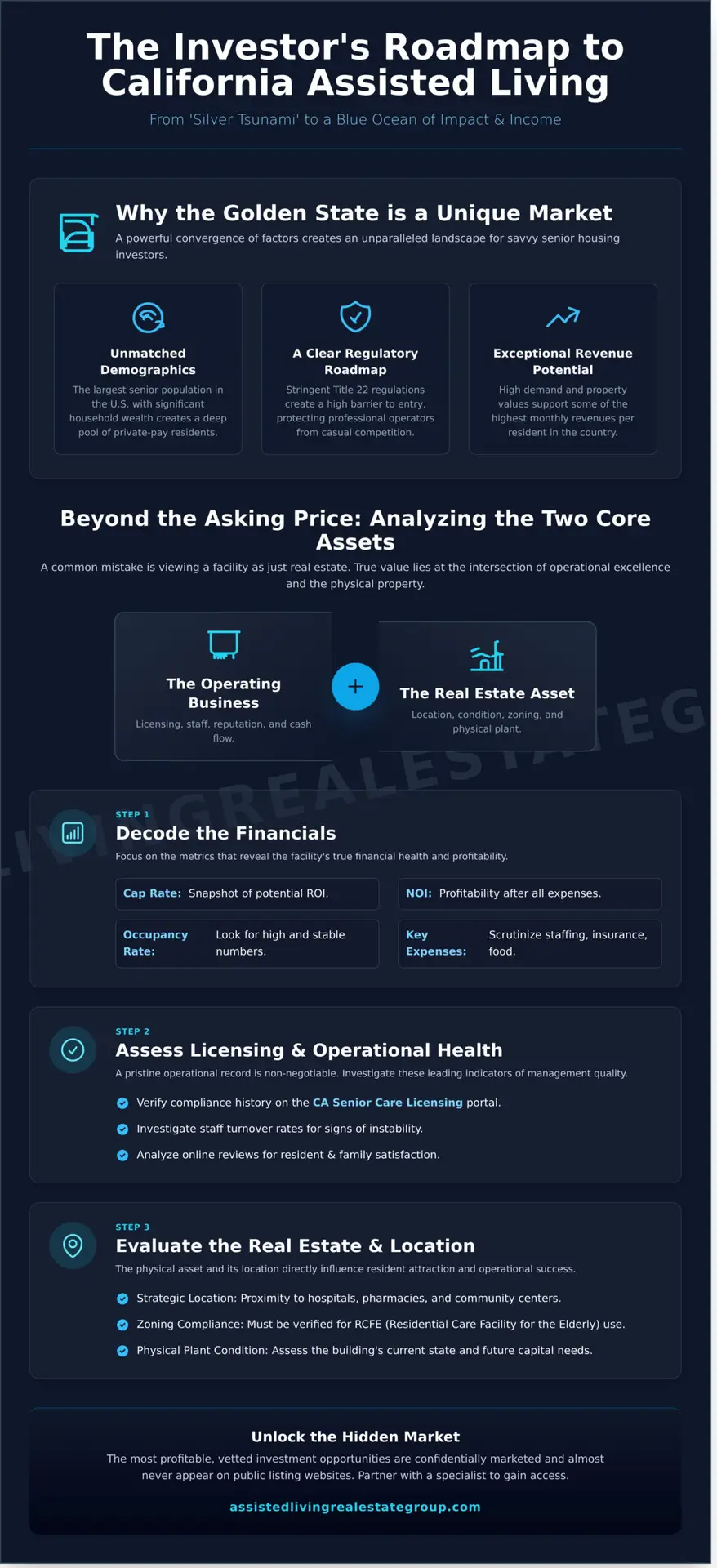
The Golden State presents an unparalleled landscape for Residential Assisted Living (RAL) investors. The market for assisted living facilities for sale in California is uniquely robust due to a convergence of powerful factors:
- Unmatched Demographics: California has the largest senior population in the nation. This, combined with significant household wealth, creates a deep and consistent pool of private-pay residents capable of affording premium care.
- A Clear Regulatory Roadmap: While stringent, California’s Title 22 regulations provide a predictable framework for operation. This high barrier to entry protects professional operators from casual competition and ensures a standard of quality.
- Exceptional Revenue Potential: High property values and intense demand allow for some of the highest monthly revenues per resident in the country, leading to impressive cap rates and a strong return on investment for well-managed facilities.
How to Analyze an Assisted Living Facility Listing: Beyond the Asking Price
The most common mistake new investors make is viewing an assisted living facility as just a piece of real estate. This is a critical error. You are acquiring a complex, highly regulated operating business that provides essential care-the building is merely the vessel. When you analyze assisted living facilities for sale in California, you must dissect two separate but intertwined assets: the property itself and the business enterprise. True value lies at the intersection of real estate performance and operational excellence, creating the potential for both impact and income.
Decoding the Financials
Look beyond the gross revenue and focus on the metrics that reveal a facility’s true financial health. The Capitalization (Cap) Rate gives you a snapshot of your potential return on investment, while the Net Operating Income (NOI) is the lifeblood, showing profitability after all expenses. Scrutinize key expense categories like staffing, insurance, and food costs. A high, stable occupancy rate combined with strong revenue per client is the formula for a thriving enterprise.
Assessing Licensing and Operational Health
A pristine operational record is non-negotiable. Your due diligence must begin with a thorough review of the facility’s history with the state’s regulatory body. You can verify compliance and check for any past citations through the official California’s Senior Care Licensing Program portal. Beyond licensing, investigate staff turnover rates and online reviews, as these are leading indicators of management quality and resident satisfaction. This analysis will reveal if you’re buying a stable, ‘turnkey’ operation or a ‘value-add’ opportunity requiring strategic improvements.
Evaluating the Real Estate and Location
The physical asset and its location directly influence your success. A prime facility is strategically located near hospitals, pharmacies, and community centers, making it attractive to residents and their families. It’s crucial to verify that the property complies with local zoning ordinances for Residential Care Facilities for the Elderly (RCFEs). Finally, assess the physical plant itself: Is it ADA-compliant? Does the mix of private versus shared rooms align with market demand and maximize revenue potential?
Exploring Common Facility Types for Sale in California
The market for assisted living facilities for sale in California is not monolithic. It’s a diverse ecosystem of opportunities, each with a unique operational footprint and investment profile. Understanding this landscape is the first step toward aligning your capital and expertise with the right asset, ensuring you can achieve your goals for both Impact and Income.
The 6-Bed ‘Boutique’ RCFE Model
This is where savvy investors often begin. The ‘Boutique’ Residential Care Facility for the Elderly (RCFE) leverages a standard single-family home to provide high-touch, personalized care in an intimate setting. Its appeal is powerful: families prefer the home-like environment over institutional alternatives, and for owner-operators, the model offers simplified management and staffing. This entry point provides a direct path to building a legacy of compassionate care while generating significant cash flow, making it an ideal first acquisition.
Mid-Sized to Large Facilities (15-50+ Beds)
Scaling up brings new challenges and rewards. These larger facilities are targeted toward experienced operators and investment groups prepared for a higher level of complexity. The primary advantage is economies of scale-bulk purchasing, centralized administration, and optimized staffing can dramatically improve profit margins. However, managing a larger operation requires sophisticated systems and a deep understanding of the regulatory environment. Navigating the comprehensive California Assisted Living Regulations becomes a critical function, demanding dedicated compliance resources to maintain licensure and operational excellence.
Lease vs. Purchase: Which is Right for You?
Beyond size, your method of acquisition is a pivotal strategic decision. Many investors are surprised to learn they can lease a fully licensed and operational facility, which offers a compelling alternative to a traditional purchase.
- Leasing a Facility: The primary benefit is a significantly lower upfront capital requirement, allowing for faster market entry. You can begin generating revenue almost immediately without securing a large real estate loan. The trade-off? You build no real estate equity and have less control over the property itself.
- Purchasing the Business & Real Estate: This is the classic path to building long-term generational wealth. You gain a tangible asset that appreciates over time and have complete control over the property and operations. While it requires more initial capital, purchasing secures your investment’s foundation and maximizes your ultimate ROI.
Determining the right model among the many assisted living facilities for sale in California is your first major milestone. To explore which strategy best fits your portfolio, connect with the specialists at assistedlivingrealestategroup.com.
The Hidden Market: Why the Best Deals Aren’t on Public Websites
If your search for assisted living facilities for sale in California begins and ends on public sites like LoopNet or BizQuest, you are missing the most valuable opportunities. That is not an opinion; it is a structural reality of this niche market. Selling a residential care facility is not like selling a duplex or a warehouse. It is the sale of a living, breathing community where discretion isn’t just a preference-it’s a requirement for preserving the asset’s value.
The Problem with Public Listings
A public ‘For Sale’ sign is the fastest way to destabilize a thriving facility. For a seller, going public creates immediate and severe risks that directly impact the business’s bottom line and operational integrity:
- Panic and Instability: The moment staff, residents, or their families learn a facility is for sale, uncertainty spreads. Key staff may seek other employment, and families may begin looking for a more stable environment for their loved ones.
- Damaged Reputation: A public listing can be perceived as a sign of distress, harming the facility’s reputation with referral sources and the local community, which can cripple occupancy rates.
Because of this, the most successful, profitable, and well-run facilities are almost never found on public websites. Serious sellers prioritize protecting their legacy, their team, and the residents they serve. They demand confidential marketing to ensure a smooth transition that protects the business they painstakingly built.
The Power of a Specialized Broker Network
The best deals happen off-market. This is the hidden ecosystem where a specialized broker becomes your strategic partner. We cultivate deep relationships with owners across California, giving us access to a pipeline of exclusive opportunities long before they would ever consider a public sale. The process is designed to protect both parties and maximize value.
It begins with a Non-Disclosure Agreement (NDA). Once you are vetted as a qualified buyer and sign an NDA, you gain access to our confidential portfolio. This isn’t just a list of properties; it’s a curated selection of pre-vetted businesses complete with the sensitive financial and operational data you need to make an informed decision. This saves you invaluable time by filtering out distressed assets and focusing your attention only on premium, high-potential investments. This is how you find the “Impact and Income” opportunities that define a successful portfolio. Access our exclusive, confidential listings today.
Secure Your Legacy in California’s Senior Housing Market
As we’ve explored, California’s demographic shift presents a generational opportunity for investors seeking both significant returns and social impact. Success in acquiring premier assisted living facilities for sale in California is not found on public websites; it requires a deep understanding of facility types, meticulous due diligence beyond the asking price, and access to the hidden market where the most valuable assets are confidentially transacted.
Navigating this high-barrier-to-entry market demands a strategic partner. With over 25 years of specialized experience in California’s RCFE and ARF transactions, The Assisted Living Real Estate Group provides the expert guidance you need. Our proven confidential marketing strategy uncovers the “Impact and Income” opportunities that build a true legacy of care and profitability.
The time to act is now. View Our Confidential California Listings and Find Your Next Investment and let’s begin building your portfolio together.
Frequently Asked Questions About Buying an Assisted Living Facility
What kind of license do I need to buy an assisted living facility in California?
In California, you must secure a Residential Care Facility for the Elderly (RCFE) license from the Community Care Licensing Division of the CDSS. This license is non-transferable; you cannot simply take over the seller’s license. The application process is rigorous, requiring a detailed operational plan, financial verification, and a qualified administrator. This crucial step ensures that only committed, capable operators can provide the high standard of care that defines a successful boutique RAL investment.
How are assisted living facilities and RCFEs typically valued for sale?
Valuation is a dual-component process, analyzing both the real estate and the business operations. The business itself is typically valued using a multiple of its Seller’s Discretionary Earnings (SDE) or EBITDA, reflecting its profitability and operational strength. Concurrently, the physical property is assessed using commercial real estate metrics like capitalization (cap) rates. This sophisticated approach ensures you are paying a fair price for both the tangible asset and the powerful, income-generating legacy business it houses.
What are the biggest challenges when buying an existing care home business?
The primary hurdles are licensing delays and ensuring operational continuity. A seamless transition is paramount for resident well-being and staff morale, which directly impacts your ROI. An investor’s challenge is inheriting the previous owner’s culture and systems, which may require immediate improvement. However, for the strategic buyer, these challenges represent a clear opportunity to implement superior management, enhance the quality of life for residents, and significantly increase the facility’s value and profitability.
Can I get financing like an SBA loan to purchase an assisted living facility?
Absolutely. SBA financing, particularly the 7(a) and 504 loan programs, is an excellent and widely used tool for acquiring these facilities. These loans are ideal because they can finance both the real estate and the business operation in a single package. Lenders view this sector favorably due to its recession-resistant nature, but they will look for a strong business plan and an experienced administrator on your team. This is a key step to leveraging capital for maximum impact.
How long does the process of buying an RCFE in California usually take?
Investors should anticipate a timeline of 6 to 12 months from offer acceptance to closing. The most significant variable is the CDSS licensing process, which can take several months to complete. Other factors include the complexity of due diligence, financing approval, and escrow. This deliberate pace is necessary to ensure all regulatory, financial, and operational components are perfectly aligned for a successful takeover. A strategic partner is essential to manage this timeline effectively and avoid costly delays.
Why are so many assisted living facility listings kept confidential?
Confidentiality is paramount to protect the stability and value of the ongoing business. A public sale announcement could cause undue stress for residents, families, and dedicated staff, potentially leading to vacancies that harm the operation. This is why many high-quality assisted living facilities for sale in California are marketed privately. This discretion ensures a smooth transition and protects the seller’s legacy and the buyer’s future investment from unnecessary disruption and competitive interference.