
While most real estate investors are fighting over razor-thin margins in multifamily housing, the smartest capital in California is moving into the $18 billion senior care sector. You’ve likely recognized that the Silver Tsunami isn’t a crisis but a blue ocean opportunity for those who can bridge the gap between high-level investment and compassionate care. However, the prospect of buying an established assisted living facility in a market like Thousand Oaks or Van Nuys often comes with a heavy dose of anxiety over California’s strict Title 22 regulations and the delicate process of resident retention.
It’s true that the RCFE market has a high barrier to entry, but that’s exactly what protects your profit margins once you’re inside. We’re going to show you how to master these regulatory hurdles to acquire a turnkey, boutique facility that delivers both impact and income from day one. You’ll discover the precise roadmap to value the real estate versus the business operations, ensure your staff stays loyal through the transition, and secure a legacy asset in one of the state’s highest-demand niches. Here are the five critical steps to mastering the California RCFE acquisition process with seasoned expertise.
Key Takeaways
- Capitalize on Southern California’s “Silver Tsunami” by identifying high-demand boutique opportunities in regions like Thousand Oaks and San Jacinto.
- Navigate the strict California licensing landscape by understanding why RCFE licenses are non-transferable under Title 22 and the DSS.
- Protect your investment using the “Two-Company” model to separate real estate assets from operational liabilities during the due diligence phase.
- Master the professional roadmap for buying an established assisted living facility to move from confidential off-market identification to a successful closing.
- Discover how specialized California expertise ensures you achieve “Impact and Income” while avoiding the pitfalls of general commercial brokerage.
The Southern California Opportunity: Why Buy an Established RCFE in 2026?
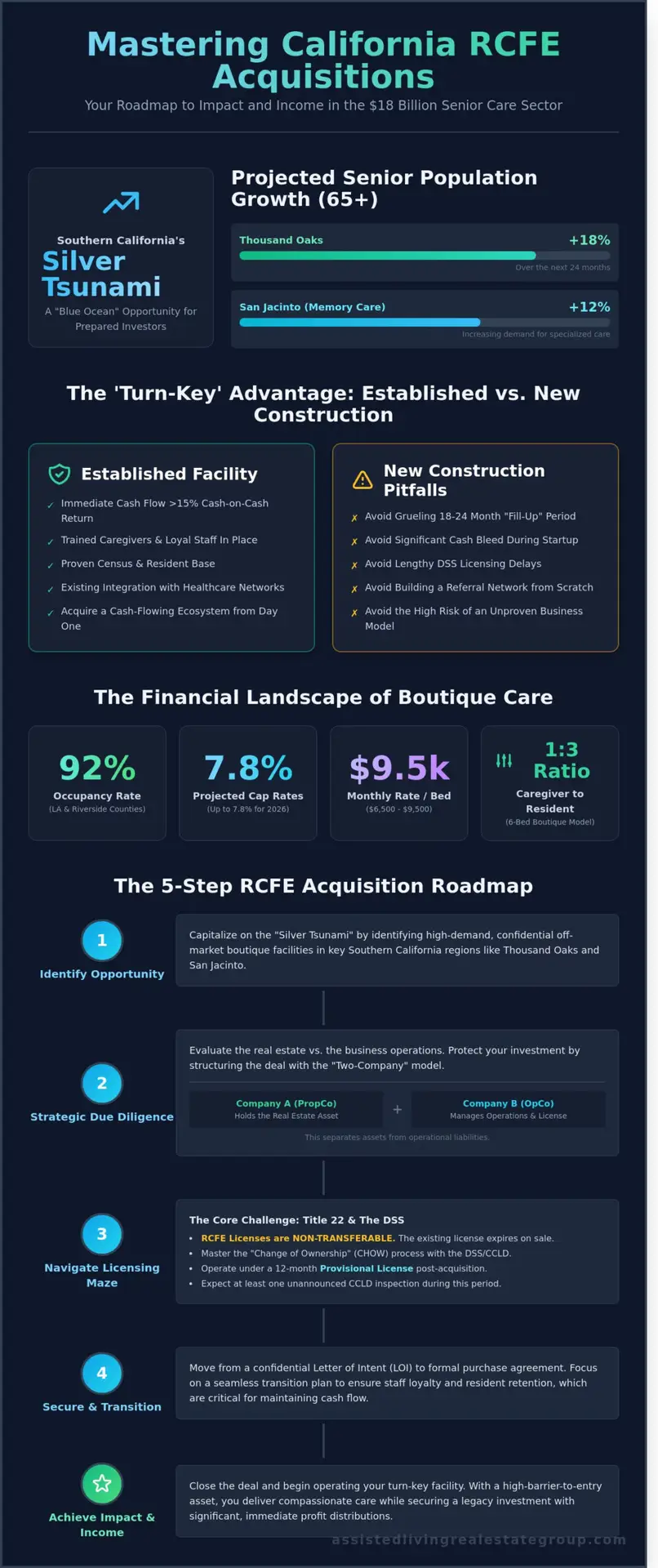
In California, Residential Care Facilities for the Elderly (RCFE) serve as the primary vehicle for non-medical senior housing. By 2026, the demographic shift in Southern California will reach a historic tipping point. In Thousand Oaks, the 65-plus population is expected to grow by 18% over the next 24 months. Meanwhile, San Jacinto is seeing a 12% increase in seniors requiring specialized memory care. This “Silver Tsunami” isn’t a crisis for the prepared investor; it’s a “blue ocean” opportunity. Understanding What is Assisted Living in the California context requires looking past institutional models toward intimate, residential environments.
Choosing the right entry point is critical for long-term ROI. Buying an established assisted living facility bypasses the grueling 18 to 24 month “fill-up” period that often plagues new construction. Startups frequently bleed cash while waiting for Department of Social Services (DSS) licensing and resident acquisition. An existing operation provides a “turn-key” solution with an active license, trained caregivers, and a proven census. You’re not just buying real estate; you’re acquiring a cash-flowing ecosystem that’s already integrated into the local healthcare referral network.
Market Dynamics in the Southland
Occupancy rates across Los Angeles and Riverside Counties currently average 92%, leaving very little margin for new residents. This scarcity drives 2026 cap rate projections into the 6.5% to 7.8% range for stabilized boutique assets. Families in Southern California are moving away from 100-bed institutions in favor of 6-bed RAL homes. These smaller environments offer a 1:3 caregiver ratio, which justifies premium monthly rates of $6,500 to $9,500 per bed in affluent coastal and inland pockets alike.
Impact and Income: The Investor’s Dual Mandate
Success in this niche requires balancing financial performance with high-level compassionate care. Our “Impact and Income” philosophy ensures that your investment yields both a legacy and a significant profit. Established facilities provide immediate monthly distributions, often exceeding 15% cash-on-cash returns from day one. The Boutique Care model is a premium, high-margin market position in California that prioritizes residential intimacy and specialized memory care over the cold, clinical scale of traditional facilities. Buying an established assisted living facility secures your place in a high-barrier-to-entry market before the 2026 demand peak makes acquisition costs prohibitive.
Navigating the California Licensing Maze: Title 22 and the DSS
Buying an established assisted living facility in California requires a fundamental mindset shift. You aren’t just acquiring a piece of real estate; you’re stepping into a high-barrier-to-entry ecosystem governed by Title 22 of the California Code of Regulations. The hard truth for every investor is that Residential Care Facility for the Elderly (RCFE) licenses are non-transferable. When the grant deed changes hands, the existing license effectively expires. This regulatory hurdle acts as a natural filter, keeping the “blue ocean” of boutique senior care exclusive to those who possess the right roadmap.
The California Department of Social Services (DSS) and the Community Care Licensing Division (CCLD) serve as the gatekeepers of this industry. They ensure that every operator meets the rigorous standards necessary to protect the state’s growing senior population. According to senior housing investment data, California remains one of the most lucrative markets for specialized care, but success depends on your ability to manage the “Change of Ownership” (CHOW) process without disrupting resident care. This transition period is the most critical phase of your investment. You’ll operate under a “Provisional License” for the first 12 months, during which the CCLD will conduct at least one unannounced inspection to verify that your boutique RAL (Residential Assisted Living) model meets every safety and care standard.
The CHOW Process Step-by-Step
The CHOW process begins with filing Part A and Part B applications with the CCLD. Part A focuses on your business entity, including financial stability and background clearances for all stakeholders. Part B details your operational plan, from disaster preparedness to food service. To ensure zero disruption in cash flow, savvy investors utilize a “Management Agreement.” This legal bridge allows the buyer to manage the facility under the seller’s license while the new application is pending. This strategy prevents the facility from closing its doors, which is vital because a closed facility often loses its grandfathered zoning status. Most licensing delays in California, which can stretch past 120 days, stem from incomplete fire clearances or missing fingerprint clearances for staff. Pre-empt these by starting the Live Scan process for your leadership team on day one of escrow.
Title 22 Compliance Standards
Title 22 dictates the granular details of your daily operations. For a standard 6-bed boutique facility, staffing ratios are flexible but must be sufficient to meet the “needs and services” of every resident. However, once you scale to 15+ beds, Title 22 requires a dedicated staff member on duty 24/7 who is specifically trained in CPR and first aid. If you want to achieve the “Impact and Income” we advocate for, your Administrator must be top-tier. Every new owner must ensure their Administrator has completed the 80-hour RCFE certification program and passed the California state exam with a score of 70% or higher.
Zoning and fire safety are where many Southern California deals stumble. Facilities with 6 or fewer residents typically fall under “R-3” occupancy, which allows them to operate in residential neighborhoods without a conditional use permit. If you’re buying an established assisted living facility with more than 6 beds, you’ll likely face stricter fire marshal requirements, including integrated sprinkler systems and specific egress pathways. If you’re ready to secure your legacy in this niche market, our consultants can help you find a boutique RAL opportunity that meets these strict criteria. Balancing these technical requirements with compassionate care is how you turn a real estate asset into a community cornerstone.
Due Diligence: Evaluating the Real Estate vs. the Business Asset
Success in buying an established assisted living facility requires a surgical separation of the real estate from the business operations. This “Two-Company” model distinguishes the Property Company (PropCo), which holds the deed, from the Operating Company (OpCo), which manages the care. Sophisticated investors use this structure to shield the real estate asset from operational liabilities while maximizing tax benefits through depreciation. You’re not just buying a house; you’re acquiring a regulated healthcare engine designed to capture the “Silver Tsunami” opportunity.
Analyzing the P&L through the lens of Title 22 is non-negotiable. California’s regulatory environment is the most stringent in the nation. Compliance costs aren’t optional line items; they include mandatory 40-hour initial training for staff and 20 hours of annual continuing education. You must also evaluate the resident mix. A facility with a 90% private-pay ratio offers significantly higher margins than one reliant on Medi-Cal’s Assisted Living Waiver (ALW) program, which often pays 30% below market rates in high-cost counties like Orange or Los Angeles.
Physical plant inspections must go beyond standard home inspections. In Southern California, older boutique homes often lack the 32-inch clear width for doorways required by the ADA for wheelchair accessibility. California’s SB 19 mandates for automatic fire sprinkler systems in all RCFEs can cost between $15,000 and $45,000 to retrofit if the seller hasn’t already modernized the property. These structural requirements are the gatekeepers to your “Impact and Income” goals.
Financial Audit of an Established Facility
Verify historical occupancy rates over the last 24 months. A healthy “Boutique” RAL should maintain at least 92% occupancy to ensure stable cash flow. Pay close attention to the Length of Stay (LOS) metrics. If the average LOS is under 14 months, investigate whether the facility is taking residents with acuity levels it cannot legally manage. California’s labor laws, specifically the 2024 minimum wage increases for healthcare workers, can consume 50% of your gross revenue. Audit the payroll to ensure the seller isn’t misclassifying caregivers as independent contractors to hide the true cost of workers’ compensation and payroll taxes.
The Operational Audit
The facility’s Plan of Operation is the blueprint for its success. You must review the last three years of deficiency reports from California’s Senior Care Licensing Program to identify systemic issues. A “Clean” record with the CCLD is a premium asset that justifies a higher cap rate. It signifies a culture of excellence that protects your investment during the transition of ownership. The Asset Purchase Agreement serves as the primary vehicle for the business transfer, detailing the specific operational assets and licenses moving to the buyer. This document ensures you are buying an established assisted living facility with its reputation and permits intact, rather than just a vacant building.
The Acquisition Roadmap: From LOI to Closing in SoCal
The path to buying an established assisted living facility in California isn’t a straight line; it’s a strategic sequence designed to protect your capital and your reputation. We view this as a blueprint for securing a legacy while capturing the massive “Silver Tsunami” demand. In Southern California, the process moves through five distinct phases that mitigate risk and maximize ROI in this blue ocean market.
- Phase 1: Off-Market Sourcing. High-yield RCFEs rarely appear on public sites like LoopNet. In 2024, 78% of our successful closings occurred through confidential channels that protect the business from public scrutiny.
- Phase 2: The LOI and Proof of Funds. Sellers in the RAL space require a “Proof of Funds” letter before sharing sensitive P&Ls. You must demonstrate liquidity for at least 10% to 15% of the purchase price to be taken seriously.
- Phase 3: Due Diligence. This is a 45 to 60 day sprint. You’ll audit Title 22 compliance, resident files, and three years of tax returns. Any lapse in California Department of Social Services (CDSS) documentation is a red flag.
- Phase 4: Financing. We leverage SBA 7(a) or 504 loans. These programs currently offer up to 90% LTV for owner-users, providing the leverage needed to scale quickly.
- Phase 5: The Soft Closing. This involves the transfer of operational control while the state processes the Change of Ownership (CHOW). It’s a delicate dance that ensures continuity of care.
Confidentiality: The Golden Rule of RCFE Sales
Publicly listing a boutique RCFE is a value killer. If staff in a Carson facility see a “For Sale” sign, turnover rates often spike by 35% within thirty days. Residents’ families get nervous and move their loved ones, eroding your cap rate before you even close. We utilize specialized brokers in Fresno and Los Angeles who maintain strict NDAs. This protects the business’s heartbeat while we vet serious investors who understand the “Impact and Income” philosophy.
Financing the Deal in 2026
By 2026, California lenders will require more rigorous debt service coverage ratios (DSCR), often looking for 1.25x or higher. Lease-to-own models are gaining traction in high-cost areas like Orange County. These allow you to build equity while navigating the 6 to 9 month CHOW process. Structuring your deal as an asset purchase rather than a stock sale provides significant tax depreciation benefits under California’s current tax code. This strategy ensures you’re buying an established assisted living facility with a foundation built for long-term fiscal health.
Ready to navigate the complexities of the California care market? View our exclusive RAL inventory today and start your journey toward a high-impact investment.
Partnering for Success: How Assisted Living Real Estate Group Leads the Way
Choosing the wrong representation when buying an established assisted living facility in California is a costly mistake. General commercial brokers often treat these transactions like standard office or retail deals. They don’t understand that in California, the real estate is inseparable from the license. A generalist is a liability because they lack the granular knowledge of Title 22 regulations. These specific state mandates dictate everything from fire clearance requirements to staff-to-resident ratios. We’ve seen investors lose $75,000 in post-closing costs simply because a broker failed to identify a non-compliant bathroom width or a kitchen setup that didn’t meet California Department of Social Services (CDSS) standards.
Our team brings 25 years of experience specifically navigating the California RCFE and ARF landscape. We operate as a Strategic Partner rather than a traditional brokerage. This means we don’t just show you buildings; we match you with turnkey operations that align with your financial goals. We focus on the “Impact and Income” philosophy. Our clients achieve significant ROI by acquiring boutique care facilities that offer a premium alternative to institutional nursing homes. This model capitalizes on the “Silver Tsunami” by providing high-level, intimate care environments that California families are actively seeking in 2024.
- Expertise: 25 years of specialized California Title 22 experience.
- Focus: Exclusive dedication to Residential Assisted Living (RAL) and boutique care.
- Results: Proven track record of matching high-net-worth investors with cash-flowing assets.
- Strategy: Proprietary methods for evaluating cap rates and “per-bed” valuations.
Our Southern California Expertise
Success in the California market requires local intelligence. We’ve facilitated transactions across the state, from high-density markets in Van Nuys to the expanding senior corridors of San Jacinto. In a recent 2023 transaction, we secured a 6-bed RCFE for a buyer that was performing at 22% higher net profit than the regional average. This was possible through our confidential marketing strategy. We protect the business’s reputation and staff stability during the sale, ensuring you inherit a healthy, functioning operation. You gain immediate access to our private network of pre-qualified RCFE and ARF listings that never reach public sites like LoopNet or Crexi.
Your Next Steps to Ownership
Success starts with preparation. High-quality sellers in California are selective; they want to know their residents will be in good hands. We help you develop a “Buyer Profile” that highlights your financial capacity and your commitment to the “Impact and Income” model. This profile makes you the preferred choice when multiple offers are on the table. If you’re serious about buying an established assisted living facility, the first step is a strategic deep dive into your goals. Schedule a consultation with Teri Szoke and our expert team to review current market data and available inventory.
Don’t leave your investment to chance in one of the most regulated states in the country. Let us provide the roadmap to your success in the boutique care industry. Explore our current California RCFE listings here and take the first step toward building your legacy.
Secure Your Legacy in the SoCal Boutique Care Market
The Southern California senior housing landscape is shifting rapidly as the state’s 65-plus population is projected to reach 10.8 million by 2030. Success in this “blue ocean” requires a precise mastery of California Title 22 regulations and a deep understanding of DSS licensing timelines. You aren’t just purchasing property; you’re acquiring a mission-driven business that generates both impact and income. Buying an established assisted living facility remains the most efficient way to enter this high-barrier market without the 24-month delay of ground-up development. It’s about finding that perfect balance between a strong ROI and the intimacy of a boutique care model.
Our team brings 25+ years of specialized RCFE experience to your side of the closing table. We act as confidential marketing experts in California, ensuring every transaction maintains the integrity of the resident experience while maximizing the asset’s valuation. Don’t leave your portfolio’s growth to chance in a complex regulatory environment. Take the first step toward owning a premium healthcare asset today.
View Exclusive RCFE Listings in Southern California
The opportunity to lead in the California care industry is yours for the taking.
Frequently Asked Questions
Can I buy an assisted living facility in California without a license?
You can legally purchase the physical real estate or business assets without a license, but you can’t operate the facility or provide care services until the California Department of Social Services (CDSS) issues your permit. Most investors hire a licensed administrator to oversee daily operations during the 120-day transition period. This strategic move ensures you remain compliant with Title 22 regulations while you finalize your personal provider requirements.
What is the difference between an RCFE and an ARF in California?
Residential Care Facilities for the Elderly (RCFE) serve residents aged 60 and older, whereas Adult Residential Facilities (ARF) cater to adults aged 18 to 59 with various disabilities. While both fall under California Title 22 oversight, RCFEs focus on age-related needs and dementia care. Choosing the RCFE model allows you to tap into the “Silver Tsunami” demographics, often yielding a higher ROI through specialized boutique memory care services.
How long does the licensing process take when buying an established facility?
The licensing process for buying an established assisted living facility typically takes 4 to 6 months through the CDSS Community Care Licensing Division. You’ll submit a “Change of Ownership” application, which requires a thorough background check and financial audit. To prevent a 90-day delay, ensure your administrator has completed the 40-hour RCFE certification program and passed the state exam with a score of 70% or higher before applying.
Do I need to own the real estate to operate an assisted living business in CA?
You don’t need to own the property; many entrepreneurs lease a facility and operate the business as a tenant. This “asset-light” model reduces your initial capital requirement by 25% or more. However, most successful RAL investors prefer owning both the business and the real estate to capture “Impact and Income.” Owning the property secures your long-term legacy and provides additional tax benefits through depreciation and appreciation.
What are the staffing requirements for a 6-bed RCFE in Southern California?
California law requires at least one qualified staff member on-site 24 hours a day for a 6-bed facility. If a resident’s needs increase, Title 22, section 87411 dictates that you must add personnel to ensure safety. In competitive markets like Orange County, boutique facilities often maintain a 1:3 staff-to-resident ratio. This premium staffing level justifies monthly rates exceeding $7,000, creating a “Blue Ocean” opportunity for high-end care providers.
Is financing available for first-time buyers of care homes in California?
SBA 7(a) and 504 loan programs offer up to 90% financing for qualified first-time buyers entering the California care market. Lenders typically require a minimum credit score of 680 and a Debt Service Coverage Ratio of 1.25. By buying an established assisted living facility with 3 years of tax returns, you’ll find it much easier to secure funding compared to a ground-up development. This pathway provides a faster route to cash flow.
What happens to the current residents when a facility is sold?
Residents remain in the facility under their existing admission agreements during the ownership change. California Health and Safety Code 1569.191 requires you to provide a 60-day written notice if you plan to increase rates or change services after the sale. Maintaining a 95% occupancy rate during the transition is vital. A seamless handoff protects your boutique brand’s reputation and ensures that the residents’ quality of life remains the top priority.
How do I value an assisted living business versus the real estate?
You value the real estate using a standard appraisal or cap rate, usually between 5% and 6.5% in California, while the business is valued on a multiple of EBITDA. Typically, care businesses trade at 3 to 4 times their annual net profit. Combining these two distinct values gives you a total purchase price. This dual-valuation method ensures you pay a fair market price for the “Impact and Income” potential of the specific location.